
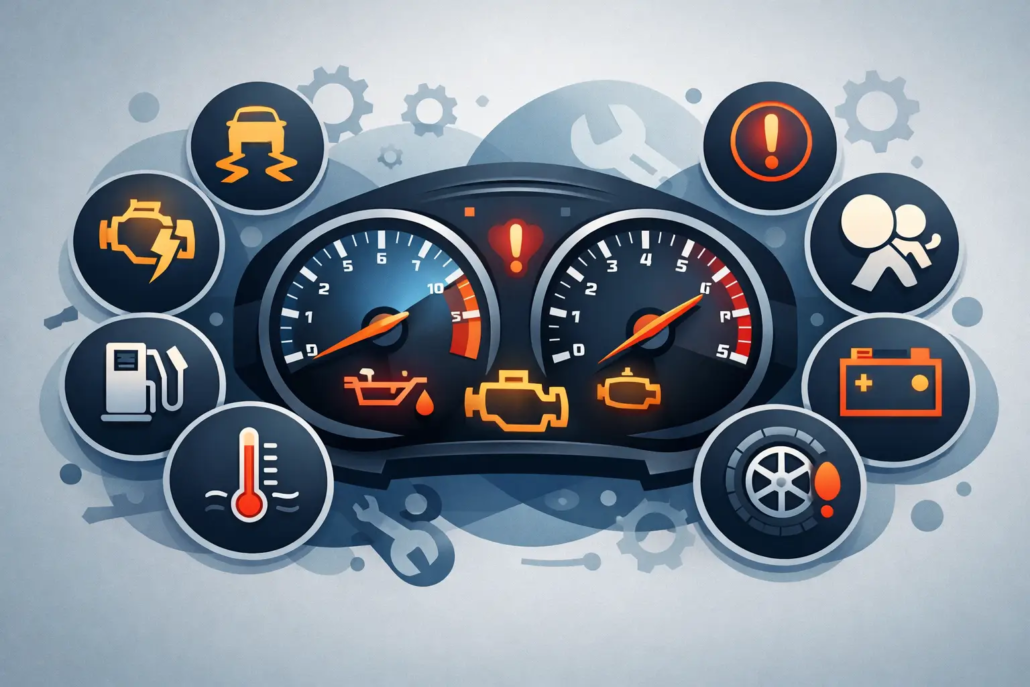
10 Common Instrument Cluster Faults
A dashboard fault rarely starts with a dramatic failure. More often, it begins with a flickering display on a cold morning, a speedometer that drops to zero for a few seconds, or warning lights that are too dim to read properly at night. These common instrument cluster faults are easy to ignore at first, but they usually get worse with time and can leave you without reliable vehicle information when you need it most.
For drivers, that means uncertainty over speed, fuel level, temperature or critical warning messages. For garages, it can mean wasted workshop time if the fault is mistaken for a sensor, wiring or control module issue elsewhere on the vehicle. The instrument cluster sits at the centre of what the driver sees, but the faults behind it are often electronic, intermittent and model-specific.
Why common instrument cluster faults are often misdiagnosed
Instrument clusters are no longer simple analogue units. On most vehicles from the late 1990s onwards, the cluster is an electronic module that processes data, communicates with other systems and displays information through gauges, LCD screens, LEDs and warning lamps. When one part starts to fail, the symptoms can look unrelated.
A non-working speedometer might suggest an ABS sensor fault. A blank centre display might be blamed on a battery issue. Random warning lights can send technicians towards deeper diagnostic work before the cluster itself is considered. That is why proper testing matters. In many cases, the underlying problem is inside the dashboard unit rather than elsewhere on the vehicle.
10 common instrument cluster faults
1. Pixel loss or missing display segments
This is one of the most familiar dashboard problems, especially on vehicles with LCD or multi-function displays. Parts of the screen disappear, characters become unreadable, or the display fades in and out depending on temperature.
The cause is often deterioration of internal display connections or failure within the display circuit itself. On some models, the fault starts small and spreads until mileage, warning messages or trip information can no longer be read clearly.
2. Speedometer failure
A speedometer that reads incorrectly, jumps, sticks or stops working altogether is a common cluster fault. Sometimes it fails permanently. In other cases, it behaves normally for a while before dropping out without warning.
It is not always the cluster, but it is often enough to justify specialist testing. Internal motor faults, dry solder joints or board-level failures can all affect speed display performance.
3. Rev counter or fuel gauge not working
When a single gauge fails, many owners assume the sender unit must be at fault. Sometimes that is true. But if the gauge needle is erratic, sits in the wrong position, or only works intermittently, the problem may be within the cluster.
Stepper motors, voltage regulation issues and circuit board faults are all common causes. A failed fuel gauge is more than an inconvenience – it can make the vehicle unreliable for daily use.
4. Complete instrument cluster failure
This is the fault most owners dread. The dashboard goes blank, all gauges stop responding, warning lights disappear and the unit appears dead. In some cases, the cluster may restart after cycling the ignition. In others, it fails completely.
This type of fault can be caused by internal power supply issues, failed components on the circuit board or communication faults within the module. Dealer replacement is often suggested at this point, but repair is frequently the more practical option where the original unit can be restored.
5. Dim, failed or permanently illuminated warning lights
Warning light faults work both ways. Some lamps stop illuminating when they should, while others stay on constantly even when no system fault is present. Dim backlighting is another common issue, especially on ageing clusters.
This matters because the cluster is part of how the driver monitors vehicle health. If brake, engine, airbag or charging warnings cannot be trusted, the vehicle becomes harder to assess safely and properly.
6. Intermittent power loss
A cluster that cuts out over bumps, during warm-up or only after a long drive often points to an internal electronic issue. These faults can be particularly frustrating because they may not appear during a quick inspection.
Heat-related solder fractures, connector problems and failing internal components can all trigger intermittent shutdowns. The fact that the fault comes and goes does not make it minor. Intermittent issues usually become full failures in time.
7. Backlight failure
If the cluster is difficult or impossible to read at night, failed backlighting may be the cause. On some dashboards, this affects the whole unit. On others, only part of the display becomes too dark.
Backlight failure is not purely cosmetic. Poor visibility of speed, fuel level and warning information can make night driving more difficult and less safe. The right repair depends on whether the issue lies with bulbs, LEDs, power supply circuits or the display itself.
8. Needles sticking, dropping or reading incorrectly
Gauge needles that sweep erratically, stick halfway or rest below zero are another of the common instrument cluster faults seen across many makes. The fault may affect one gauge or several.
This is often linked to failing gauge motors or electronic control issues inside the unit. Recalibration alone may not solve it if the hardware itself is failing. The only reliable answer is proper bench testing and repair.
9. Communication errors between cluster and vehicle
Modern clusters often act as part of the wider network on the vehicle. If communication is lost, the symptoms can include immobiliser issues, no-start conditions, warning messages, or missing data from other modules.
This is where generic diagnosis can become expensive. Replacing sensors or modules without confirming the cluster’s role can waste time and money. Communication faults need careful assessment because the fix depends on whether the problem is internal to the cluster or caused by wiring or another module.
10. Mileage or display data corruption
Corrupt characters, scrambled screens, incorrect information display or loss of stored data can all point to an internal cluster fault. This can be particularly concerning where mileage display is affected.
In these cases, preserving the original unit matters. Repairing the existing cluster is often preferable to replacement because it helps retain coding, configuration and mileage integrity where the unit can be properly restored.
What causes these faults?
Most dashboard failures come down to age, heat, vibration and component wear. Cars and vans place electronics under constant stress. Every journey brings changes in temperature, road shock and voltage load. Over time, solder joints can crack, display connections can degrade and internal components can fail.
It also depends on the vehicle. Some makes and models are known for repeated display faults, while others are more prone to gauge motor failure or total power loss. That is why experience with model-specific faults makes a difference. A specialist will usually know the common patterns and the likely repair route far quicker than a general diagnostic process alone.
Repair or replace – what makes sense?
If a main dealer recommends replacing the full cluster, the quote can be hard to justify on an older vehicle. New units are expensive, may need coding, and can involve extra delay if parts are on back order. For many owners and garages, that is not the best route.
Repair is often faster and more economical, particularly when the original unit can be restored and returned with the existing mileage and coding intact. That keeps the vehicle closer to its original specification and avoids the disruption that can come with swapping modules.
There are exceptions. If the cluster has suffered severe liquid damage, fire damage or previous poor-quality repair work, replacement may sometimes be the only practical answer. But in a large number of cases, a proper electronic repair is the smarter option.
When to act on instrument cluster faults
If the fault is intermittent, now is the time to deal with it. Waiting until the dashboard fails completely usually adds inconvenience and can make diagnosis more difficult if other symptoms start appearing alongside it.
For vehicle owners, the warning signs are straightforward: unreadable displays, dead gauges, missing warning lamps, flickering power or random behaviour from the dash. For workshops, repeat customer complaints, inconsistent test results and faults that do not match live data are all reasons to suspect the cluster itself.
A specialist repair service with bench testing and model-specific knowledge can save a lot of wasted time. Cartronix deals with instrument cluster faults across a wide range of vehicles from 1996 onwards, offering repair rather than unnecessary replacement, with fast turnaround and a lifetime warranty tied to vehicle ownership.
The main thing is not to treat dashboard faults as cosmetic. If the cluster cannot report the vehicle’s information properly, the problem is already affecting how the car is driven, diagnosed and trusted – and that is usually the point where repair starts making real sense.









Trackbacks & Pingbacks
[…] is a common pattern on ageing instrument clusters. Heat cycles, vibration and component wear can affect the LCD panel, its connections, the […]
[…] longer visible as intended. This is common on certain makes and models where the display develops pixel loss, poor contrast or complete screen […]
Comments are closed.