
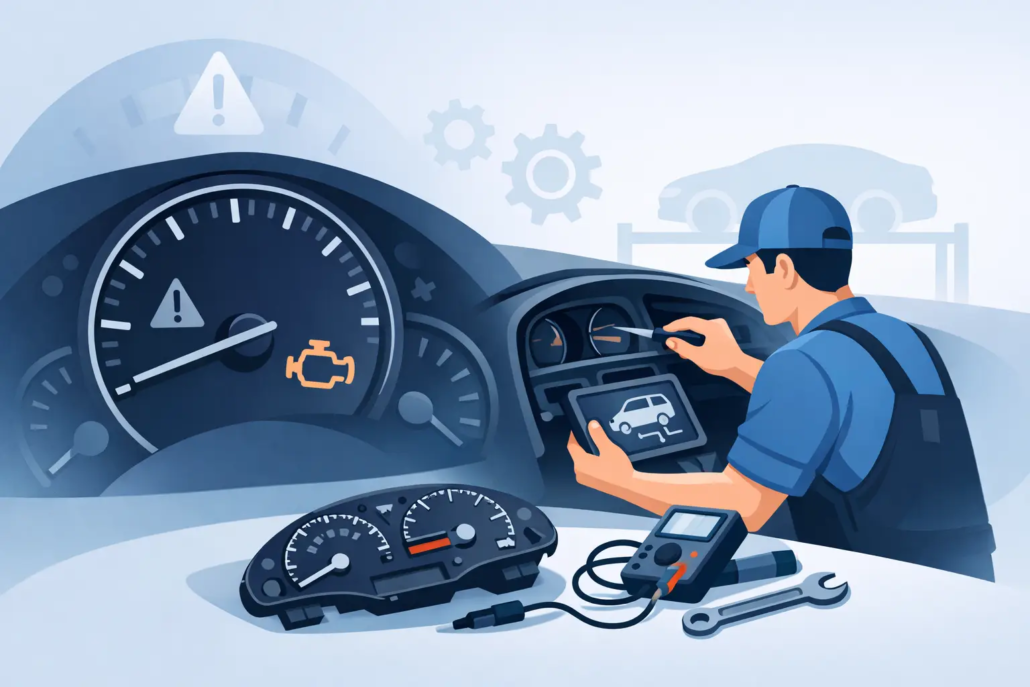
Speedometer Not Working Repair Guide
When the speed needle drops to zero, flickers across the dial or works only when it feels like it, the fault is rarely as simple as the gauge itself. A proper speedometer not working repair starts with diagnosis, because the signal can be lost at the sensor, wiring, ABS system, ECU or inside the instrument cluster.
That matters for two reasons. First, you need an accurate road speed reading for safe driving and legal compliance. Second, replacing parts on guesswork gets expensive very quickly, especially on newer vehicles where the speed signal passes through several control units before it reaches the dashboard.
What causes a speedometer fault?
On older vehicles, a failed vehicle speed sensor or damaged wiring was often the main culprit. On modern cars and vans, the picture is more mixed. Many models derive road speed from the ABS system, then send that data over the CAN network to the cluster. If any part of that chain drops out, the speedometer can stop working even though the cluster itself still powers up.
The cluster is still a common failure point. Dry solder joints, failed stepper motors, internal circuit board faults and power supply issues can all cause an intermittent or dead speed reading. In some cases the speedometer is the only gauge affected. In others, it comes with warning lights, communication errors, display faults, dim illumination or complete dashboard failure.
It also depends on the vehicle. Certain makes and model years are known for cluster faults, while others are more likely to suffer ABS module or wiring problems. That is why a fault code scan alone does not always tell the full story. You need the symptoms, the vehicle history and proper testing together.
Speedometer not working repair – the first checks
Before assuming the dashboard needs attention, start with the basics. If the speedometer has stopped completely, check whether the odometer, cruise control and other gauges are behaving normally. If several functions fail together, that often points towards a wider cluster or communication issue.
A blown fuse can be involved, although it is less common than people hope. If the fuse is intact, the next question is whether the vehicle is actually generating a speed signal. On many cars, a diagnostic tool can read live wheel speed or vehicle speed data from the ABS or ECU. If the module sees speed but the dial stays dead, suspicion moves towards the instrument cluster.
If there is no speed data at module level, the problem may sit outside the dashboard. That could mean a failed sensor, damaged ABS reluctor ring, module fault or wiring issue. This is where replacing the cluster first would be the wrong call.
Intermittent faults need even more care. A speedometer that works when cold, fails when warm or comes back after a bump in the road often suggests an internal electronic fault rather than a sensor issue. Those patterns matter.
Signs the instrument cluster is the real problem
A cluster fault usually leaves a trail. The speedometer may stick, read erratically or lag behind actual speed. The rev counter might also misbehave. LCD or pixel displays can fade or drop lines. Warning lights may dim, stay on or fail altogether. Some vehicles develop total or partial power loss to the dashboard, with needles sweeping incorrectly or resetting at random.
If the cluster has already been replaced once, coding or mileage issues can complicate matters further. That is one reason repairing the original unit is often the better route. You keep the original coding and stored vehicle data intact instead of introducing a second-hand unit with unknown history.
Why replacement is not always the smart option
Main dealer replacement can solve the problem, but it is rarely the most economical path. A new cluster may need ordering, coding and setup, and the total cost can be hard to justify on an older car, van or motorhome. There is also downtime to factor in.
Repair is different. If the original unit can be fault-found and repaired properly, you retain the correct mileage and configuration, avoid unnecessary replacement costs and often get the vehicle back on the road faster. For trade customers, that speed matters just as much as the invoice total. A vehicle tied up waiting for parts is a vehicle that cannot be delivered.
There is a trade-off, though. Repair is only the right answer if the fault has been diagnosed accurately and the work is carried out by a specialist who deals with instrument clusters every day. General electronics repair and cluster repair are not the same thing.
What a proper repair process looks like
A sound speedometer repair should begin with symptom matching and bench testing, not guesswork. Once the cluster is removed, specialist testing equipment can simulate vehicle inputs and confirm whether the speedometer circuit responds correctly. That matters because many faults only become obvious when the unit is tested under controlled conditions.
From there, failed components can be identified and repaired at board level. Depending on the unit, that may involve rebuilding the power supply section, repairing known weak points, replacing failed gauge drive components or correcting solder and connection faults. The goal is to restore the original unit, not just mask the symptom.
Bench testing after repair is just as important. A cluster that powers up is not automatically fixed. The speedometer, warning lamps, displays and communications all need checking before the unit goes back into the vehicle.
When the fault is not in the cluster
Not every speedometer problem ends with a dashboard repair, and any honest specialist should say so. If testing shows the cluster is healthy, attention should return to the vehicle. Wheel speed sensor signals, ABS data, wiring continuity, earth points and network communications all need checking methodically.
For garages, this is often where a specialist partner earns their keep. Sending the cluster for testing can rule the unit in or out quickly, which prevents wasted fitting time and unnecessary parts. For private owners, it gives clarity before spending money in the wrong place.
Postal repair or while-you-wait?
For many drivers, the practical question is how quickly the problem can be sorted. A postal repair service suits customers anywhere in the UK who can remove the cluster or have a garage do it for them. The unit is sent in, repaired, tested and returned ready to refit. That keeps the process simple, especially for vehicles that are off the road temporarily.
A while-you-wait appointment makes more sense when downtime needs to be kept to a minimum or the cluster removal is awkward. Trade customers often prefer this on busy jobs, and some owners simply want the reassurance of same-day turnaround.
Either way, speed and diagnosis need to go together. Fast service is valuable only when the root cause has been identified properly.
What motorists and garages should avoid
The biggest mistake is parts swapping. Fitting a sensor, then an ABS module, then a used cluster can easily cost more than a proper diagnostic route from the start. Used clusters bring their own risks, from hidden faults to coding problems and incorrect mileage.
The second mistake is ignoring related symptoms. If the speedometer has failed alongside display issues, warning light faults or intermittent total cluster loss, focus on the whole unit rather than the needle alone. Those extra clues usually point to the real failure.
The third is delaying the repair too long. Intermittent cluster faults often worsen. What starts as a flickering speed reading can become full cluster failure, which is more disruptive and harder to work around.
Choosing the right specialist for speedometer not working repair
Experience with instrument clusters matters more than broad claims about vehicle diagnostics. You want a specialist that understands common make-specific faults, can bench test units properly, repairs original clusters rather than relying on replacement, and stands behind the work with a meaningful warranty.
Turnaround matters too. So does clarity on pricing, VAT and what happens if the unit tests good. For garages, dependable communication is essential. For private owners, reassurance matters just as much – especially when the concern is mileage integrity and whether the vehicle will come back coded correctly.
Cartronix handles instrument cluster faults across a wide range of vehicles from 1996 onwards, with postal coverage, workshop appointments, specialist testing and a lifetime warranty tied to vehicle ownership. For the right fault, that is often faster and far more cost-effective than replacing the dashboard through the dealer network.
A dead speedometer is not just an inconvenience, and it is rarely fixed well by guesswork. If the vehicle is telling you the fault sits in the cluster, getting the original unit tested and repaired properly is usually the quickest route back to a dashboard you can trust.










Trackbacks & Pingbacks
[…] pixel loss and LCD failure, dim or failed backlighting, intermittent warning lights, failed gauges, speedometer faults, power loss, communication errors and complete dashboard failure. The exact repair depends on the […]
Comments are closed.