
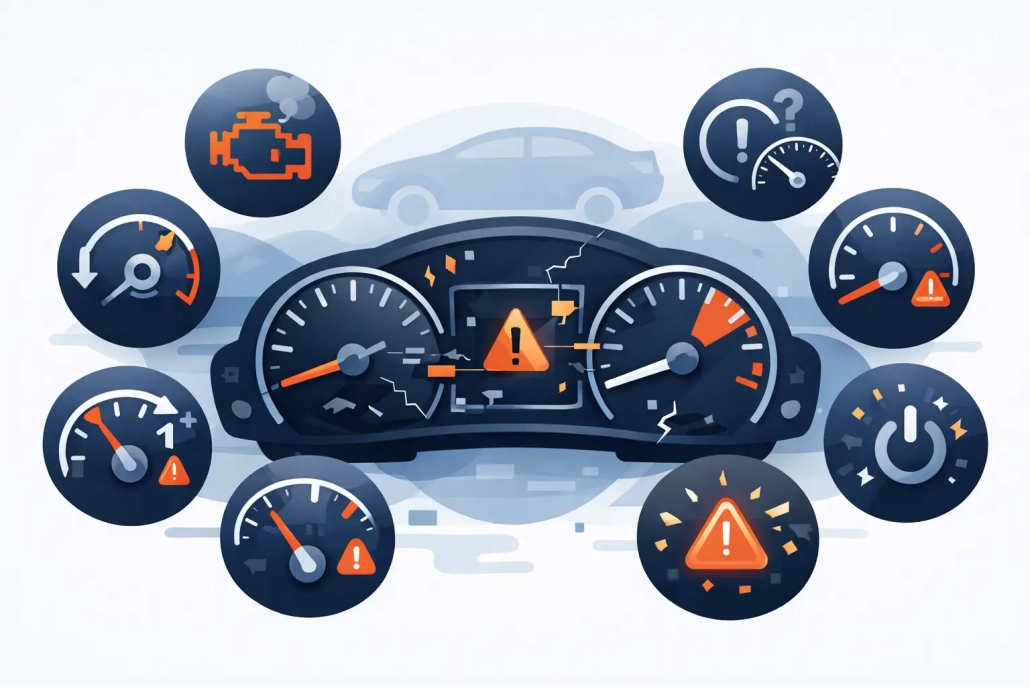
8 Failed Gauge Cluster Symptoms to Watch
Failed Gauge Cluster Symptoms: quick repair guidance
8 Failed Gauge Cluster Symptoms to Watch covers a common dashboard and instrument cluster problem. Cartronix checks the symptoms, repairs the original electronics where possible, and tests the result before return.
First, note the fault clearly. Next, check when it appears. Then, book the repair with the vehicle details. This gives the workshop useful information before the unit arrives.
Quick checks before booking
- Record the vehicle make, model, and year.
- Write down the exact dashboard warning or display fault.
- Check whether the issue appears every time you start the vehicle.
- Note any dead gauges, dim screens, pixel loss, or flashing lights.
- Tell the team if another garage opened the unit.
- Take a photo of the fault if the display still works.
- Keep the original unit with the vehicle whenever possible.
- Pack the cluster securely before posting it.
- Include your name, phone number, return address, and fault notes.
- Use tracked postage for the repair parcel.
- Contact Cartronix first if the vehicle has water damage.
- Ask for advice if the fault only appears when the vehicle warms up.
How Cartronix handles the repair
Firstly, technicians inspect the unit and confirm the reported fault. Secondly, they repair the failed components and check the circuit carefully. Finally, they test the unit before it leaves the workshop.
This approach helps drivers avoid unnecessary dealer replacement costs. It also helps garages reduce downtime, protect the original mileage data, and give customers a clearer repair option.
A dashboard rarely fails all at once. More often, it starts with small, easy-to-dismiss faults – a flickering display on a cold morning, a speedometer that drops to zero for a few seconds, or warning lights that stay dark during ignition. Those early failed gauge cluster symptoms matter because they usually point to an internal fault that gets worse over time.
For drivers, that means lost vehicle information and rising inconvenience. For garages, it means a fault that can be mistaken for sensors, wiring or control module issues if the cluster is not properly assessed from the start. Knowing what to look for helps you decide whether the vehicle needs further diagnosis, repair of the original unit or immediate attention before it becomes a complete no-start or communication problem.
What a gauge cluster actually controls
On most vehicles from the late 1990s onwards, the instrument cluster is more than a set of dials. It acts as an electronic module that receives, processes and displays data from across the vehicle. Depending on the make and model, it may handle speed, revs, fuel level, coolant temperature, warning indicators, LCD information, immobiliser functions and communication with other control units.
That matters because a cluster fault does not always look like a simple display problem. A failed unit can create symptoms that seem unrelated at first, especially on vehicles where the dashboard is part of the wider data network. In some cases the issue is isolated to the display or gauges. In others, the cluster can affect vehicle start-up, mileage display, warning lamp operation or communication with diagnostic equipment.
Failed gauge cluster symptoms drivers notice first
1. Gauges that stop working, stick or read incorrectly
This is usually the symptom that gets noticed first. The speedometer may drop out while driving, the rev counter may freeze, or the fuel and temperature gauges may behave erratically. Sometimes the needles stick in one position and then suddenly wake up again. In other cases, the readings drift and become unreliable rather than failing outright.
That inconsistency is often a clue that the problem is inside the cluster rather than with the gauge sender itself. A faulty fuel sender, for example, tends to affect one reading. When several gauges become intermittent together, the instrument cluster becomes a much more likely suspect.
2. LCD, pixel or display failure
Faded screens, missing segments, lines through the display or complete screen blackout are classic cluster faults. This is common on many European vehicles where the centre display shows mileage, outside temperature, warning messages or trip information.
Pixel loss often starts as a nuisance and then spreads. If the mileage display, service messages or fault warnings become unreadable, the cluster is no longer doing its basic job properly. On some vehicles, a dim display may still be visible in certain light conditions, which can make the issue seem minor when it is actually a sign of worsening internal failure.
3. Warning lights that do not illuminate properly
A failed cluster can cause warning lights to remain off, stay on constantly or flicker when they should not. This includes indicators for battery charge, engine management, ABS, airbag and other safety-critical systems.
The detail matters here. If warning lamps do not illuminate during ignition self-check, that is not something to ignore. It may be a cluster fault rather than a fault with the individual system, and it can leave the driver without proper warning of genuine issues.
4. Intermittent power loss to the dashboard
One of the more obvious failed gauge cluster symptoms is when the whole dashboard cuts out and then comes back. Needles drop to zero, displays go blank and warning lights disappear, sometimes only for a moment. This may happen over bumps, during temperature changes or completely at random.
Intermittent faults like this are often caused by failing internal components, dry joints or power supply issues within the unit. They can be difficult to pin down without specialist testing because the fault may not be present when the vehicle is inspected.
Less obvious signs of a failing instrument cluster
5. The cluster works only when warm, cold or after tapping the dash
This is a common pattern and a useful diagnostic clue. If the dashboard behaves differently depending on cabin temperature, or starts working after the vehicle has been running for a while, internal electronic failure is a strong possibility.
The same goes for units that briefly return to life after the dash is tapped or after the ignition is cycled. That does not mean the problem has gone away. It usually means there is a poor internal connection or component fault that is becoming more advanced.
6. Mileage, clock or trip data resets itself
If the odometer display disappears, the clock keeps resetting or trip information clears unexpectedly, the cluster may be losing stable internal power or memory retention. This can present as an occasional glitch at first and then become more frequent.
For owners, this is frustrating. For workshops, it is a warning sign that the cluster may be failing at board level rather than just suffering from a cosmetic display issue. Where mileage and coding are stored in the original unit, replacement is rarely the first choice unless repair is not viable.
7. Communication faults and diagnostic issues
Modern instrument clusters often sit on the vehicle network, so a failing unit can interfere with communication. A diagnostic machine may report no communication with the cluster, intermittent module faults or implausible data shared with other systems.
This is where the job can go off course if the cluster is not considered early enough. Garages may understandably look at CAN wiring, ignition supply, body control modules or related sensors first. Sometimes that is correct. But if the dashboard also has display faults, dead gauges or random resets, the cluster deserves closer attention.
8. Non-start or immobiliser-related symptoms on some models
Not every vehicle will do this, but on certain makes the cluster is tied into immobiliser or key recognition functions. When the unit fails, the car may not start, may start and cut out, or may show immobiliser warnings on the display.
This is one of the reasons replacing the cluster outright is not always the sensible first move. Coding, vehicle configuration and mileage integrity all need to be considered. In many cases, repairing the original unit is the cleaner and more economical route.
Why these faults are often misdiagnosed
Instrument cluster faults can mimic several other problems. A dead speedometer may be blamed on an ABS sensor. A flickering dash may be blamed on the battery. Warning lamp behaviour may be mistaken for a separate control unit fault. Sometimes those diagnoses are correct, but not always.
The pattern of failure usually tells the real story. Multiple symptoms across gauges, displays and warning lights point more strongly to the cluster itself than to a single sender or sensor. Intermittent operation is another clue. So is a fault that worsens gradually rather than appearing as a clean, permanent failure from one day to the next.
For trade customers, this is where specialist bench testing earns its keep. A proper assessment can separate a genuine cluster failure from a wiring or vehicle-side issue before unnecessary parts are fitted.
When to stop driving and get it checked
It depends on which functions have failed. If the display has minor pixel loss but all gauges and warning lights still work correctly, the vehicle may remain usable in the short term. If the speedometer is dropping out, warning lights are missing, or the dashboard cuts out completely while driving, it needs attention sooner rather than later.
The same applies if the vehicle has starting issues linked to the cluster or if diagnostics cannot communicate properly with the unit. At that point, the fault has moved beyond annoyance into reliability and safety territory.
Repair or replace?
Dealer replacement is often the most expensive path, and on many vehicles it also brings coding, mileage transfer and availability concerns. A new unit may need programming, may not be available quickly, or may still require additional setup before the car is usable again.
Repairing the original cluster usually makes more sense when the fault is internal and the housing, coding and mileage data can be retained. That keeps the vehicle original, avoids unnecessary replacement costs and typically reduces downtime. For many common faults – failed gauges, dim displays, dead warning lamps, pixel issues and intermittent power loss – specialist repair is the practical option.
Cartronix deals with these faults every day across a wide range of cars, vans and motorhomes, with postal repair and workshop options for customers who need a faster alternative to replacement.
What to do if you recognise these failed gauge cluster symptoms
Do not wait for a complete failure if the signs are already there. Note exactly what the dashboard is doing, when it happens and whether the fault affects one function or several. If possible, check whether the warning lamps perform their normal ignition test and whether the issue changes with temperature or vibration.
That information helps narrow the fault down quickly and avoids chasing the wrong diagnosis. A failing cluster rarely fixes itself, but it often gives you warning before it stops completely. Catching it at that stage usually means a simpler, faster path back to a fully working dashboard.











Trackbacks & Pingbacks
[…] symptoms make an internal dashboard fault more likely. These include a needle that sticks, jumps, falls back to zero while driving or works intermittently after the vehicle warms up. A digital speed display that […]
[…] Speedometer, rev counter, fuel gauge or temperature gauge dropping out […]
[…] temperature readings, communication data and security-related coding. A fault may show itself as dead gauges, missing pixels, dim backlighting, intermittent warning lights or a complete loss of […]
Comments are closed.