
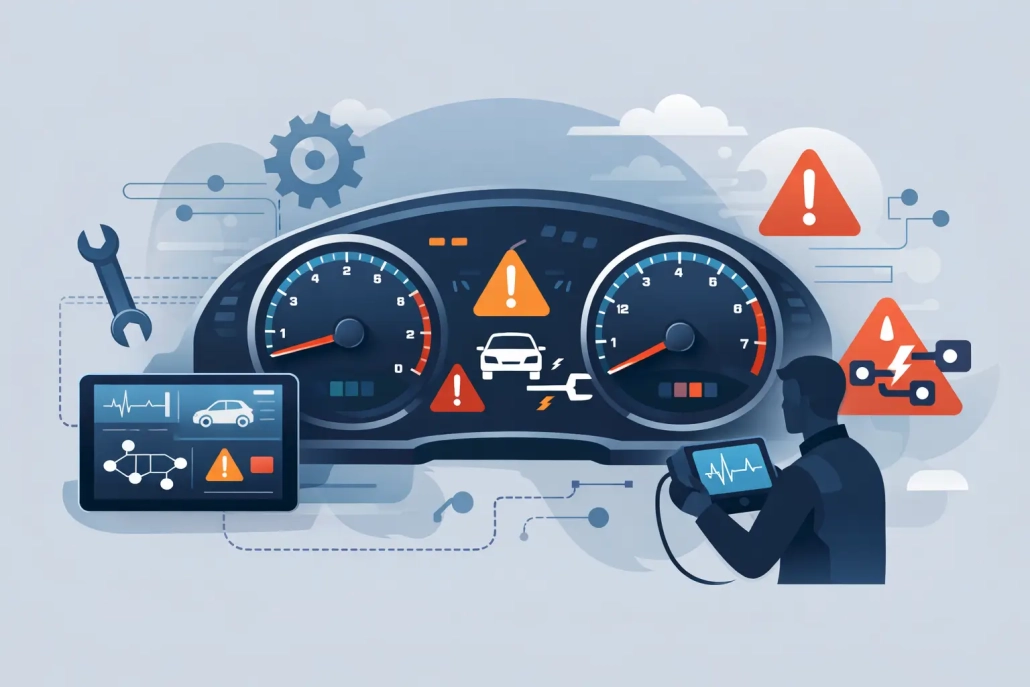
Instrument Cluster Communication Fault Fixes
A warning for an instrument cluster communication fault usually appears alongside other odd behaviour – gauges dropping to zero, warning lamps staying on, a blank display, or a dashboard that works one minute and goes dead the next. For many drivers and workshops, that message points straight to expensive replacement. In practice, the fault is often more specific than that, and the right diagnosis can save both time and money.
Modern instrument clusters do far more than display speed and fuel level. They sit on the vehicle network, exchanging data with modules such as the ECU, body control unit, immobiliser and steering column electronics. When that communication is interrupted, the cluster may stop receiving the information it needs, or other control units may stop recognising the cluster altogether.
What an instrument cluster communication fault actually means
In simple terms, the cluster is not talking properly to the rest of the vehicle. That can happen because the cluster itself has developed an internal electronic fault, but it can also be caused by wiring issues, poor power supply, low system voltage or network problems elsewhere on the car.
This is why a fault code on its own is only the starting point. A scan tool may report no communication with the instrument panel, intermittent communication loss, or a CAN bus-related fault. Those codes matter, but so does the way the dashboard behaves in real use. An intermittently dead display suggests a different path from a cluster that is permanently blank but still allows the vehicle to start.
On many vehicles from 1996 onwards, the cluster is tied into mileage storage, immobiliser functions and coded vehicle data. That makes guesswork expensive. Fitting a used unit can create its own problems, especially if coding, mileage discrepancies or component protection become part of the job.
Common symptoms linked to instrument cluster communication fault issues
The wording of the fault may vary by manufacturer, but the symptoms are often familiar. The speedometer and rev counter may stop working, the LCD may flicker or go blank, warning lights may stay dim or fail completely, and the vehicle may log multiple communication errors across different modules.
Some faults are temperature-related. The cluster works from cold, then fails once the cabin warms up. Others are vibration-related, where hitting a pothole or closing a door causes the display to cut in and out. These patterns can point towards internal solder failures, degrading components or connector issues rather than a complete module failure.
Trade customers will often see the same complaint arrive in a less precise form: no dash, intermittent dash, non-start with cluster fault, mileage display missing, or all gauges dead. That is normal. The job is to narrow the symptom down to whether the issue is power, ground, network or the cluster electronics themselves.
The fault is not always the cluster
This is where many jobs go off course. If battery voltage is unstable, communication faults can be logged across several systems at once. Likewise, a wiring fault on the CAN lines, water ingress at a connector, or a failed module elsewhere on the network can upset dashboard operation.
That said, instrument clusters do fail internally, and when they do, the fault can mimic a wider network problem. Internal processor issues, failed voltage regulation, damaged circuit boards, failed stepper motor control sections and display driver faults can all trigger communication-related symptoms.
Why proper diagnosis matters before replacing anything
Main dealer replacement is rarely the first option worth taking. A brand-new cluster can be costly, may need ordering from abroad, and nearly always requires coding and setup. That increases downtime and can create avoidable complications with mileage and immobiliser data.
A proper diagnostic approach usually starts with the basics: battery condition, charging voltage, relevant fuses, earths and connector condition. After that, network integrity and module communication should be checked with suitable equipment. If power, ground and CAN signals at the cluster are correct, attention turns to the unit itself.
Bench testing can make a big difference here. A specialist can power the cluster independently, simulate vehicle inputs and confirm whether the failure is internal. That is often the clearest route when the fault is intermittent or when the vehicle has multiple symptoms that could mislead a general workshop.
Typical causes found during testing
Although every make has its own known patterns, a few causes turn up regularly. Dry joints on the circuit board are common, especially on older units or vehicles exposed to repeated temperature cycling. Failed display sections are also frequent, particularly where pixel loss or dim screens started before the communication issue appeared.
Power supply faults inside the cluster are another major cause. When voltage regulation becomes unstable, the cluster may reboot, lose communication or fail completely. In some cases, memory or processor faults are involved, particularly on units that have suffered jump-start damage, battery spikes or moisture contamination.
Repair or replace – what makes most sense?
It depends on the exact fault, the vehicle and how quickly it needs to be back on the road. Replacement can make sense if the cluster has severe physical damage, fire damage or corrosion beyond economic repair. For most communication-related faults, however, repair is usually the more practical option.
Repair keeps the original unit with the vehicle. That matters because the original coding and mileage data remain with the cluster, which avoids many of the headaches that come with sourcing and programming a replacement. It is also normally far more economical than dealer supply.
For owners, the biggest advantage is often speed. For garages, it is predictability. A specialist repair service can test the unit, confirm the internal fault and return it quickly, often on a same-day or next-working-day basis depending on the job. That is very different from waiting on dealer parts and then arranging coding afterwards.
When a garage should send the cluster for specialist repair
If scan data suggests intermittent or total loss of communication with the instrument panel, and basic vehicle-side checks have already been done, sending the unit for specialist testing is usually the sensible next step. The same applies where the cluster has obvious display or gauge faults alongside communication errors.
This is especially true when the workshop has already proved power, earth and network feeds at the cluster connector. At that point, continuing to chase faults elsewhere can waste labour. A specialist instrument cluster repair company with emulator testing can isolate whether the unit fails under controlled conditions, which gives the garage a much firmer answer.
For trade customers, that means less time tied up on a ramp and fewer return visits. For private owners, it means not paying for a replacement unit simply because the dashboard stopped talking to the rest of the car.
What to expect from a specialist repair service
A proper service should test the cluster, identify the failed area, carry out component-level repair where possible and return the original unit ready to refit. The key point is that the repair should address the cause, not just the symptom. If the display has been replaced but the power supply fault remains, the problem will come back.
This is where experience with known faults across Audi, Ford, Fiat, Alfa Romeo, Aston Martin and other marques matters. Pattern failures differ between manufacturers and even between model years. A specialist that sees these units daily can usually identify the likely failure much faster than a general electronics repairer.
Cartronix works with both vehicle owners and trade customers across the UK, offering postal repairs as well as workshop appointments, which is often the quickest route when dashboard faults are causing immediate usability problems.
What vehicle owners can check before booking a repair
There are a few sensible checks worth making before removing the cluster. If the battery is weak or recently went flat, have charging voltage checked first. A low-voltage event can create multiple warning messages that look worse than the root cause.
It is also worth noting exactly what the dash does. Does it fail from cold or only once warm? Are all gauges affected or just one section? Does the backlighting work when the display does not? Does the vehicle start normally? These details help narrow the fault down quickly.
Avoid fitting a second-hand cluster as a shortcut unless you already know the compatibility and coding implications. On many vehicles, that route becomes more expensive once programming problems and mileage issues are factored in.
Getting the fault sorted without dealer-level cost
An instrument cluster communication fault sounds broad, but the solution is often quite focused once the unit is properly tested. The key is not to treat every communication code as proof that the whole dashboard needs replacing. Sometimes the issue is external, sometimes it is internal, and the difference only becomes clear with structured diagnosis.
If the cluster is the problem, repair is usually the fastest and most economical route. You keep the original unit, retain the vehicle’s data where appropriate, and avoid the cost and delay of unnecessary replacement. That is good for private owners trying to get back on the road and just as important for garages managing customer expectations and workshop time.
When the dashboard starts dropping out, warning lamps behave oddly or communication faults keep returning, the best next step is a proper test rather than another guess. A clear answer early on usually saves the most money.








Trackbacks & Pingbacks
[…] fault and replacement. A garage may also face extra diagnostic work if the vehicle develops communication errors because a fitted cluster has not been coded […]
[…] before repairs begin. It also avoids replacing a dashboard when the actual issue is a vehicle feed, CAN communication fault or connector […]
Comments are closed.