
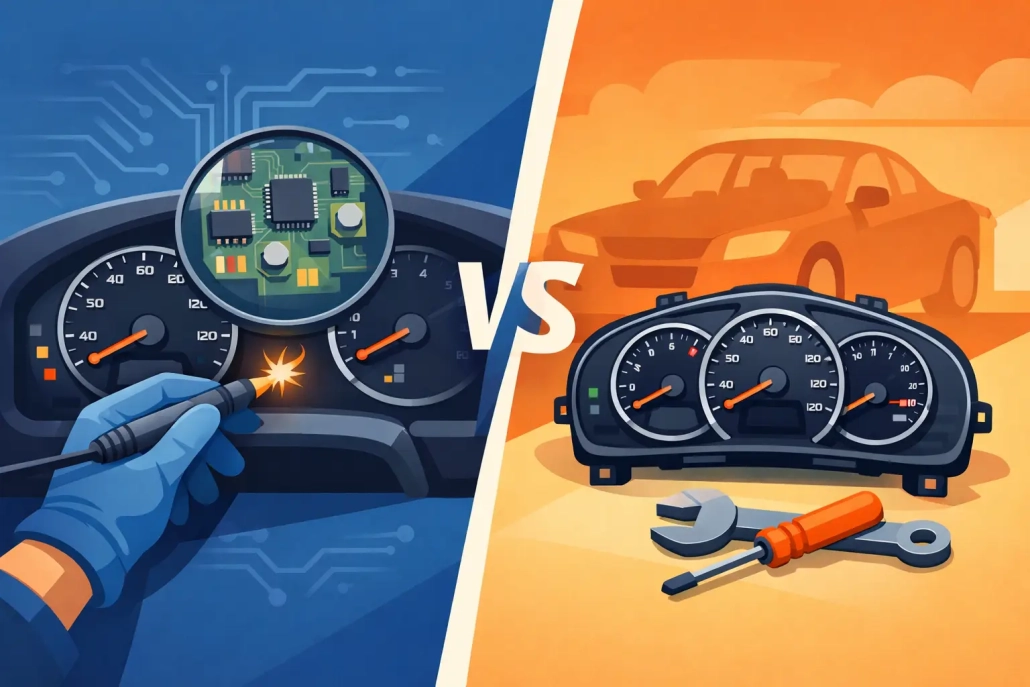
Dashboard Repair Versus Used Cluster: Which Wins?
A blank speedometer, fading LCD screen or dead gauges can make a used instrument cluster look like the quickest answer. But dashboard repair versus used cluster is rarely as simple as comparing the purchase price. On many modern vehicles, the cluster is tied into mileage records, immobiliser functions, vehicle coding and network communications. Fitting a second-hand unit can create a bigger job than the original fault.
For many drivers, garages and workshops, repairing the original dashboard is the faster and more dependable route. It keeps the vehicle’s own unit in place, avoids unnecessary coding issues and preserves the information already stored in the car. That said, there are occasions when a used cluster is a sensible option. The right choice depends on the fault, the vehicle and whether the replacement unit can be matched and configured correctly.
Dashboard Repair Versus Used Cluster: The Real Cost
A used cluster can appear inexpensive on an auction site or from a breaker. The advertised price, however, is only the starting point. Before it will work correctly, it may need part-number matching, security data transfer, coding, mileage correction where legally appropriate, component protection removal or immobiliser adaptation. It may also arrive with its own hidden faults.
A repair price is usually clearer. The existing cluster is tested, the known fault is repaired and the unit is returned for refitting. Because it remains the vehicle’s original module, its coding, configuration and stored mileage are normally retained. There is no need to introduce a different unit with an unknown history.
This is particularly relevant on Audi, Ford, Fiat, Alfa Romeo, Aston Martin and many other vehicles built from the late 1990s onwards. Instrument clusters became far more than a set of gauges. They are electronic control modules that exchange information with the engine ECU, body control module, ABS system, steering controls and diagnostic equipment.
The cheapest part is not always the cheapest repair. A low-cost used dashboard can become expensive once diagnostic time, programming, removal and refitting are added. For a garage, that also means a vehicle occupying a bay while compatibility problems are resolved.
Why the Original Cluster Is Usually Worth Saving
An original instrument cluster belongs to the vehicle in more ways than one. It has the correct trim level, warning-light layout, display settings and communication setup. Repairing it means the car continues using the module it left the factory with.
Mileage is one of the biggest concerns. On many vehicles, mileage information may be held in more than one control unit. If a used cluster shows a different reading, the vehicle can display an inconsistency, log a fault or show the higher mileage. Attempting to alter mileage dishonestly is illegal. A legitimate repair to an original unit avoids this issue because the existing stored data stays with the car.
Originality also matters when diagnosing an intermittent issue. If a display has missing pixels, the illumination has failed, a fuel gauge reads incorrectly or needles drop out, the fault is often within the cluster itself. Replacing the whole unit without proving the cause can leave the original problem untouched, especially where the true fault lies in a power supply, wiring connection, sensor or CAN network.
A specialist repair begins with testing. Using vehicle-specific equipment and emulators, the cluster can be assessed away from the car where appropriate. This helps establish whether the fault is internal before parts are replaced or a used unit is sourced.
Common faults that are suited to repair
Many cluster failures are repairable at component level. These include pixel loss and LCD failure, dim or failed backlighting, intermittent warning lights, failed gauges, speedometer faults, power loss, communication errors and complete dashboard failure. The exact repair depends on the make, model, year and fault type, but a failed display does not automatically mean the entire cluster has reached the end of its life.
Repairing at this level is more targeted than swapping modules. It addresses the failed components rather than introducing another ageing dashboard with the same design weaknesses.
The Risks of Fitting a Used Instrument Cluster
A used cluster is an unknown electronic part. It may look clean and have the correct connector, but that does not guarantee it is compatible or fault-free. Different production years, engine variants, transmission types and option packs can use visually identical dashboards with different software or hardware references.
Part numbers need checking carefully, including suffixes. Even then, a matching part number does not always mean plug-and-play operation. The replacement may be locked to its donor vehicle or require security access before it will communicate correctly.
There is also the condition issue. A breaker cannot always test every gauge, pixel, lamp, display segment and communication circuit under real vehicle conditions. The cluster may have been removed because of an unrelated accident, water ingress, electrical surge or an existing dashboard fault. It may work initially, then develop the same common failure weeks later.
A used unit can be a reasonable solution when the original cluster has suffered severe physical damage, extensive fire or water damage, or when internal repair is no longer economically viable. In those cases, it should be treated as a programmed replacement job, not simply a quick parts swap.
When a Used Cluster May Be the Better Option
There are genuine situations where replacement makes sense. If the circuit board is badly corroded, the casing and connectors are broken beyond recovery, or previous poor repairs have damaged multiple tracks and components, a sound donor cluster may be the practical choice.
Availability can also influence the decision. For some older or unusual vehicles, donor units are easier to source than specific internal parts. Conversely, for popular models, used clusters may be plentiful but still require programming and carry no meaningful guarantee.
Before choosing a used unit, establish four things:
- the complete part number and hardware version match the original;
- the supplier confirms the unit has been tested, not merely removed from a vehicle;
- the vehicle can be coded and adapted correctly after installation;
- the total cost includes programming, diagnostic time and a realistic warranty.
If any of these points are uncertain, the apparent saving can disappear quickly.
Do Not Diagnose by Symptoms Alone
A non-working dashboard is not always a dashboard failure. Low vehicle voltage, a weak battery, damaged fuses, poor earth connections, water ingress and network faults can all cause warning lights, dead displays or intermittent gauge operation. A cluster that goes blank during cranking, for example, may point to a battery or supply issue rather than an internal electronic failure.
The same applies when multiple modules are affected. If the dashboard, electric windows and central locking all behave unpredictably, a body control module, wiring fault or charging-system issue may need investigating first. Fitting a replacement cluster in this situation is unlikely to solve the fault.
For workshops, a proper fault code scan and basic power, earth and communication checks should come before removing the cluster. For vehicle owners, recording the symptoms clearly is useful: does the fault happen when the vehicle is cold, after a period of driving, over bumps, or only when the lights are switched on? These details help narrow down the cause.
Turnaround, Downtime and Warranty Matter
A vehicle off the road costs more than parts. Drivers need their car for work and family commitments, while garages need to keep workshop flow moving. That is why a repair with same-day or next-working-day turnaround can be more valuable than waiting for a donor part, then arranging coding and fitting.
Postal repair also gives owners outside a specialist workshop area a practical route to repair. The cluster can be removed, sent for testing and repair, then refitted as the original unit. For local customers, a while-you-wait appointment may reduce downtime further where the repair type allows it.
Warranty should be compared properly as well. A used cluster may come with only a short start-up guarantee, often covering the part but not the labour or programming needed to fit it. A specialist repair warranty provides more confidence because the repaired fault has been identified and addressed. Cartronix repairs are backed by a lifetime warranty for as long as you own the vehicle, giving motorists and trade customers a clear route if the repaired issue returns.
Choose the Fix That Protects the Vehicle
If the original cluster is repairable, repairing it is normally the cleaner option. It retains the car’s mileage and coding, avoids donor-module uncertainty and focuses spending on the actual failed component. It is also the more straightforward choice when time matters.
A used cluster has a place where the original unit is physically beyond repair or where a properly matched, programmable donor unit is available at a sensible all-in cost. Just make the decision after diagnosis, not because a second-hand part looks cheap on a listing.
The most helpful next step is to identify the exact vehicle, part number and dashboard symptoms before ordering anything. A few accurate checks at the start can save days of downtime, unnecessary coding work and the cost of fitting the wrong cluster.




Trackbacks & Pingbacks
[…] issue. Proper diagnosis matters. Clearing a fault code without finding the cause, or fitting a used cluster, is not a reliable […]
[…] should not be the only consideration. A low-cost used cluster may seem tempting, but it can create more problems than it solves. It may carry different mileage, […]
[…] is why a reputable repair is very different from simply fitting a used cluster. The original unit is repaired and returned, so its coding, mileage and vehicle-specific […]
[…] other systems. A replacement unit may need programming, adaptation and mileage correction, while a repaired original cluster normally keeps the vehicle’s existing […]
[…] is why repair is often more economical than fitting a new dealer-supplied cluster. A replacement unit can require coding, configuration and mileage programming before it will work correctly in the […]
Comments are closed.