
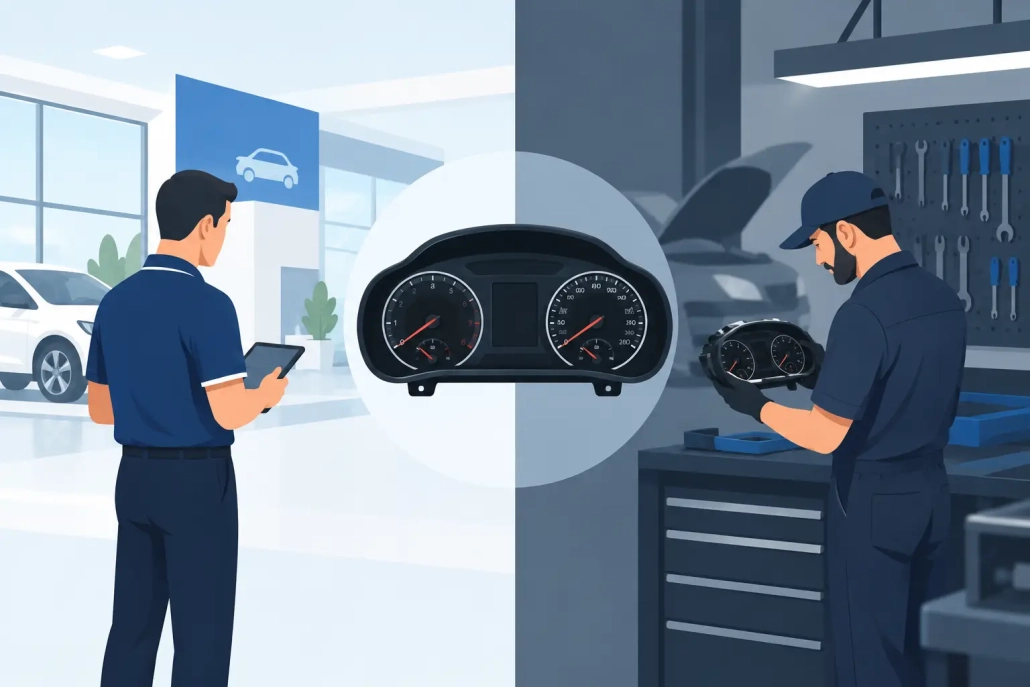
Dealer Versus Specialist for Cluster Repairs
A failed dashboard can quickly turn a straightforward drive into an uncertainty. The speedometer may drop to zero, warning lights may fade, the LCD may lose pixels, or the whole instrument cluster may go blank. When that happens, the dealer versus specialist decision is not simply about where to take the car. It affects cost, vehicle downtime, original mileage data and whether the unit you already have can be saved.
For many vehicles built from 1996 onwards, an instrument cluster fault does not automatically mean the dashboard needs replacing. A specialist can diagnose the fault at component level and repair the original unit where practical. That is often faster and more economical than ordering a replacement through a main dealer.
Dealer versus specialist: what is the real difference?
A main dealer is set up to support the manufacturer’s approved parts and procedures. If diagnostic checks identify a faulty instrument cluster, the usual route is often replacement with a new unit. This can be the right answer where a vehicle is under a manufacturer warranty, a new unit is required, or a fault is tied to a wider vehicle system that needs dealer-level software support.
However, replacement is not always the most proportionate answer to an electronic fault. Instrument clusters contain circuit boards, displays, motors, illumination components and communication circuitry. A failure in one of these areas can make the entire dashboard appear faulty, even though much of the unit remains serviceable.
A specialist repairer works differently. The focus is on finding the failed component or known weakness, testing the cluster outside the vehicle where necessary, and repairing the original unit. This approach is particularly useful for common faults such as failed gauges, blank or dim LCD screens, pixel loss, intermittent power, non-functioning warning lights and communication errors.
The difference matters because replacing a complete cluster to resolve a repairable display or gauge fault can add unnecessary cost and delay.
Why original unit repair is often the better route
Your original instrument cluster is part of the vehicle’s electronic identity. It holds information that may include mileage, coding and configuration data specific to the car. A replacement cluster may need ordering, programming and adapting before it can be fitted correctly.
Repairing the original unit avoids changing what already belongs to the vehicle. Provided the fault is repairable, the mileage and coding remain intact because the same cluster is returned. There is no need to source a used dashboard of uncertain history, and no risk of fitting a unit with incorrect specifications or incompatible software.
This is especially relevant for owners who want to retain the vehicle’s originality. It also helps independent garages that need a dependable solution without handing a customer back a car with an incorrectly configured display, warning messages or mileage discrepancy.
A specialist should still be clear when repair is not the sensible option. Severe fire or water damage, physical destruction of the circuit board, or a fault caused elsewhere in the vehicle may mean further diagnosis or replacement is necessary. Good diagnosis comes before a repair decision.
Cost: replacement price versus repair value
Dealer replacement quotes can appear high because they may include a new instrument cluster, programming, fitting, diagnostic time and VAT. There is also the possibility of additional charges if the replacement process identifies other coding or communication issues.
Specialist repair pricing is usually based on the known fault and vehicle model. It is generally more economical because the repair targets the affected part of the original unit rather than replacing every component inside it. For a driver facing a failed speedometer, missing pixels or a blank display, that can make a substantial difference.
Price should not be the only consideration. A low-cost used cluster may seem tempting, but it can create more problems than it solves. It may carry different mileage, require coding, have the same age-related faults waiting to develop, or simply not be compatible with the vehicle. A repair to the original unit is usually the cleaner route when the cluster is serviceable.
For trade customers, predictable repair costs also make estimates easier to explain. Rather than presenting a customer with a full replacement bill for a contained electronic fault, a garage can offer a targeted repair with a defined turnaround.
Turnaround and vehicle downtime
A main dealer may need to order a replacement part before work can begin. Depending on availability, this can leave the vehicle off the road for days or longer. The fitting and coding appointment then has to be arranged around workshop capacity.
A specialist repair service is designed around the urgency of an electronic failure. Many common cluster repairs can be completed on the same day or the next working day once the unit is received. Some repairs can be carried out while you wait by appointment, while national postal repair allows owners and garages across the UK to send the cluster securely for testing and repair.
The practical benefit is simple: the vehicle spends less time waiting for parts. For a family car, van, motorhome or business vehicle, that reduction in downtime can be as valuable as the saving on the repair itself.
Diagnosis is where the specialist earns its place
Modern clusters are not just displays. They communicate with other control modules and can show symptoms caused by a fault in the unit, its power supply, vehicle wiring or wider network communication. Swapping parts without confirming the cause can be expensive guesswork.
A proper specialist assessment uses model-specific knowledge and bench testing equipment. Emulators can replicate vehicle signals outside the car, allowing the cluster to be tested under controlled conditions. This helps distinguish an internal fault from an issue elsewhere in the vehicle.
That level of testing is particularly helpful when a fault is intermittent. A cluster that works one morning and fails the next may have a weak connection, failing component or temperature-related issue that is difficult to confirm with a basic fault-code scan alone.
For garages, this means less time lost trying to solve an electronics issue with mechanical processes. The workshop can remove the unit, send it for specialist assessment and refit the tested original cluster when it returns.
Warranty and accountability after the repair
A new dealer-supplied cluster will normally come with a parts warranty, subject to the dealer’s terms. That offers reassurance, but it does not always cover the cost or inconvenience of a replacement route in the first place.
With specialist repair, look for a warranty that directly supports the work carried out. A lifetime warranty tied to your ownership of the vehicle gives confidence that the repair is intended to last, not merely get the dashboard working long enough to leave the workshop.
The warranty should also be backed by clear fault descriptions, straightforward contact details and a repairer that understands the exact model and symptoms. If the vehicle has a separate wiring or control-module fault, that should be explained honestly rather than presented as a cluster repair issue.
When a main dealer is the right choice
There are cases where a main dealer remains the best option. A nearly new vehicle under manufacturer warranty should generally go back through the approved network. The same can apply where a manufacturer recall, software campaign or wider system fault needs attention.
A dealer may also be appropriate if the cluster is unavailable for repair, the car requires manufacturer-authorised security programming, or the diagnosis confirms a non-cluster fault requiring access to factory systems. The point is not that one route suits every vehicle. It is that a full replacement should be a considered decision, not the default response to every dashboard problem.
Choosing the right repair route
Before agreeing to replacement, ask whether the original cluster has been tested and whether the fault can be repaired. Ask what happens to mileage and coding if a new unit is fitted, how long parts will take to arrive, and what warranty covers the completed work.
Cartronix repairs original instrument clusters for a wide range of cars, vans and motorhomes, including common Audi, Aston Martin, Fiat, Ford and Alfa Romeo faults. The aim is straightforward: diagnose accurately, repair the unit where possible, preserve the vehicle’s data and get you back on the road without dealer replacement costs.
A blank dashboard or failed speedometer is frustrating, but it does not automatically call for a new cluster. Get the fault assessed properly first. The right repair can keep the original unit in the vehicle, protect its history and turn an expensive replacement quote into a practical fix.




