
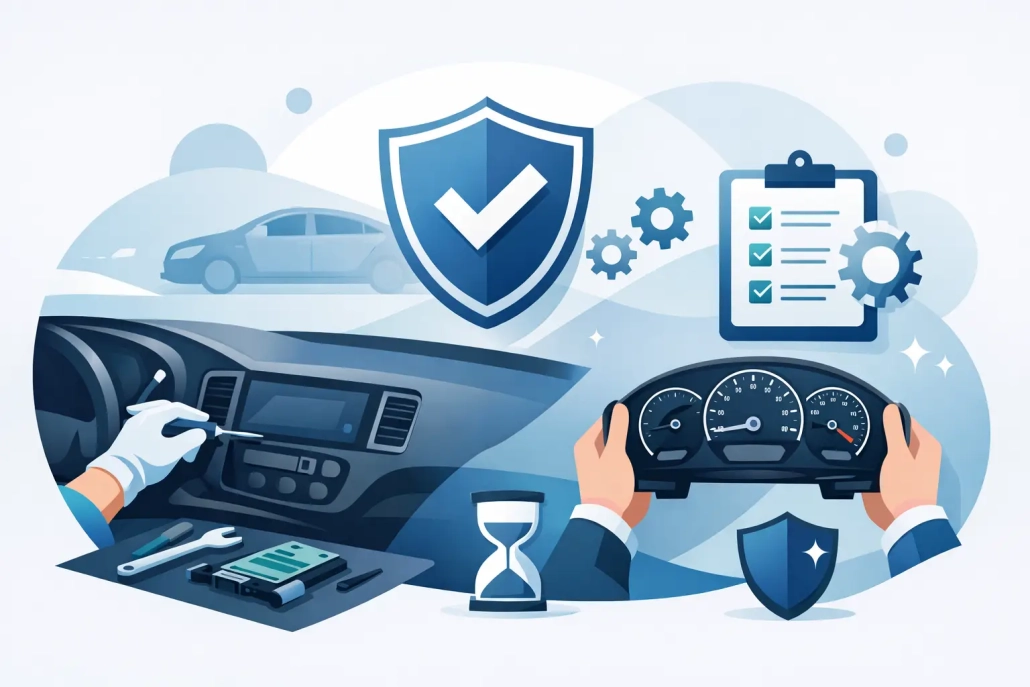
Lifetime Warranty Dashboard Repairs Explained
A speedometer that cuts out, a pixel display that fades, or warning lights that stop illuminating can quickly turn a straightforward journey into an uncertain one. Lifetime warranty dashboard repairs give UK drivers and workshops a practical alternative to replacing the whole instrument cluster through a dealer, often avoiding the cost, coding work and delay that comes with fitting a replacement unit.
For most vehicles, the instrument cluster is far more than a set of gauges. It is a coded electronic control unit that stores mileage, communicates with other vehicle systems and provides essential information while driving. Repairing the original unit keeps those details where they belong while resolving the fault that caused the problem.
What a Lifetime Warranty Covers on Dashboard Repairs
A lifetime warranty helps to remove the worry of paying twice for the same fault. Where a repaired instrument cluster develops a recurrence of the fault the repair warranty covers, you can return it for inspection and rectification for as long as you own the vehicle.
That distinction matters. A warranty applies to the specific repair carried out, not every possible future issue affecting the dashboard. Physical damage, liquid ingress, accident damage, attempted repairs by another party, wiring faults elsewhere in the vehicle and unrelated component failures may need separate investigation. Clear fault diagnosis at the start helps make those boundaries straightforward.
For motorists, this means the repair does not simply get the vehicle through an MOT or prepare it for sale. The repair aims to restore dependable operation for the period you keep the car, van or motorhome. For garages, it provides confidence that a specialist repair has ongoing support behind it.
Why Repair the Original Instrument Cluster?
Dealer replacement can be the right answer in some circumstances. This matters where impact or water has destroyed a unit. It also matters where the vehicle needs a manufacturer-only software action. However, a replacement cluster can be expensive and may require ordering, programming, mileage alignment and immobiliser coding before the vehicle is usable again.
Repairing the original cluster avoids many of those complications. Because the vehicle keeps its existing unit, the original mileage and coding stay in place. There is no need to fit a used dashboard with unknown history or risk buying a second-hand unit that has the same age-related weakness waiting to appear.
This is especially relevant on vehicles from 1996 onwards, where clusters regularly suffer repeatable electronic faults rather than complete mechanical failure. Failed stepper motors, dry solder joints, faulty LCD connections, damaged illumination circuits and internal processor faults specialists can often identify and repair them at component level.
A proper repair goes beyond clearing a fault code or applying a temporary workaround. The unit needs testing under controlled conditions, the underlying issue located and the specialists must verify the repair before they return it to the vehicle.
Common Repairable Dashboard Faults
Instrument cluster faults do not always look dramatic. A driver may first notice that the speedometer needle occasionally sticks, the fuel gauge gives an implausible reading, or the display loses a few pixels when the cabin is cold. These intermittent faults can become permanent without warning.
Common repair requests include failed or erratic speedometers, rev counters and temperature gauges; dim, blank or flickering LCD screens; missing pixels on driver information displays; warning lights that do not illuminate correctly; backlight failures; communication errors; and complete cluster failure.
The exact symptoms depend on the make and model. Audi dashboards may develop display or gauge issues, while Ford, Fiat, Alfa Romeo and Aston Martin clusters can each have model-specific electronic weaknesses. Accurate diagnosis is more useful than assuming every blank display needs a replacement unit.
A vehicle can also have a fault outside the cluster that creates dashboard symptoms. A low battery, poor earth, damaged wiring, CAN communication problem or sensor fault may trigger warning messages or cause gauges to behave unexpectedly. This is why a specialist should assess the cluster fault rather than replacing parts by guesswork.
How a Specialist Dashboard Repair Works
The process should be simple for both private owners and trade customers. Cartronix uses the vehicle registration, model year and fault symptoms to identify the likely cluster type and repair requirement. If that model has a known common failure, Cartronix can often confirm the likely repair route before booking.
Technicians then remove the cluster from the vehicle and test it with specialist equipment and emulators. This allows technicians to reproduce vehicle signals without relying solely on a road test. Technicians can check gauges, displays, warning lights, power supply circuits and communications in a controlled environment.
Once testing confirms the fault, technicians repair the damaged components or connections. Technicians then retest the unit to confirm that the original functions operate correctly. Retaining the original unit is key: the mileage, vehicle configuration and coding stay intact rather than moving into an unknown replacement dashboard.
For customers who cannot visit a workshop, a national postal repair service keeps the process practical. You can send the cluster securely for repair. Cartronix returns it ready to refit. Where a while-you-wait appointment is available, the vehicle owner or technician can benefit from a much shorter turnaround. Cartronix can complete many repairs the same day or by the next working day, depending on the cluster type and fault.
Lifetime Warranty Dashboard Repairs vs Used Replacements
A used dashboard can look like the cheapest option until you consider the full job. It may carry different mileage, need coding, be incompatible with the vehicle specification or contain an undisclosed fault. Even if it works initially, there is rarely certainty over how long it will last.
A repaired original cluster has a clearer history. It is your vehicle’s own unit, repaired for the identified problem and tested before return. Because the lifetime warranty follows vehicle ownership, the value is not only in the initial repair cost. It is in avoiding another bill if the same repaired fault returns.
There are cases where repair may not be economical. Severe fire damage, extensive corrosion, multiple failed circuits following water ingress or an unavailable display component can change the options. A reputable specialist will explain this before proceeding rather than promising a repair the specialist cannot support.
What to Check Before Booking a Repair
Start by recording the symptoms as clearly as possible. Note whether the fault is constant or intermittent, whether it happens only when cold or hot, and whether the fault affects other electrical features. A short video can be useful for an intermittent gauge or display issue.
If the cluster is still working intermittently, avoid repeatedly disconnecting and reconnecting it in an attempt to force it back to life. This can complicate diagnosis and, on some vehicles, introduce additional communication faults. Check the vehicle battery condition and relevant fuses. But do not assume a fuse is the cause simply because the display is blank.
Garages should include the vehicle make, model, year, engine type, cluster part number where available and any diagnostic fault codes. This gives the repair specialist the best chance of confirming the correct service before the unit arrives.
A Better Long-Term Fix for Drivers and Workshops
The most useful repair is one that gets the vehicle back on the road quickly without creating a new coding or mileage problem. That is why original-unit repair remains a sensible option for many dashboard faults. It preserves the vehicle’s authenticity, reduces downtime and avoids unnecessary dealer replacement costs.
Cartronix provides specialist instrument cluster repairs with lifetime warranty protection for the repaired fault, helping drivers and workshops choose a supported repair rather than an uncertain replacement. When a dashboard starts showing the first signs of failure, dealing with it early can save time, cost and avoidable disruption later on.




Trackbacks & Pingbacks
[…] for a warranty that clearly states what the repair covers and how long it lasts. A lifetime warranty tied to vehicle ownership offers stronger reassurance than a brief guarantee, particularly for a […]
Comments are closed.