
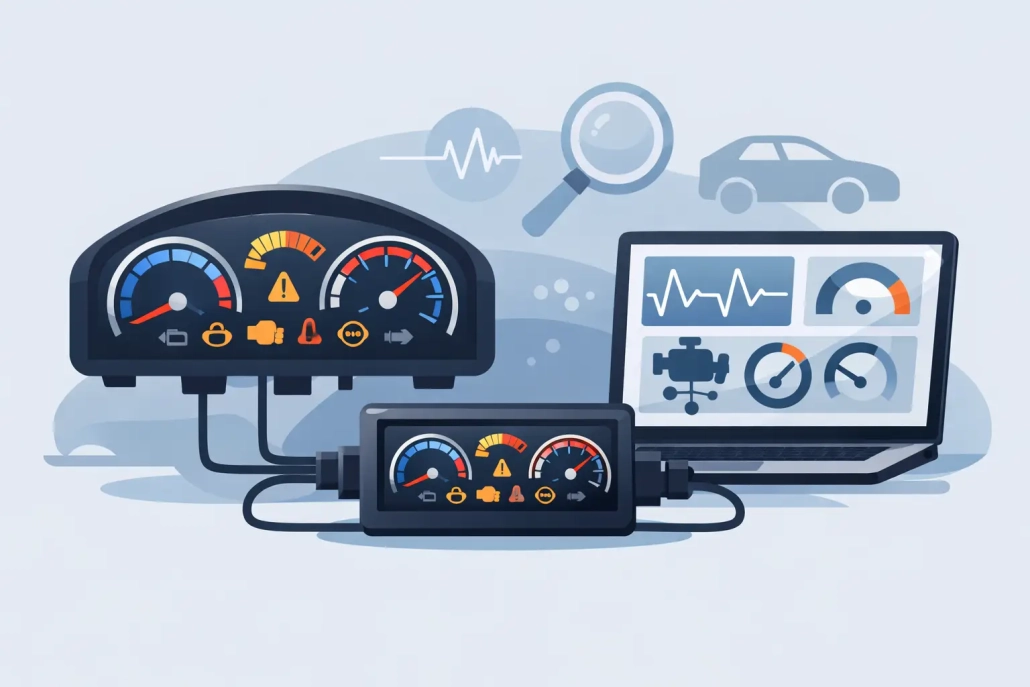
Instrument Cluster Emulator Diagnostics Explained
Instrument cluster emulator diagnostics are used when a dashboard fault cannot be proved simply by plugging in a diagnostic scanner. A cluster may arrive with dead gauges, missing warning lights, a blank LCD, pixel loss or an intermittent communication error. The question is not just what has failed, but whether the fault is inside the instrument cluster, in the vehicle wiring, or caused by another control module. An emulator helps provide a clear answer before any repair work begins.
For motorists, that means avoiding unnecessary dealer replacement costs. For garages and workshops, it means a specialist can test a removed cluster under controlled conditions, rather than relying on a fault that may only appear occasionally in the vehicle. Where repair is appropriate, the original unit can be retained with its mileage, coding and vehicle identity intact.
What is an instrument cluster emulator?
An instrument cluster emulator is specialist bench-testing equipment designed to reproduce the electrical signals and network communication an instrument cluster expects to receive in a vehicle. Depending on the make, model and year, this may include ignition feeds, battery voltage, CAN bus messages, speed signals, fuel-level inputs, warning-light commands and illumination controls.
In practical terms, it allows a technician to power up a cluster on the bench and make it behave as though it is fitted to the car. Gauges can be commanded through their operating range, display functions can be checked, and communication between the cluster and simulated vehicle systems can be monitored.
This is very different from a standard code read. A diagnostic scanner can report stored fault codes and live data from a vehicle, but it cannot always confirm whether the cluster itself is processing those signals correctly. An emulator isolates the unit from the rest of the vehicle and gives the technician a repeatable test environment.
Why instrument cluster emulator diagnostics matter
Many dashboard faults have similar symptoms but very different causes. A speedometer that reads zero, for example, may be caused by a failed gauge motor, a damaged circuit on the cluster, a missing speed signal, a CAN network issue or a fault elsewhere in the vehicle. Replacing the cluster without proving the cause can be an expensive gamble.
Instrument cluster emulator diagnostics help separate internal electronic faults from external vehicle faults. If a cluster receives the correct simulated signals on the bench but a gauge does not respond, attention can be focused on the cluster. If it works correctly on the emulator but not in the vehicle, the vehicle wiring, power supply, network or associated control module may need further investigation.
That distinction matters particularly on modern vehicles, where the cluster is not simply a display panel. It is often a coded control unit that communicates with the ECU, body control module, immobiliser and other systems. A replacement unit may need programming, adaptation and mileage correction, while a repaired original cluster normally keeps the vehicle’s existing configuration.
Controlled testing removes guesswork
Intermittent faults are among the most frustrating issues for drivers and technicians. A dashboard may fail after the car has warmed up, cut out over bumps, lose pixels in cold weather or work normally when it reaches the workshop. Bench testing lets the technician inspect power consumption, communication behaviour and component operation without having to wait for the fault to happen during a road test.
It also makes post-repair testing more meaningful. Once components have been repaired, the cluster can be run through the same simulated conditions to confirm that gauges sweep correctly, warning lamps illuminate as commanded, displays remain stable and communication is restored.
Faults that can be checked on an emulator
The exact scope depends on the unit and the test equipment available, but emulator testing is particularly useful for common instrument cluster failures. These include failed speedometers, rev counters, fuel and temperature gauges, dim or non-functioning backlighting, failed warning indicators, blank central displays and LCD pixel faults.
It can also assist with clusters that appear completely dead. A unit may have no illumination, no gauge movement and no communication due to internal power supply faults, damaged tracks, failed voltage regulators or component-level issues. Testing the cluster with known-good simulated feeds helps rule out a vehicle-side supply problem before the repair begins.
Communication faults deserve careful interpretation. A no-communication code does not automatically mean the cluster is defective. Corrosion in connectors, low battery voltage, damaged wiring and faults on a shared CAN network can all create similar symptoms. A bench test can confirm whether the cluster wakes up and communicates correctly when it receives the conditions it requires.
What an emulator cannot prove on its own
An emulator is a diagnostic tool, not a shortcut around proper vehicle assessment. It cannot physically inspect a damaged vehicle connector, reproduce every real-world vibration condition or prove that every external module on the car is healthy. Some faults only occur when the unit is installed, particularly where water ingress, poor earth connections or network wiring are involved.
That is why good diagnosis considers the reported symptoms, vehicle scan results and basic power and earth checks alongside the bench test. If a cluster performs correctly on an emulator, sending it for internal repair may not solve the customer’s fault. A dependable specialist will explain that outcome rather than repairing a unit unnecessarily.
How the diagnostic process works
A proper assessment begins with the vehicle details: make, model, year, part number and exact symptoms. The more specific the description, the easier it is to reproduce the fault. Details such as whether the display fails only when cold, whether warning lights remain on, or whether the speedometer drops out after starting can be highly useful.
The cluster is then inspected for obvious damage, previous repair work, liquid contamination or overheated components. It is connected to suitable bench equipment and powered in a controlled manner. The technician checks whether it starts correctly, communicates on the required network and responds to the simulated inputs expected by that design.
Where a fault is confirmed, the repair is tailored to the unit rather than based on a blanket replacement approach. This may involve repairing failed display connections, replacing defective motors or electronic components, restoring illumination circuits, or correcting internal board faults. The repaired cluster is then retested before return.
For a postal repair, this process gives customers a practical alternative to leaving the car at a dealer while a new coded unit is ordered. For workshop appointments, it supports quick diagnosis and repair where the vehicle and fault allow it. Cartronix uses specialist emulators as part of this focused approach to instrument cluster repair, helping avoid replacement where an original unit can be restored.
Benefits of repairing the original cluster
The strongest reason to repair an original cluster is not only cost. It is continuity. The unit already belongs to the vehicle and normally retains the correct mileage, coding and configuration. This avoids the added complications that can arise when fitting a used or replacement dashboard.
A used cluster may carry the wrong mileage, have hidden faults, require coding or fail to communicate correctly with the car. A new dealer unit can involve higher parts costs, programming charges and longer downtime. Repairing the original is often the more economical route when the fault is repairable.
There are limits. Severe water damage, burnt circuit boards or unavailable parts may mean repair is not viable. Older designs and unusual variants can also require a more individual assessment. The right answer depends on the condition of the unit, not a promise that every cluster can be saved.
Useful information to provide before booking
To speed up diagnosis, provide the vehicle registration or full make, model and year, together with the part number from the cluster where available. Describe the fault plainly: for example, all gauges dead, fuel gauge reads empty, display has vertical lines, warning lights are dim, or cluster loses power intermittently.
If a garage has scanned the vehicle, include the fault-code information and any checks already completed. It is also helpful to state whether the battery has recently gone flat, the car has suffered water ingress, or another electrical repair took place before the problem started. These details can point towards an external cause and prevent wasted time.
The best repair decision starts with proof, not assumption. When an instrument cluster is tested against known signals on the bench, both drivers and workshops can move forward with a clearer diagnosis, a realistic repair route and less risk of paying for parts that were never needed.




