
Vehicle Coding When an Instrument Cluster Fails
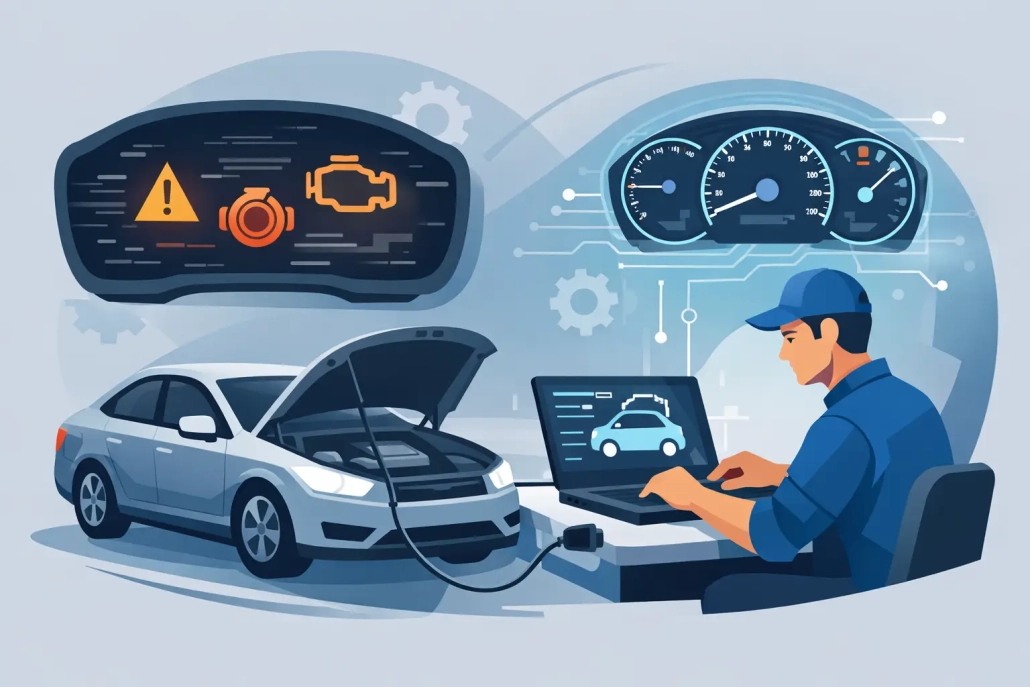
A failed dashboard can leave a vehicle with no speedometer, no warning lights, missing pixels or a completely blank display. At that point, vehicle coding is often a concern – particularly when a garage has suggested replacing the entire instrument cluster. The key question is whether the original unit can be repaired, because retaining it usually retains the vehicle’s mileage, configuration and coding too.
For most drivers, the best outcome is straightforward: repair the original cluster, refit it and get back on the road without a dealer replacement bill or unnecessary programming work. That is not possible in every case, but it is the right starting point when a modern dashboard develops a fault.
What vehicle coding means in practice
Vehicle coding is the electronic configuration stored within control units. It tells a module how the vehicle is equipped and how it should communicate with the rest of the car. Depending on the make and model, coding can cover items such as transmission type, fuel type, steering wheel controls, warning systems, country settings, display options and fitted equipment.
An instrument cluster is not simply a set of gauges. In many vehicles, it is a networked control module that receives information from the engine ECU, ABS system, body control module and other units. It displays vehicle speed, fuel level, temperature, warning messages and service information. It may also hold vehicle-specific data including mileage, immobiliser information or chassis-number-related records.
This is why fitting a used cluster from another vehicle is rarely as simple as plugging it in. Even if the part numbers appear to match, the donor unit may contain different coding, incorrect mileage or security data that prevents normal operation. Some cars will start but show faults or incorrect functions. Others may reject the replacement unit altogether.
Why original cluster repair is normally the better route
When the fault is inside the original instrument cluster, repairing that unit avoids many of the complications associated with replacement. The vehicle keeps the cluster it left the factory with, along with its stored configuration and vehicle-specific information.
Typical repairable faults include failed stepper motors, intermittent gauges, pixel loss, dim LCD screens, failed backlighting, power supply faults, damaged circuit-board components and communication faults. A speedometer that drops to zero, a rev counter that behaves erratically or a display with missing lines does not automatically mean the whole cluster needs replacing.
A specialist repair works at component level. The aim is to diagnose the cause of failure, repair or replace the defective electronic parts, test the unit correctly and return the original cluster for refitting. In this situation, vehicle coding should not need to be recreated because it has not been lost or replaced.
That distinction can save considerable time and cost. A dealer replacement may require a new cluster, ordering delays, programming procedures and additional labour. Repairing the original unit is often quicker and helps preserve the vehicle’s originality.
When instrument cluster coding may be needed
There are situations where repair is not viable. Severe water damage, fire damage, extensive corrosion, previous poor repair work or an irreparably damaged processor can make replacement necessary. In these cases, coding or programming may be part of the process, but the exact requirement depends entirely on the vehicle.
Some vehicles require a replacement cluster to be configured with manufacturer-level diagnostic equipment. Others need security synchronisation or immobiliser adaptation before the vehicle will start normally. Certain systems may require mileage data to be transferred where this can be carried out legitimately and accurately. These are not jobs for guesswork, generic scan tools or a like-for-like part bought without checks.
There is also a difference between coding and calibration. Coding configures the module for the vehicle. Calibration may relate to gauge positions, warning lamp operation or a specific sensor input. Programming can mean loading software into a module. People often use these terms interchangeably, but a proper diagnosis identifies which one is actually required.
For garages, this matters before quoting a customer. A cluster that looks beyond repair may still be recoverable at board level. Sending it for specialist assessment before ordering a replacement can prevent a costly chain of parts, programming and delays.
Common misconceptions about vehicle coding
One common assumption is that any dashboard fault needs coding. Usually, a failed display, faulty gauge or dead illumination is an electronic repair issue, not a coding issue. Reprogramming cannot repair a cracked LCD, worn motor, failed voltage regulator or damaged solder joint.
Another is that disconnecting the battery will erase vehicle coding. In normal circumstances, it will not. A battery disconnect can create temporary warning lights or require settings such as the clock and electric windows to be reset, but the stored configuration in control modules remains in place.
Used clusters create another source of confusion. A pre-owned unit can be tempting because the purchase price looks low. However, its compatibility is about much more than the physical shape of the unit. Hardware version, software version, part number, security system and vehicle specification can all matter. Once diagnostic work, coding and the risk of incompatibility are considered, the apparent saving can disappear quickly.
Mileage is particularly sensitive. The recorded mileage must remain accurate, and any work involving stored vehicle data must be handled correctly. Repairing the original cluster is generally the cleanest way to avoid mileage discrepancies because the original data remains with the original unit.
The diagnosis should come before coding
An instrument cluster may be the symptom rather than the cause. Before condemning it, a technician should consider the vehicle’s power supplies, earth points, fuses, CAN network and related control modules. A communication error can be caused by wiring damage, low battery voltage or another module pulling down the network.
Equally, a fuel gauge fault may be caused by the tank sender, while a speedometer issue may originate from an ABS signal fault. Reading fault codes is useful, but it is only one part of diagnosis. Live data, wiring checks and known fault patterns are often needed to establish whether the cluster itself has failed.
Specialist testing makes a real difference here. Using suitable diagnostic equipment and emulators, a cluster can be assessed away from the vehicle in controlled conditions. This helps confirm whether the unit is receiving and processing signals correctly, and whether the fault is internal. It also reduces the risk of replacing parts unnecessarily.
What to do when your dashboard develops a fault
If your dashboard is blank, flickering, showing pixel loss or displaying incorrect readings, avoid assuming that replacement is the only answer. Record the symptoms clearly. Note whether the fault is constant or intermittent, whether it began after a flat battery or jump start, and whether any other electrical systems are affected.
For a garage, provide the vehicle registration, make, model, year, engine type and a description of the fault. If the cluster has been removed, keep it protected from moisture and physical damage. Do not attempt to open the unit or resolder components unless you have the correct equipment and experience – unsuccessful DIY work can turn a straightforward repair into a more involved job.
Cartronix repairs original instrument clusters for vehicles from 1996 onwards, helping motorists and trade customers avoid unnecessary dealer replacement costs. With postal repairs and workshop appointments available, the focus is on accurate diagnosis, fast turnaround and retaining the original unit wherever possible.
A warning light, failed gauge or blank display deserves proper investigation before anyone talks about replacement coding. Keeping the original cluster repairable can protect the vehicle’s data, reduce downtime and give you a clearer, more economical route back to a fully working dashboard.




