
Can Dashboard Faults Fail MOT? What to Check
A dashboard fault can turn an otherwise sound vehicle into an MOT failure. Not every dead pixel, faulty gauge or blank display will automatically result in a rejection. The key question is whether the fault affects a warning lamp or system the tester must inspect. If you are asking, can dashboard faults fail MOT, the short answer is yes. This matters where a safety or emissions warning light stays on, fails to illuminate, or the tester cannot check it properly.
For drivers and garages, the practical approach is simple. Do not wait for the MOT station to identify an instrument cluster problem. Check the dashboard before the test, find out what the warning is reporting. Repair the underlying fault rather than trying to hide it.
Which dashboard faults can fail an MOT?
The MOT test is not a full electronic health check of every function in the instrument cluster. Testers do not generally strip the dashboard down or carry out dealer-level diagnostics. However, they must inspect certain warning lamps and their operation where fitted.
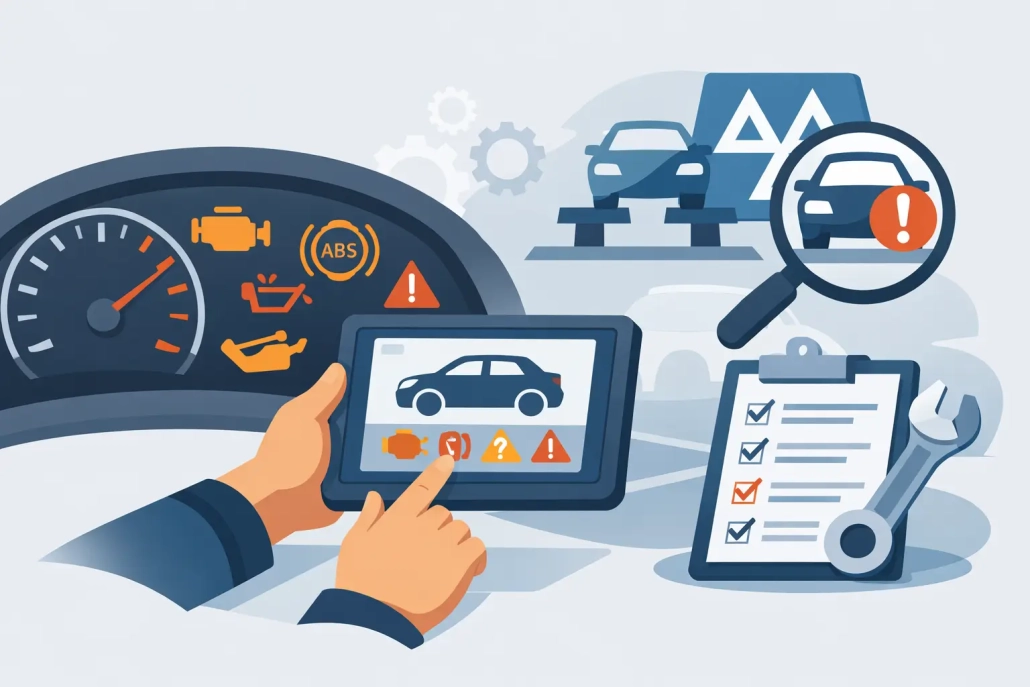
A warning lamp illuminated to show a fault in a safety-critical or emissions-related system can lead to a Major defect and an MOT fail. This commonly includes the engine management light, ABS warning light, airbag or SRS light, electronic stability control warning light and certain brake system warnings.
The lamp’s behaviour matters as much as whether it is lit. On many vehicles, the relevant warning lights should come on with the ignition and then go out once the engine starts or the system has completed its self-check. If a lamp stays on to indicate a malfunction, it is a problem. If a required lamp fails to come on at all, that can also be a problem because the tester cannot confirm that the warning system is working.
This is why a dim, intermittent or failed instrument cluster you should not treat it as cosmetic. A cluster with failed illumination may conceal a warning light that needs to be visible during the test.
Engine management and emissions warnings
An illuminated malfunction indicator lamp, often shown as an engine symbol, counts as one of the most common dashboard-related MOT failures. It many issues can trigger it by a wide range of issues, from an emissions control fault to a sensor, wiring or communication problem.
Clearing the fault code shortly before the test is rarely a dependable solution. If the fault remains, the light may return. On some vehicles, clearing codes can also reset emissions readiness information, creating another issue during the emissions check. The vehicle needs accurate diagnosis and a proper repair.
ABS, airbag and stability control lights
ABS, SRS or airbag, and electronic stability control warnings deserve immediate attention. These systems help to support control and occupant protection, so a warning lamp that remains illuminated will usually result in a fail where the system is fitted and the warning shows a malfunction.
There is an important distinction between a genuine vehicle fault and a dashboard fault. An ABS light may be on because of a wheel speed sensor, damaged wiring, an ABS module or low system voltage. Equally, the cluster itself may have an LED, circuit-board or communication fault that makes the warning appear incorrectly. Proper you need proper diagnosis before replacing parts.
Brake warning lights
A red brake warning light can indicate that the parking brake is applied. But it may also point to a brake fluid, hydraulic or electronic braking issue depending on the vehicle. If the lamp remains on when it should not, do not assume it is only a dashboard problem. The braking system must be checked before the MOT and before the vehicle is driven any further than necessary.
Do pixel loss, LCD faults and failed gauges cause an MOT fail?
Not necessarily. A damaged LCD display, missing pixels, faded information screen or failed fuel gauge is frustrating. But it is not automatically an MOT failure in its own right. The MOT is based on specific inspection requirements, not the general appearance of the dashboard.
That said, a display fault can become relevant if it prevents the tester from seeing a required warning indication. For example, a heavily faded cluster that makes the airbag, ABS or engine management lamp impossible to verify may cause an issue. The same applies where an instrument panel has been altered, covered or replaced in a way that prevents the required lamp operation from being assessed.
A faulty speedometer is another common concern. It is not normally tested for accuracy as part of the MOT in the way many drivers expect. However, driving with a speedometer that does not work is not sensible or safe, and it can leave the driver unable to comply with speed limits. It should be repaired promptly even if it is not the reason for an MOT rejection.
A warning light is a symptom, not always the fault
Modern dashboards are part of a wider vehicle network. The instrument cluster receives information from control modules, sensors and the vehicle’s CAN system, then displays it as gauges, messages and warning lights. A fault shown on the cluster may therefore originate elsewhere.
Before booking an MOT retest, a workshop should establish whether the problem is in the system being monitored, the wiring and power supply, network communication, or the instrument cluster itself. Guesswork can become expensive very quickly. Replacing an ABS sensor will not fix a cluster with a failed warning-light circuit, and fitting a replacement dashboard without correct coding can create mileage and configuration problems.
A specialist cluster repair can be the right answer where the original unit has common faults such as intermittent gauges, blank screens, pixel loss, failed backlighting, warning lights that do not illuminate, or complete loss of display. Repairing the original unit retains the vehicle’s mileage and coding, avoiding the complications and cost that can come with a replacement dashboard.
What to check before taking the vehicle for MOT
Start the vehicle with enough time to observe the ignition sequence. Warning lights should illuminate as expected, then extinguish once the engine is running, apart from reminders such as the parking brake or seat belt where applicable. If any safety or emissions lamp remains on, arrange diagnosis before the test.
Also check that the cluster is readable in normal lighting. Dim backlighting, a flickering screen or a display that comes and goes when the dashboard is warm can make a simple fault harder to diagnose at the test station. Intermittent faults are still faults, and they often worsen without warning.
If the vehicle has recently had a flat battery, jump start or charging problem, do not dismiss new warning lights automatically. Low voltage can create multiple stored faults. But the battery and charging system should be checked first. Once the supply voltage is stable, diagnostic equipment can confirm which faults are current and which are historic.
For garages, recording the warning-light behaviour before sending a cluster away is useful. Note which lamps fail to illuminate, remain on, flicker or appear only after a period of driving. This gives the repair specialist a clearer starting point and helps avoid confusing a vehicle-side fault with an instrument-cluster defect.
Can you pass an MOT by removing or covering a warning light?
No. Removing a bulb, covering a lamp or using coding to suppress a warning is not a repair. If a required warning indicator does not operate correctly, the vehicle can fail because the tester cannot verify the system’s status. More importantly, the underlying safety or emissions fault may still be present.
The same applies to fitting a used replacement cluster without establishing compatibility. A donor unit can have different coding, mileage, warning-light configuration or module communication. It may appear to work at first but create further faults or leave important functions unavailable.
Repair the dashboard before it becomes an MOT problem
An MOT failure caused by a warning light often means lost time, a retest and an urgent repair booking. Addressing a flickering cluster, failed display or warning lamp issue beforehand is usually the more economical route.
Cartronix repairs original instrument clusters for cars, vans and motorhomes, helping retain existing mileage and coding without main dealer replacement costs. With specialist diagnosis, fast turnaround and a lifetime warranty for as long as you own the vehicle, a dashboard repair can put a recurring MOT concern behind you before test day arrives.




Trackbacks & Pingbacks
[…] lamp check may prevent the driver from knowing the system has stored a fault. It may also lead to an MOT failure where a required warning lamp is missing, inoperative or indicates a […]
Comments are closed.