
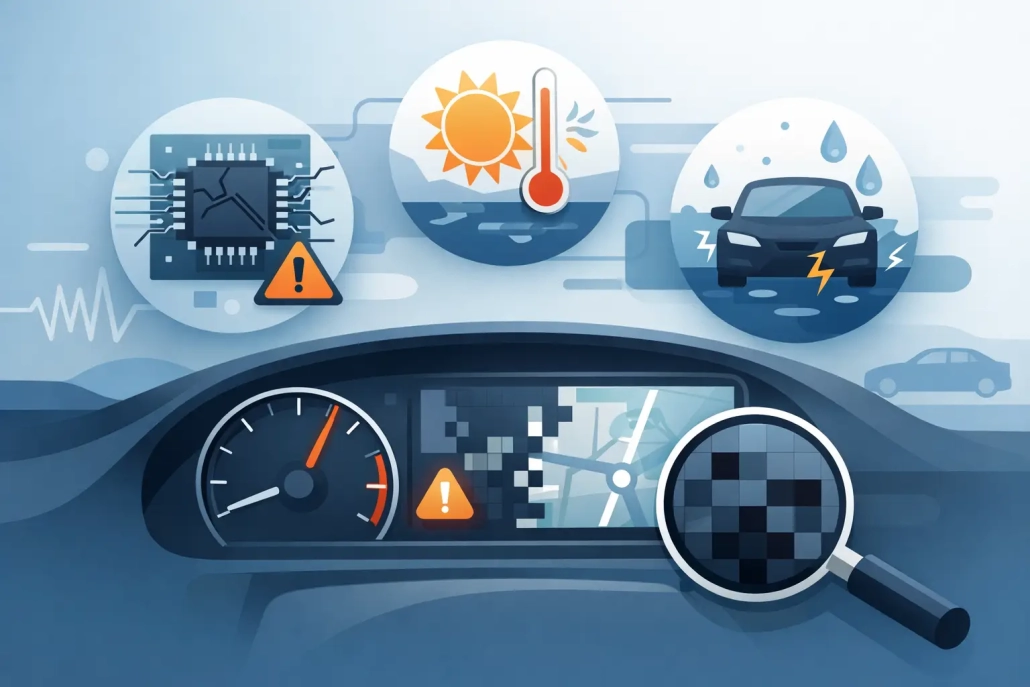
Top Causes of Pixel Failure in Car Dashboards
A dashboard display can look acceptable one day, then develop missing lines, faded characters or blank sections the next. The top causes of pixel failure are rarely the pixels themselves in isolation. More often, the fault lies in the connections, heat damage or electronic components that allow the display to operate.
For drivers, pixel loss can make mileage, warning messages, trip data and temperature readings difficult or impossible to read. For garages, it can create a frustrating diagnosis when the vehicle otherwise starts and drives normally. Understanding which part has failed helps avoid unnecessary dealer replacement costs and prevents a display fault mistaking it for a wider instrument cluster problem.
Top Causes of Pixel Failure in Instrument Clusters
Heat damage and ageing display connections
Heat counts as one of the most common reasons for failed dashboard pixels. Instrument clusters sit behind the windscreen, where they repeatedly face to summer sun, cabin heat and sharp temperature changes. Over years of use, this can weaken the bonded connections between the LCD screen and its ribbon cable or conductive strip.
When these connections begin to fail, individual rows or columns of pixels disappear. The display may improve briefly when the cabin is warm, worsen after a cold night, or change when you apply pressure around the screen. That inconsistency is a useful clue. But pressing on the display is not a repair and can make fragile connections worse.
This fault appears especially often on older LCD-based clusters. But age alone is not the deciding factor. Vehicle design, display position and how much time the car spends parked in direct sunlight all affect how quickly materials deteriorate.
Failed ribbon cables and poor LCD bonding
The flexible ribbon cable between the display and cluster circuit board carries the signals that create each character and pixel. It is thin, tightly packaged and often heat-bonded rather than connected with a conventional plug. Once the bond degrades, missing pixels, vertical lines and partial information displays can follow.
A ribbon cable fault can appear very similar to a failed LCD. The difference matters because replacing only the screen without repairing the underlying connection may not solve the issue. A proper repair involves dismantling the original cluster, assessing the display and connection method, then restoring the relevant parts using the correct equipment and process.
DIY fixes involving foam pads, tape or improvised pressure behind the display some guides suggest. They may temporarily alter the contact. But they do not provide a controlled, durable repair. They can also damage the screen, distort the cluster housing or leave the display worse than before.
Moisture ingress and corrosion
Instrument clusters the dashboard protects inside the dashboard. But they are not immune to moisture. A leaking windscreen, blocked scuttle drains, water ingress following body repairs, or persistent condensation can introduce moisture into the dashboard area. Once inside the cluster, even a small amount of corrosion can affect display contacts, circuit tracks and connector pins.
Pixel failure caused by moisture may be accompanied by other symptoms. Gauges may behave erratically, warning lights may dim or fail to illuminate, and the display may flicker rather than simply lose fixed sections. In more serious cases, the cluster can lose communication with other vehicle systems.
The display you should not treat it as the only problem where water you suspect water damage. The source of the leak needs attention as well. Repairing a cluster without stopping the moisture ingress risks the same fault returning, or a different electrical fault developing later.
Voltage problems, weak batteries and poor earths
A car’s instrument cluster relies on stable voltage and reliable earth connections. A weak battery, charging fault, poor battery connection or corroded earth point can cause low-voltage events and electrical irregularities. These do not always permanently damage a display. But they can expose an existing weakness or cause temporary screen faults.
If pixel loss appeared immediately after a flat battery, jump start or alternator issue, check the vehicle’s charging system before assuming the LCD has failed. A cluster that resets, flickers or loses several functions at once may have a supply issue rather than a display-only fault.
However, a stable vehicle voltage does not restore pixels lost through degraded ribbon bonding or a damaged LCD. This is where accurate diagnosis saves time. The fault may be electrical, mechanical or a combination of both.
Backlight faults mistaken for pixel failure
Not every unreadable dashboard display has missing pixels. A failed backlight can leave the information present but too dim to see, particularly at night or when the headlights are on. In daylight, the display may look faint; shining a torch across it can sometimes reveal characters that are still producing.
Backlight faults can come from failed illumination components, damaged solder joints or a problem in the cluster’s power circuitry. On some vehicles, dimming settings and light-sensor behaviour can also confuse the diagnosis. The practical difference is simple: a pixel fault removes parts of letters and numbers, while a backlight fault affects how brightly the whole display can be seen.
A specialist test can separate these issues before parts are replaced. This is particularly useful when the cluster has more than one display, as one section may have a pixel fault while another has an illumination fault.
Component failure on the circuit board
The LCD is only one part of the instrument cluster. The circuit board contains processors, power-regulation components, soldered connections and driver circuits that control the display. Age, heat cycling and electrical stress can cause faults in these components, leading to distorted graphics, intermittent display operation or a completely blank screen.
A circuit-board fault is more likely when pixel loss is joined by other symptoms, such as non-functioning gauges, warning light issues, intermittent cluster operation or communication errors. It is also possible for a cluster to work normally for a period, then fail once it warms up.
This is why testing the cluster away from the vehicle can be valuable. Using the correct emulator and diagnostic equipment allows the unit to be powered and assessed under controlled conditions. It helps establish whether the problem is internal to the cluster or linked to wiring, power supply or another vehicle module.
Physical damage and previous repair attempts
A sharp impact to the dashboard, accident damage or careless removal of the cluster can crack an LCD, damage a ribbon cable or disturb soldered connections. The fault may not be visible from the front, particularly if the outer lens is intact.
Previous repairs can also complicate the picture. Missing screws, damaged connectors, incorrect bulbs, poor soldering and non-standard parts can all affect reliability. A cluster that has been opened before is not automatically beyond repair. But it needs careful inspection before a repair route testing confirms the fault.
When Pixel Failure Needs Specialist Repair
If the display has a fixed missing section but the rest of the cluster works, the repair may be limited to the LCD or its connections. If the fault is intermittent, accompanied by gauge problems or follows a water leak, a wider cluster inspection is sensible. The right repair depends on the fault found, not just the visible symptom.
Replacing the entire cluster through a dealer can be expensive and may introduce mileage, coding and immobiliser complications. Repairing the original unit retains the vehicle’s original mileage and coding. This applies when the cluster is repairable. It also avoids fitting a used unit with an unknown history.
For motorists and trade customers, the key is to describe the symptom accurately when booking: which display is affected, whether pixels are missing or the screen is dim, when the fault occurs and whether any other dashboard functions have changed. Clear fault information speeds up diagnosis and helps avoid avoidable vehicle downtime.
Cartronix repairs original instrument clusters for a wide range of vehicles, with specialist testing, fast turnaround options and a lifetime warranty tied to vehicle ownership. If your display is becoming difficult to read, arranging a repair before it fails completely is usually the simplest way to keep the vehicle usable and the original dashboard intact.




