
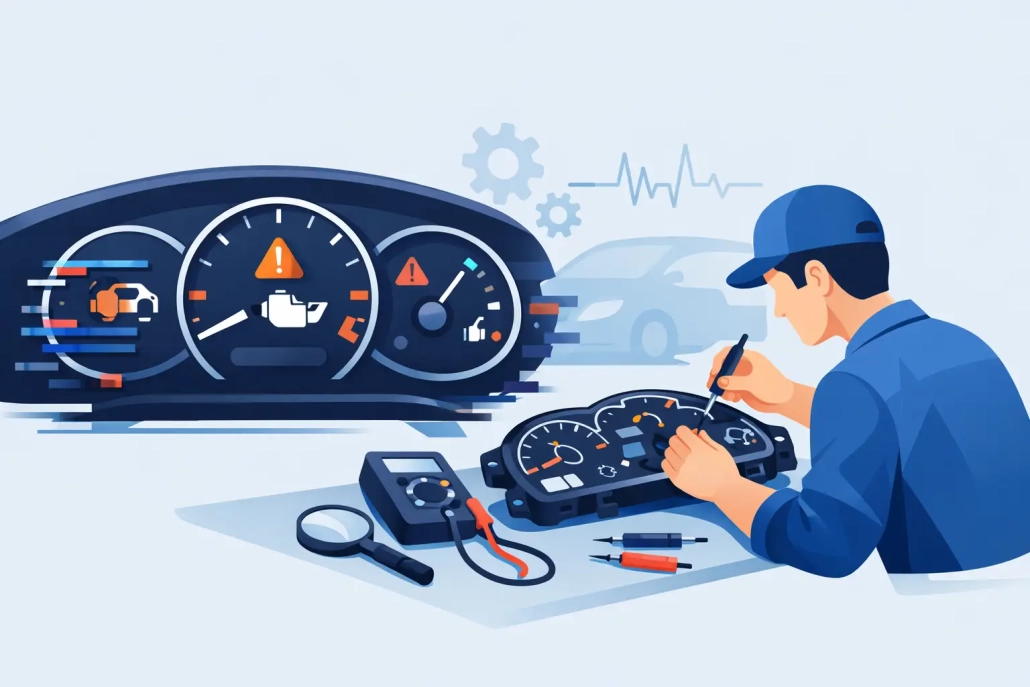
Gauge Repair for Faulty Car Dashboard Displays
A speedometer that drops to zero, a fuel gauge stuck on empty or a temperature needle with a mind of its own can make every journey uncertain. Gauge repair is often the sensible answer when the rest of the instrument cluster is working. That avoids replacing an expensive dashboard assembly and introducing coding or mileage complications.
For drivers, garages and dealerships, the priority is straightforward. Identify the real cause, repair the original unit where possible and get the vehicle back on the road quickly. A faulty gauge is not always just an inconvenience. It can affect driver confidence, hide a developing vehicle fault and, in some cases, create an MOT concern when warning lamps or essential displays the fault also affects them.
When gauge repair is the right answer
Instrument clusters fitted to vehicles from 1996 onwards contain more electronics than many owners realise. Behind the needles, LCD panels and warning lamps are circuit boards, stepper motors, processors and communication components. When one of these parts begins to fail, the symptoms can look random. But they are often repeatable faults within the cluster itself.
Common faults include:
- Speedometer, rev counter, fuel or temperature gauges that stick, jump or stop working
- Gauges that read incorrectly after starting the vehicle or during a journey
- Needles that fail to return to zero when the driver switches off the ignition
- Intermittent dashboard operation, particularly when the vehicle is cold or warm
- Dim, failed or flickering warning lights alongside gauge faults
- Pixel loss, faded LCD displays or missing information on the driver display
A professional repair is particularly worthwhile when the cluster is otherwise original to the vehicle. Replacing it with a used unit can bring a different set of problems. The mileage may not match, warning messages can appear, and the replacement may need programming before it works correctly. A brand-new dealer unit may also require coding and can be considerably more expensive than repairing the existing dashboard.
Repairing the original cluster normally retains its stored mileage, configuration and vehicle coding. That is a major advantage for owners who want to preserve the car’s originality, and for workshops that need a dependable solution without tying up a ramp or bay for longer than necessary.
A gauge fault is not always a failed gauge
It is tempting to assume that a non-working fuel gauge means the gauge itself is defective. Sometimes it is. In other cases, the cause may be a sender unit in the fuel tank, a wiring issue, a poor connection, an engine control fault or a communication problem elsewhere on the vehicle network.
The same applies to speedometers and temperature readings. A failed wheel speed sensor, vehicle speed signal issue or coolant sensor can produce symptoms on the dashboard without the cluster being at fault. Replacing or repairing the cluster before checking the wider system can waste time and money.
This is why accurate diagnosis matters. A specialist should assess the reported fault, vehicle model and known failure patterns before beginning work. On suitable units, bench testing with dedicated emulators can simulate vehicle signals and communications. This allows cluster specialists to test it away from the vehicle and helps confirm whether the fault lies within the instrument panel rather than elsewhere in the car.
For trade customers, this removes guesswork. A garage can send in a suspected cluster knowing it specialists will assess it by technicians working with these faults every day. That avoids replacing parts on a trial-and-error basis.
Intermittent faults deserve proper testing
Intermittent gauge faults can be the most frustrating. The dashboard may work perfectly when the vehicle arrives at a workshop, then fail again the following morning. Heat, vibration, voltage changes and internal component wear can all expose a weak point in the circuit.
A quick visual inspection is rarely enough. The unit needs controlled testing, with attention paid to the reported behaviour. A gauge that sticks at one position, for example, points to a different fault path from one that works until the dashboard warms up. Clear fault information from the owner or garage helps speed up that process: note which gauge is affected, when it fails, whether warning lights or displays are involved, and whether the fault appeared after battery work or another repair.
How professional gauge repair works
Once the cluster fault testing has confirmed the fault, the repair process should focus on the defective components, not simply on swapping the whole unit. Depending on the make, model and fault, this may involve replacing failed motors, restoring damaged connections, repairing circuit-board faults or resolving display and illumination issues.
The repaired unit technicians then test it to make sure the gauges respond correctly and the dashboard functions correctly. This matters because a needle that moves is not automatically a needle that reads accurately. The test must check the range and behaviour of the gauge, along with relevant displays, warning lamps and communications where applicable.
The exact repair depends on the vehicle. Audi, Aston Martin, Fiat, Ford and Alfa Romeo instrument clusters can each have their own common faults, layouts and diagnostic requirements. Cars, vans and motorhomes also vary widely, even where they share a manufacturer. The safest approach is to match the repair to the specific make, model, year and symptoms rather than treating all dashboards as interchangeable.
At Cartronix, original instrument clusters technicians repair and test using specialist equipment, with postal repairs available across the UK as well as while-you-wait workshop appointments for suitable jobs. Many repairs can be completed the same day or by the next working day, subject to the fault type and booking arrangement. The aim is to avoid dealer replacement costs while keeping downtime to a minimum.
Why replacement can be the more expensive route
A replacement cluster may appear to be the fastest fix, particularly if a used part is readily available. However, the price of the part is only one part of the decision. A replacement unit can require coding, mileage correction where legally and technically appropriate, immobiliser or configuration work, and further diagnosis if it does not communicate correctly with the vehicle.
There is also no guarantee that a used cluster is fault-free. It may have the same age-related weaknesses as the original unit, or it may carry faults that only become apparent after installation. New dealer units avoid the unknown history. But can involve higher parts costs and longer lead times.
Gauge repair is not the answer in every case. Severe liquid damage, fire damage, extensive board corrosion or a unit that is no longer supported may make replacement necessary. A reputable specialist will be clear when repair is viable and when it is not. Where a repair can be completed, preserving the original unit is usually the cleaner and more economical option.
Preparing a cluster for repair
For postal work, the cluster should be removed carefully and packed so it cannot move in transit. Avoid sending loose screws, trim pieces or unrelated vehicle parts unless requested. Include the vehicle registration, make, model, year, the exact fault and reliable contact details. If the issue is intermittent, explain when it happens rather than simply writing “not working”.
Garages should also mention any diagnostic trouble codes, recent battery replacement, jump-starting, water ingress or electrical repairs. This context can be useful. But it does not replace testing. A low battery or charging fault can create misleading dashboard behaviour, so the vehicle’s power supply should be checked before assuming the cluster has failed.
Once refitted, the dashboard should be checked with the ignition on and during a road test where safe to do so. Confirm that the affected gauge responds normally, warning lamps behave as expected and no new messages are displayed. Keeping a record of the original symptoms and the completed repair is good workshop practice, especially for fleet, trade and warranty work.
A repair that protects the vehicle’s original specification
A failed gauge does not automatically mean the vehicle needs a new dashboard. With the right diagnosis, specialists can repair many faults at component level, retaining the cluster fitted by the manufacturer and avoiding unnecessary coding work. That is better for the owner, simpler for the workshop and often quicker than waiting for a replacement part.
If your dashboard readings cannot be trusted, act before a minor fault becomes a daily disruption. A clear description of the symptoms and a properly tested gauge repair give you the best chance of getting the original cluster working as it should.




