
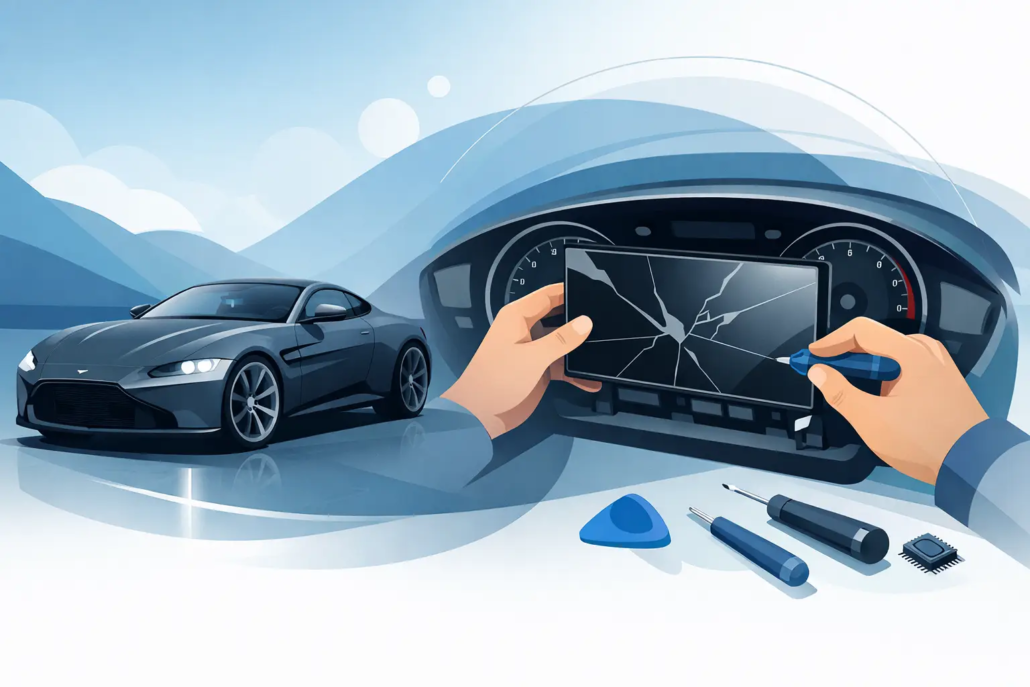
Aston Martin Vantage Display Repair
Aston Martin Vantage Display Repair: quick repair guidance
Aston Martin Vantage Display Repair covers a common dashboard and instrument cluster problem. Cartronix checks the symptoms, repairs the original electronics where possible, and tests the result before return.
First, note the fault clearly. Next, check when it appears. Then, book the repair with the vehicle details. This gives the workshop useful information before the unit arrives.
Quick checks before booking
- Record the vehicle make, model, and year.
- Write down the exact dashboard warning or display fault.
- Check whether the issue appears every time you start the vehicle.
- Note any dead gauges, dim screens, pixel loss, or flashing lights.
- Tell the team if another garage opened the unit.
- Take a photo of the fault if the display still works.
- Keep the original unit with the vehicle whenever possible.
- Pack the cluster securely before posting it.
- Include your name, phone number, return address, and fault notes.
- Use tracked postage for the repair parcel.
- Contact Cartronix first if the vehicle has water damage.
- Ask for advice if the fault only appears when the vehicle warms up.
How Cartronix handles the repair
Firstly, technicians inspect the unit and confirm the reported fault. Secondly, they repair the failed components and check the circuit carefully. Finally, they test the unit before it leaves the workshop.
This approach helps drivers avoid unnecessary dealer replacement costs. It also helps garages reduce downtime, protect the original mileage data, and give customers a clearer repair option.
When the screen in an Aston Martin Vantage starts fading, dropping pixels or going unreadable altogether, the problem is rarely just cosmetic. An Aston Martin Vantage display repair is often the difference between a dashboard you can trust and one that leaves you second-guessing basic vehicle information every time you drive.
On a car like the Vantage, owners quite rightly expect everything in the cabin to work properly. A dim display, missing characters or a blank section in the instrument cluster quickly takes the shine off the car. More importantly, it can make warning messages, trip data and vehicle information difficult or impossible to read. For garages, it creates the same frustration – a customer presents with a clear dashboard fault, but a dealer replacement can be expensive, slow and unnecessary.
Common Aston Martin Vantage display faults
The most common issues tend to be pixel loss, dim or dark screens, intermittent display operation and complete display failure. Sometimes the screen starts off working when the car is cold, then fades as the unit warms up. In other cases, parts of the information panel disappear, certain lines of text become unreadable, or the backlighting weakens to the point where the display can barely be seen.
These faults are usually linked to internal electronic failure within the cluster or display assembly rather than anything the driver has done wrong. Age, heat cycling and component degradation all play a part. On prestige vehicles, this can be particularly frustrating because the rest of the cluster may still appear to function, which leads some owners to put up with the fault longer than they should.
That is rarely the best approach. Display problems often worsen over time, and once the screen becomes unreadable, even routine checks become awkward. If there are warning messages present, that loss of visibility matters.
Why replacement is not always the right answer
Dealer-level replacement can sound like the obvious route, but it often comes with drawbacks that owners and workshops would prefer to avoid. Cost is usually the first one. Replacing a complete instrument cluster to solve a display fault can be disproportionately expensive when the real issue is confined to a repairable section of the original unit.
Then there is coding, mileage and vehicle configuration. On many modern instrument clusters, these are not simple plug-and-play parts. Swapping the unit can introduce extra programming steps, compatibility concerns and avoidable delays. Keeping the original cluster and repairing it instead is often the cleaner solution.
That matters on an Aston Martin. Preserving the original unit helps maintain the car’s existing coding and mileage data, while avoiding the complications that can come with sourcing and configuring replacement parts. It is also generally the faster option when handled by a specialist with the right test equipment.
What a proper Aston Martin Vantage display repair involves
A proper repair starts with diagnosis, not guesswork. A failed or unreadable display can point to several internal faults, and the right repair depends on identifying the actual cause. That may involve bench testing the unit, checking power and communication behaviour, and using specialist emulation equipment to confirm the fault path.
Once the issue has been verified, the faulty components within the cluster can be repaired rather than replacing the entire dashboard assembly. This is the key difference between specialist electronic repair and a simple parts-swap approach. The aim is to restore the original display operation while retaining the vehicle’s existing data and setup.
For owners, the practical benefit is straightforward. You get the original cluster back in working order without paying main dealer replacement costs for a fault that can often be repaired. For independent garages and workshops, it means having a specialist route for jobs that sit outside normal mechanical or diagnostic work.
Symptoms that should not be ignored
Some display faults are obvious from the start, but others begin subtly. You may notice the screen is harder to read in daylight, certain pixels vanish now and then, or the display only behaves properly for part of the journey. Intermittent issues can tempt people to wait, especially if the car is not in daily use.
That delay can be a mistake. Intermittent faults rarely fix themselves, and they often progress into full failure. If the display is tied to warning messages or essential driver information, the inconvenience soon becomes a practical problem.
Garages should also be cautious about assuming the fault lies elsewhere in the vehicle. While power supply and communication checks still matter, repeated display issues on the same cluster often point back to the unit itself. Sending it to a specialist repairer can save time compared with extended fault-finding that leads back to the dashboard in the end.
Repair or used replacement – what makes more sense?
A used replacement cluster may look cheaper on paper, but there are trade-offs. You do not always know its history, internal condition or whether the same display fault is waiting to happen. Even if the unit appears sound, matching it to the vehicle can involve coding complications, mileage discrepancies and extra labour.
Repairing the original cluster avoids most of that. The unit already belongs to the car, the coding is already there, and the aim is to restore what the vehicle had from the factory rather than introducing another unknown. In many cases, that is the more sensible long-term fix.
This is particularly relevant on specialist and prestige vehicles, where originality matters and electronic compatibility is not something to leave to chance. The lowest upfront price does not always produce the best outcome.
Turnaround matters when the car is off the road
Display faults are not just an annoyance. If the cluster is out for repair, the vehicle may be off the road, and that means turnaround time matters. Owners want the car back without a drawn-out parts search. Garages want a dependable repair partner that does not leave a bay tied up for longer than necessary.
That is why specialist repair services are built around speed as well as technical accuracy. Bench diagnosis, component-level repair and return of the original unit can often be handled much faster than ordering and programming a new replacement through dealer channels.
For UK customers, postal repair coverage is often the most practical route. Workshops and vehicle owners can send the unit in, have the fault diagnosed and repaired, then receive the same cluster back ready to refit. Where workshop attendance is possible, while-you-wait arrangements can also reduce downtime further.
What owners and trade customers should look for
Not every electronics repair service is equipped for instrument cluster work, and not every cluster specialist has experience across prestige marques. For Aston Martin Vantage display repair, the key things to look for are straightforward – accurate diagnosis, experience with cluster electronics, retention of original coding and mileage, a clear turnaround, and a proper warranty.
A warranty matters because it shows the repairer stands behind the work. It also gives confidence to trade customers who are fitting the repaired unit back into a customer’s vehicle. If the provider can test the unit properly outside the car and verify the fault before and after repair, that is a strong sign the process is built on technical capability rather than trial and error.
This is where a specialist such as Cartronix fits naturally. The value is not just in repairing the fault, but in doing it quickly, preserving originality and backing the repair with long-term reassurance.
When booking an Aston Martin Vantage display repair
Before sending the unit away, it helps to describe the symptoms clearly. Is the screen dim all the time, only when warm, missing pixels, flickering or completely blank? Has the fault changed over time? Has any other work been done on the vehicle recently? Good fault information helps speed up diagnosis.
For garages, it is also useful to note whether vehicle power, earth and network checks have already been carried out. That avoids duplication and helps the repair process start in the right place. For owners removing the cluster independently, careful packaging is essential. Instrument units are precision electronics, and physical transit damage is avoidable with proper packing.
If you are deciding whether to repair now or wait, the better option is usually to act while the cluster is still showing a repeatable fault rather than after complete failure. Early repair can prevent a minor display issue from becoming a larger interruption.
A failing Vantage display does not automatically mean a costly new cluster. In many cases, the smarter answer is to repair the original unit properly, keep the car’s data intact and get the dashboard working as it should – quickly, correctly and without unnecessary replacement.