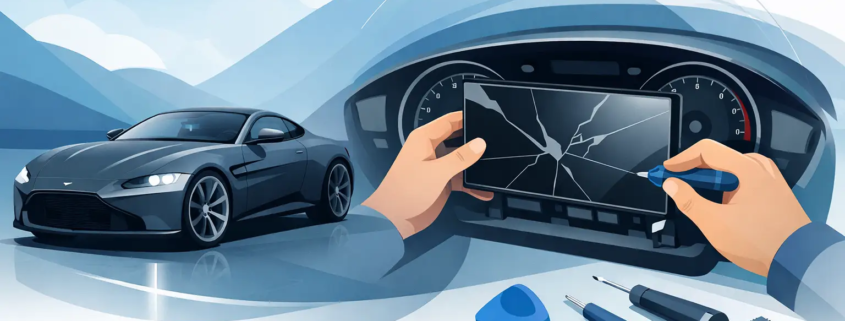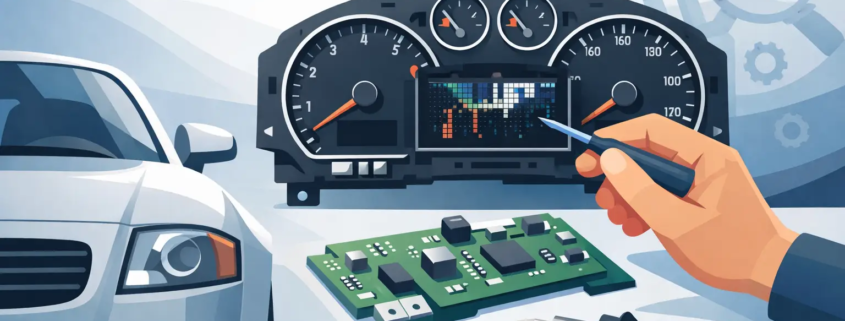
Vehicle-specific dashboard, LCD display and instrument cluster repair guides.

Audi A4 LCD display fault case study

Audi LCD Display Fault Case Study in an A4

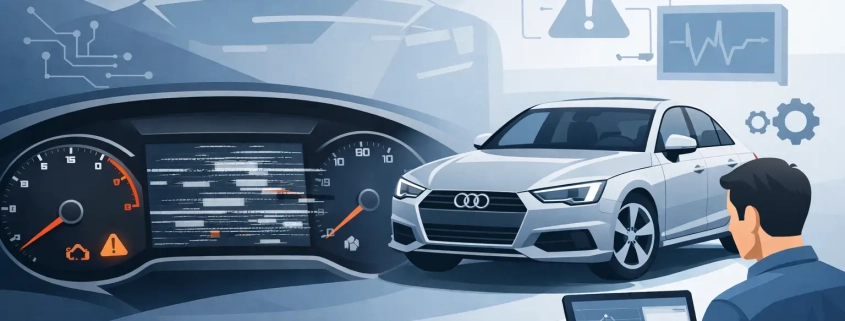
A dim centre screen can turn an otherwise good Audi dashboard into a daily frustration. In this Audi LCD display fault case study, we look at a typical A4 instrument cluster sent in after the driver could no longer reliably read the clock, outside temperature, trip information or warning messages.

The speedometer and rev counter still worked. The vehicle started and drove normally. That led the owner to assume the LCD itself was the only problem, but a proper cluster repair begins by checking whether the display is the failed part or simply the first visible symptom of a wider fault.

What an Audi LCD display fault looks like

The Audi arrived with a centre LCD that was weak when cold, improved slightly after the cabin had warmed up, then faded again. Several lines of information were missing and the backlight had an uneven, yellowed appearance. At night, warning messages could be seen only by looking directly at the display.

This is a common pattern on ageing instrument clusters. Heat cycles, vibration and component wear can affect the LCD panel, its connections, the illumination circuit or the cluster’s internal power supply. On some units, pixel loss is gradual. On others, the display appears to fail suddenly after becoming unreliable for weeks or months.

The important point is that replacing bulbs or increasing the dashboard dimmer setting will not cure an internal LCD fault. If the screen has lost sections, is bleeding, has poor contrast or only works intermittently, the fault needs to be addressed inside the original instrument cluster.

Why the original cluster mattered

The owner had been quoted for a replacement dashboard by a dealer. That route can be expensive, and a replacement cluster is not normally a simple fit-and-go part. It may require coding, adaptation and mileage handling before it works correctly with the vehicle.

The original Audi cluster contains vehicle-specific information. Depending on the model and specification, this can include mileage, immobiliser-related data, coding and stored configuration. Replacing the unit can add time, cost and unnecessary complications, particularly where the rest of the dashboard is functioning correctly.

Repairing the original unit keeps the vehicle’s own cluster in place. The aim is not to disguise the problem with a used part of unknown history. It is to restore the failed display circuit while retaining the original mileage and coding.

Audi LCD display fault case study: diagnosis before repair

Once removed, the cluster was tested on specialist equipment rather than being judged only by its appearance in the car. This matters because a poor display can occasionally be caused by an external issue, such as a voltage problem, water ingress or a communication fault elsewhere on the vehicle.

The cluster was powered and checked under controlled conditions. The LCD fault remained present, confirming that the issue was internal to the unit. The gauges, warning lamps, illumination control and communications were also assessed. In this case, the needles operated correctly and there was no evidence of a CAN communication failure, but the screen and its illumination circuit were clearly degraded.

A useful diagnosis separates faults that happen together from faults that merely happen at the same time. For example, a non-working speedometer alongside a dim display may point to more than one failed component. Equally, a dead cluster with no warning lights or gauges may need a different repair approach from a vehicle with an isolated centre-screen failure.

What the inspection ruled out

The cluster showed no signs of a burnt main power feed or liquid damage. There was also no indication that a previous repair had caused the problem. This narrowed the repair to the display assembly and related connections, rather than requiring a full cluster rebuild.

That distinction affects both turnaround and cost. There is little value in replacing parts that test correctly. A specialist repair should address the confirmed fault, then fully test the unit before it is returned.

The repair process

The instrument cluster was carefully opened to access the internal display section. Dashboard electronics are not well suited to improvised repair attempts. The casing, needles, dial faces, ribbon connections and circuit board all need to be handled correctly. A damaged needle mechanism or incorrectly refitted dial can create an additional fault that was not present before.

The failed LCD assembly was replaced with a suitable high-quality part, and the associated display connections were inspected and renewed where required. The illumination was also checked to ensure the repaired screen would be readable in normal daylight and at night.

After reassembly, the cluster was tested again using an emulator. The display was checked across its full information area, including warning-message sections and normal trip display functions. Gauges, warning lamps and illumination behaviour were tested at the same time.

This final stage is where a repair earns its value. A screen that lights up on the bench is not necessarily a finished repair. It needs to show clear information consistently, respond correctly to dimming and operate alongside the rest of the dashboard functions.

The result after refitting

Once refitted to the Audi, the original cluster displayed clear, even information immediately. The owner could again read the temperature, clock, trip data and warning messages without straining to see the screen. There was no need for replacement-cluster coding, mileage correction or a return visit to resolve compatibility issues.

For the owner, the practical benefit was straightforward: the car was back in use quickly, with its original dashboard retained. For a garage, this type of repair avoids tying up a ramp while waiting for a dealer-supplied unit and then arranging programming work.

A successful LCD repair should look unremarkable once complete. The driver should simply have a clear, reliable display again, with no new warning lights, no altered mileage and no concern over whether the replacement part will communicate properly with the vehicle.

When an Audi LCD fault may be something else

Not every unreadable Audi display has the same cause. A screen that is completely blank, for example, may be linked to a cluster power fault rather than the LCD panel itself. If the dashboard resets while driving, the needles drop and warning lights flash, testing may identify a supply or circuit-board issue.

Likewise, a display problem accompanied by water ingress, corrosion or multiple electrical faults needs a wider assessment. Water can damage tracks and components beyond the LCD area. In those cases, the repair depends on the condition of the board and whether the damage is limited or extensive.

There are also cases where the screen appears faulty but the real issue is poor vehicle voltage. A weak battery, charging fault or poor connection can cause unusual dashboard behaviour. If the cluster works perfectly when bench tested, vehicle-side checks should be carried out before any internal repair is approved.

What to do if your Audi display is fading

If the LCD is becoming dim, losing pixels or showing incomplete information, it is worth dealing with it before the display becomes unreadable. Warning messages and low-fuel information are easier to miss when the screen is failing, and intermittent faults tend to become more frequent rather than resolving themselves.

Avoid pushing hard on the screen, dismantling the cluster without the correct tools or fitting a second-hand dashboard as a quick fix. Those options can create extra damage or leave you with an incompatible unit. A clear description of the fault, the vehicle model and year, and whether the gauges and warning lights still work will help establish the likely repair required.

Cartronix repairs original Audi instrument clusters with specialist testing, fast turnaround options and a lifetime warranty for as long as you own the vehicle. When an Audi LCD display fault is the only problem, repairing the original unit is usually the sensible next step.
Ford Focus Dashboard Repair Example

Ford Focus Dashboard Repair Example

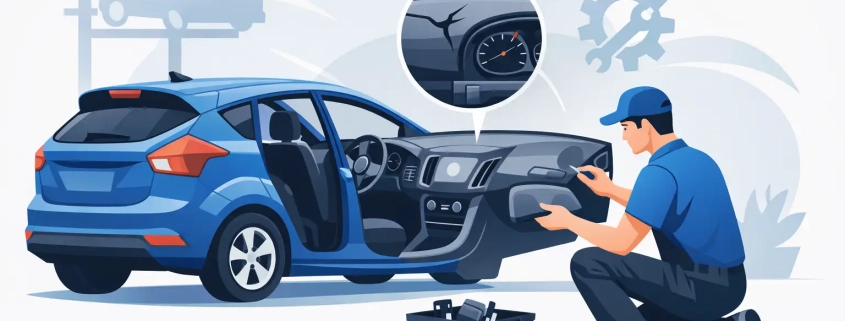
A Ford Focus dashboard can fail in ways that look far worse than they are. If you are searching for a Ford Focus dashboard repair example, the usual pattern is familiar – dead gauges, warning lights behaving oddly, a blank or dim display, or an intermittent cluster that comes back to life after a bump in the road. In many cases, the fault sits within the instrument cluster itself, which means repair is often the sensible route rather than replacing the whole unit.

For Focus owners and garages alike, the key question is not just what has stopped working. It is whether the original dashboard can be repaired quickly, without dealer-level replacement costs, and without creating extra issues around mileage, coding or vehicle downtime. On this type of job, the answer is often yes.

A typical Ford Focus dashboard repair example

A common Ford Focus case starts with intermittent failure. The customer may report that the speedometer drops to zero, the rev counter sticks, the warning lights flicker, or the LCD display becomes unreadable. Sometimes the dashboard powers up normally on a cold start, then fails once the car has warmed through. In other cases, the entire cluster goes dead without warning.

On the vehicle side, these symptoms can easily be mistaken for a battery problem, a wiring issue or a wider electrical fault. That is why proper diagnosis matters. A failed dashboard is not always completely dead, and partial function can send garages in the wrong direction if the cluster is not tested properly.

In a typical repair example, the unit is removed from the vehicle and assessed on the bench using specialist test equipment and emulators. This allows the fault to be reproduced outside the car and helps separate a genuine instrument cluster fault from a vehicle-side issue. Once confirmed, the repair usually involves addressing failed internal components, poor solder joints, power supply faults or display-related failures, depending on the version of Focus cluster involved.

The important part is that the original unit is retained. That means the dashboard already matched to the vehicle can usually be repaired and returned, rather than replaced with a second-hand or new unit that then raises coding and compatibility questions.

Common Focus dashboard faults we see

A Ford Focus instrument cluster can fail in several different ways, and the exact fault often depends on age, model year and cluster design. Some units suffer from complete power loss. Others develop gauge faults where one or more needles stop responding properly. Display issues are also common, especially where the screen dims, loses segments or becomes unreadable in normal daylight.

Warning light faults are another regular issue. A customer may report that certain tell-tales no longer illuminate, while others stay on when they should not. In some cases the cluster works intermittently, which is often the most frustrating fault because it can disappear during basic checks and return later.

Communication problems can also be tied to the dashboard. If the cluster is not processing or displaying information correctly, the vehicle may appear to have more than one electrical issue at once. This is where experience with these units makes a real difference. Replacing parts based on guesswork tends to get expensive quickly.

Why these faults are often repairable

Most Focus dashboard failures come down to known electronic faults within the unit rather than physical damage that makes repair impossible. Age, heat cycles, vibration and component wear can all take their toll over time. The good news is that this kind of failure is usually exactly what specialist repair is designed for.

Repairing the existing cluster keeps the original electronics architecture in place. That matters because replacement clusters can create new problems, especially where immobiliser pairing, mileage discrepancies or variant coding come into play. A repair approach is often faster, cleaner and more cost-effective.

Repair or replacement – what makes more sense?

For many owners, dealer replacement sounds like the safe option until the price comes through. A new cluster can be costly, and that is before coding, setup and potential delays for parts availability are added. On older Focus models, a brand-new unit may not even be the most practical answer.

A used replacement can look cheaper on paper, but it comes with risks. You do not always know the history of the donor unit, whether the internal fault is already developing, or whether it will code correctly to the vehicle. Mileage and configuration issues can turn a simple-looking swap into a longer job.

Repairing the original dashboard is often the better choice because it preserves what is already matched to the car. Mileage and coding remain with the original unit, and the fault is addressed at source. For trade customers, that also means fewer unknowns and a more predictable result.

When replacement may still be needed

There are cases where repair is not the right route. Severe liquid damage, burnt tracks beyond viable recovery, major casing destruction or previous poor-quality tampering can all change the picture. The point is not to claim every cluster is repairable regardless of condition. It depends on the fault, the extent of damage and whether the unit has already been compromised.

That said, many dashboards that have been written off elsewhere can still be repaired once properly tested by a specialist.

What the repair process usually looks like

With a Ford Focus dashboard repair example, the process should be straightforward. First, the cluster fault is identified based on the symptoms and, where needed, tested to confirm that the dashboard is the actual cause. Once the unit is removed, it can be bench tested under controlled conditions.

After diagnosis, the repair is carried out on the original cluster. That may involve component-level work, rectifying known weak points, restoring display function or resolving intermittent operation. The repaired unit is then retested to make sure gauges, warning lights, display functions and communication behave as they should.

For customers, speed matters almost as much as accuracy. This is why specialist dashboard repair services are built around same-day or next-working-day turnaround wherever possible. For a daily driver or a workshop with a ramp tied up, that reduced downtime makes a real difference.

Why proper testing matters on a Focus cluster

One of the biggest mistakes with dashboard faults is assuming the cluster is at fault without proving it, or assuming it is not at fault because it works briefly during inspection. Intermittent electrical issues can waste hours if they are not approached methodically.

Bench testing with the right equipment allows the dashboard to be checked in a way that is difficult to achieve in the vehicle alone. This is particularly useful where the problem only appears under certain conditions or where multiple symptoms overlap. It also helps garages avoid unnecessary replacement of batteries, alternators, control modules or wiring sections when the real issue sits inside the cluster.

For trade customers, that confidence is essential. You need to know the unit you are refitting has been properly tested and the original fault has been dealt with, not just temporarily masked.

A practical Ford Focus dashboard repair example for owners and garages

Take a Focus with an intermittent blank dashboard, non-working speedometer and warning lamps flickering at random. The owner may have already replaced the battery and checked fuses, with no lasting fix. A garage may even suspect a body control issue because the symptoms appear inconsistent.

Once the cluster is removed and bench tested, the fault is traced to the dashboard itself. Internal electronic failure is causing unstable operation across multiple functions. The original unit is repaired, tested again, and returned ready to refit. The vehicle regains normal gauge operation, stable warning light behaviour and a readable display, without needing a dealer-supplied replacement cluster.

That is the value of specialist repair in real terms. It is not just about saving money, though that matters. It is about getting to the actual fault quickly and putting the original part back into reliable service.

What to look for from a repair service

If you are booking this type of work, look for a service that understands instrument clusters specifically rather than general auto electrics alone. The difference shows up in diagnosis, turnaround and confidence with model-specific faults. You also want clear pricing, proper testing and a warranty that reflects the quality of the repair.

For a Ford Focus dashboard issue, retaining the original unit should be a priority wherever possible. That keeps things simpler and usually avoids the headaches that come with replacement coding. A service such as Cartronix is built around that exact approach – repair the original cluster, keep downtime low and return a tested unit with lifetime warranty cover tied to vehicle ownership.

For owners, the main benefit is getting the car back on the road without paying dealer replacement costs. For garages, it is having a dependable specialist option when a cluster fault falls outside normal workshop repair.

If your Focus dashboard is failing, the best next step is not guesswork. It is proper diagnosis followed by repair of the original unit where viable. That usually gives the quickest route back to a working dashboard, with less cost and fewer complications than replacement.

Alfa Romeo 166 Lcd Pixel Repair guide image

Alfa Romeo 166 LCD Pixel Repair

Alfa Romeo 166 Lcd Pixel Repair: quick repair guidance

Alfa Romeo 166 LCD Pixel Repair covers a common dashboard and instrument cluster problem. Cartronix checks the symptoms, repairs the original electronics where possible, and tests the result before return.

First, note the fault clearly. Next, check when it appears. Then, book the repair with the vehicle details. This gives the workshop useful information before the unit arrives.

Quick checks before booking

  • Record the vehicle make, model, and year.
  • Write down the exact dashboard warning or display fault.
  • Check whether the issue appears every time you start the vehicle.
  • Note any dead gauges, dim screens, pixel loss, or flashing lights.
  • Tell the team if another garage opened the unit.
  • Take a photo of the fault if the display still works.
  • Keep the original unit with the vehicle whenever possible.
  • Pack the cluster securely before posting it.
  • Include your name, phone number, return address, and fault notes.
  • Use tracked postage for the repair parcel.
  • Contact Cartronix first if the vehicle has water damage.
  • Ask for advice if the fault only appears when the vehicle warms up.

How Cartronix handles the repair

Firstly, technicians inspect the unit and confirm the reported fault. Secondly, they repair the failed components and check the circuit carefully. Finally, they test the unit before it leaves the workshop.

This approach helps drivers avoid unnecessary dealer replacement costs. It also helps garages reduce downtime, protect the original mileage data, and give customers a clearer repair option.

When the centre display in an Alfa Romeo 166 starts dropping characters, fading in hot weather or becoming unreadable at night, it is rarely the whole dashboard at fault. In most cases, alfa romeo 166 lcd pixel repair is the sensible answer – not a full replacement unit, not a coding headache, and not main dealer pricing for parts that may now be difficult to source.

Pixel failure on the 166 happens often as these units age. It usually starts as a few missing lines or broken characters on the LCD, then gradually becomes a display you can no longer trust. Time, temperature cycles and deterioration within the display connection all play a part. The result is simple enough: information that should be clear at a glance becomes patchy, dim or impossible to read.

What usually goes wrong on the Alfa Romeo 166 LCD display

Drivers normally see missing pixels, faded sections, weak contrast or text that appears complete one moment and broken the next. Some owners first notice it in warmer weather, while others find the display is poor all the time. Either way, the problem tends to worsen rather than settle down.

On the Alfa Romeo 166, the LCD assembly and its internal connections are vulnerable to age and heat. That means the issue is often within the display itself rather than elsewhere in the vehicle. The fault can look like a power problem or a wider instrument issue, but in many cases the underlying fault stays local and repairable.

That distinction matters. A proper display repair avoids original unit replacement, extra cost, unnecessary parts swapping and compatibility concerns.

Why replacement is often the wrong route

With older vehicles such as the 166, replacement is not always straightforward. A used unit may come with its own faults, including the same pixel loss that develops over time. A new unit, when available, often costs far more than the required repair.

There is also the practical side. Replacing electronic dashboard components can create avoidable complications around coding, configuration and originality. For many owners and workshops, keeping the original unit is the cleaner solution. The vehicle keeps its mileage, the original electronics stay in place, and the repair tackles the fault directly rather than working around it.

That is why alfa romeo 166 lcd pixel repair is usually the better option when the rest of the unit is functioning correctly. It is faster, more economical and far more predictable than chasing replacement parts for a model that is no longer current.

How should a proper Alfa Romeo 166 LCD pixel repair work?

A correct repair starts with confirmation of the fault. Missing pixels happen often, but a specialist still needs to check whether the display failure sits alone or points to a broader issue within the cluster or associated circuitry. Guesswork wastes time. Accurate diagnosis shortens downtime and avoids replacing parts that are not actually faulty.

Once confirmed, the repair should focus on the failed display components and their connections using the correct process for the unit. This is not the same as a temporary fix or an improvised attempt to press, heat or clamp the display back into life. Those shortcuts may produce a brief improvement, but they do not address the underlying deterioration and often lead to repeat failure.

A specialist repair keeps the original unit intact while restoring legibility to the LCD. For owners, that means the car remains original. For garages and technicians, it means a cleaner handover back to the customer with no unnecessary programming or adaptation work.

Common symptoms that point to pixel repair

In real terms, most customers contact a specialist when the display has become difficult to rely on rather than completely dead. The warning signs are usually obvious. Characters break up across the screen, sections disappear, numbers become hard to distinguish, or the display only looks readable from certain angles or at certain temperatures.

Some drivers also report that the problem is worse after the cabin has heated up, while others notice poor visibility during night driving when the display illumination should be at its clearest. If the unit still powers up but the information is incomplete or distorted, pixel repair is the first thing worth considering.

If the entire display is blank, it may still be repairable, but that can move the job beyond a straightforward pixel fault. In that situation, proper testing becomes even more important because the issue may involve power supply faults, internal component failure or communication problems elsewhere in the unit.

Why specialist testing matters

An Alfa Romeo 166 is not the vehicle for trial-and-error electronics work. By the time these cars develop display faults, they often need careful handling and accurate bench testing to separate one issue from another. A workshop that specialises in instrument and display repairs can test the unit properly, often using dedicated equipment and emulators to confirm operation outside the vehicle.

That matters to both private owners and trade customers. If you are a driver, you want the fault identified quickly and fixed once. If you are a garage, you need confidence that the display fault will not turn into an open-ended electrical investigation that ties up workshop time.

A proper diagnostic approach reduces that risk. It also gives a clearer answer on whether the job is a display repair, a wider cluster repair, or something outside the unit entirely.

Postal repair or while-you-wait

For many owners, convenience is as important as the repair itself. Postal service works well when the customer can remove the unit and send it securely for testing and repair, especially from outside the local area. It gives nationwide coverage without the need to source a second-hand replacement or leave the job unresolved.

For local customers and trade accounts, a workshop appointment may be the quicker route. Reduced downtime gives customers the main advantage. The specialist assesses, repairs and returns the unit without the delay that comes with ordering parts or sending the car through a dealer network.

That explains why motorists and trade customers use specialists such as Cartronix. The specialist treats the job as a repair service, not a parts sale, which usually means faster turnaround and lower overall cost.

What owners and garages want from the repair

The expectations are usually the same whether the booking comes from a private customer or a workshop. The display needs to be readable again, the original unit needs to stay with the car, and the repair needs to be dependable. Nobody wants a temporary improvement that fails a few weeks later.

Speed also matters. If the Alfa Romeo 166 is still in regular use, the owner wants minimal disruption. If the car is with a garage, the workshop wants the vehicle turned around quickly without tying up a bay waiting for a replacement part that may never arrive.

That is why a specialist repair service with fast turnaround and a clear warranty is the practical route. It removes uncertainty and gives the customer a straightforward answer to a very common fault.

Is repair always possible?

Usually, pixel loss on the Alfa Romeo 166 is repairable, but it depends on the condition of the unit. Previous failed repair work, physical damage, corrosion or wider circuit board faults can change the scope of the job. In some cases, the display issue is only one part of a larger cluster problem.

That does not automatically require replacement. It simply means a specialist needs to assess the unit properly before confirming the final repair path. A good specialist will say so clearly rather than promise a standard fix for every fault.

For most typical cases of missing or faded pixels, though, repair remains the most sensible option. It preserves the original electronics, avoids dealer replacement costs and gets the display working as intended without unnecessary complication.

The practical next step for Alfa Romeo 166 LCD pixel repair

If your Alfa Romeo 166 display is losing pixels, fading or becoming unreadable, leaving it alone rarely helps. The fault normally gets worse with time, and an early repair makes the display usable again without the expense of replacing the unit.

For owners, that means restoring a dashboard you can actually read. For garages, the service resolves a known fault through a specialist instead of wasting time on parts or repairs outside normal workshop scope. In both cases, the best result usually comes from repairing the original unit properly, quickly and with warranty cover behind it.

A clear display should not make Alfa Romeo 166 ownership difficult, and the right team can handle the fault properly.

Fiat Ducato Instrument Cluster Repair guide image

Fiat Ducato Instrument Cluster Repair

Fiat Ducato Instrument Cluster Repair: quick repair guidance

Fiat Ducato Instrument Cluster Repair covers a common dashboard and instrument cluster problem. Cartronix checks the symptoms, repairs the original electronics where possible, and tests the result before return.

First, note the fault clearly. Next, check when it appears. Then, book the repair with the vehicle details. This gives the workshop useful information before the unit arrives.

Quick checks before booking

  • Record the vehicle make, model, and year.
  • Write down the exact dashboard warning or display fault.
  • Check whether the issue appears every time you start the vehicle.
  • Note any dead gauges, dim screens, pixel loss, or flashing lights.
  • Tell the team if another garage opened the unit.
  • Take a photo of the fault if the display still works.
  • Keep the original unit with the vehicle whenever possible.
  • Pack the cluster securely before posting it.
  • Include your name, phone number, return address, and fault notes.
  • Use tracked postage for the repair parcel.
  • Contact Cartronix first if the vehicle has water damage.
  • Ask for advice if the fault only appears when the vehicle warms up.

How Cartronix handles the repair

Firstly, technicians inspect the unit and confirm the reported fault. Secondly, they repair the failed components and check the circuit carefully. Finally, they test the unit before it leaves the workshop.

This approach helps drivers avoid unnecessary dealer replacement costs. It also helps garages reduce downtime, protect the original mileage data, and give customers a clearer repair option.

When a Fiat Ducato dashboard starts misbehaving, the problem is rarely just an annoyance. A flickering display, dead gauges or warning lights that do not illuminate properly can leave you without clear vehicle information when you need it most. That is why fiat ducato instrument cluster repair is usually a better route than replacing the whole unit – especially when speed, cost and keeping the vehicle original all matter.

For van owners, motorhome owners and garages, the instrument cluster is not a cosmetic part. It is a core electronic module that communicates key information every time the vehicle is on the road. If it begins to fail, the vehicle may still run, but confidence in it quickly drops. In many cases, the fault sits within the cluster itself rather than elsewhere on the vehicle, and proper bench testing is the only reliable way to confirm it.

Common Fiat Ducato instrument cluster repair faults

Fiat Ducato clusters can suffer from a range of internal electronic failures. Some faults are obvious from the first turn of the key. Others start intermittently and worsen over time. The most common symptoms include a blank or dim display, pixel loss, non-working speedometer or rev counter, warning lights failing to illuminate, gauges reading incorrectly, or a complete dead cluster.

Intermittent faults are particularly common. A dashboard may work when cold, then fail once the van warms up. In other cases, tapping the top of the dash appears to bring the cluster back to life for a short time. That usually points to internal solder, component or circuit board issues rather than a vehicle wiring fault.

For trade customers, this matters because replacing sensors, batteries or wiring without proper confirmation can waste time and money. If the cluster is the root cause, the quickest route is to have the original unit tested and repaired by a specialist who deals with these faults every day.

Why repair is often better than replacement

Main dealer replacement can be expensive, and it is rarely the quickest option. On a working van, a delivery vehicle or a motorhome booked for a trip, downtime costs more than the part itself. A new cluster may also require coding, programming and setup that adds delay and complexity.

A proper Fiat Ducato instrument cluster repair keeps the original unit with the vehicle. That means the existing coding and mileage data remain with the cluster rather than introducing avoidable replacement issues. It is also usually far more economical than fitting a brand-new unit.

There is a practical point here as well. Original equipment is often worth keeping where possible. If the casing, connectors and configuration already match the vehicle, repairing the internal fault is the cleanest solution. You are fixing the failure, not creating a second job around adaptation.

What causes Fiat Ducato cluster failure?

Most instrument cluster faults are caused by age, heat, vibration and electronic component failure. Vans and motorhomes work hard, and the dashboard electronics are exposed to years of daily use. Repeated heat cycles inside the cabin can weaken solder joints and stress components on the circuit board. Over time, that leads to intermittent operation, display issues or complete failure.

Voltage-related problems can also play a part. A weak battery or charging issue may trigger symptoms, but that does not always mean the battery is the true cause. Sometimes an existing internal weakness in the cluster only becomes obvious when voltage conditions change. That is why proper testing matters – it separates a vehicle-side issue from a cluster-side failure.

On motorhome-based Ducato vehicles, long storage periods can add another layer. Vehicles left standing for extended periods may show faults after battery drain, voltage fluctuations or damp-related issues. Again, it depends on the exact symptom. A specialist diagnosis is the difference between guessing and knowing.

How specialist testing saves time

A cluster should not be repaired on assumption alone. The right process starts with confirming the fault. Bench testing with specialist equipment and emulators allows the unit to be checked outside the vehicle, so gauge movement, warning light operation, display output and internal communication can all be assessed accurately.

This is where general electrical diagnosis and specialist electronics repair part company. A workshop may identify that the dash is faulty, but the actual repair requires electronic fault tracing at component level. Once the failed area is identified, the repair can be carried out to the original unit and retested before return.

For garages, that means less comeback risk. For private owners, it means paying for the fault that exists rather than replacing a complete dashboard assembly unnecessarily.

Fiat Ducato instrument cluster repair for vans and motorhomes

The Fiat Ducato is used in more than one way, so the impact of cluster failure varies. For a tradesperson, a dead speedometer or failed warning display can stop a working day before it starts. A courier or fleet operator feels the direct cost of vehicle downtime. Motorhome owners often see the issue right before a trip, when reliability matters most.

The repair approach is the same, but urgency can differ. A postal repair service suits owners and garages across the UK who need national coverage without travelling. A while-you-wait appointment may suit those who want the vehicle dealt with quickly and locally. In both cases, the aim is straightforward – get the original cluster repaired, tested and back in service with minimal delay.

What to expect from the repair process

In most cases, the process begins with removal of the instrument cluster from the vehicle. Once received, the unit is tested to confirm the reported fault and to check for any related internal issues. The repair is then carried out to the affected electronic areas, followed by post-repair testing to make sure the cluster performs correctly.

Turnaround matters. There is little value in a technically sound repair if the vehicle is off the road for a week longer than necessary. That is why same-day or next-working-day service is often the deciding factor for both private and trade customers.

It is also worth asking what happens to the original data. A proper repair to the customer’s own unit preserves the vehicle’s existing mileage and coding. That is a major advantage over replacement and one of the main reasons specialist repair is so often the preferred option.

When it is not just the cluster

Not every dashboard symptom is caused by the cluster itself. Wiring faults, poor power supply, CAN communication problems or battery and charging issues can produce similar behaviour. The key is not to assume either way.

If the cluster has been tested and passes, that points attention back to the vehicle. If the cluster fails under bench test, you have a clear answer. Good diagnosis prevents parts darts and gives garages a dependable route forward when a fault falls outside routine mechanical work.

That balance matters. The right specialist will not tell you every fault is a cluster fault. They will test it, confirm it and repair it only when the evidence supports it.

Choosing a Fiat Ducato instrument cluster repair specialist

This is not a job for a general electronics bench or a used-parts seller. You need a repairer with experience in automotive dashboards, proper test equipment and a process built around fast turnaround. The details matter – retained originality, no dealer replacement costs, clear pricing, reliable communication and a warranty that gives you confidence after the unit goes back in.

Cartronix is set up around exactly that kind of work, with specialist instrument cluster testing and repair, national postal coverage, workshop support and a lifetime warranty tied to vehicle ownership. For Fiat Ducato owners and trade customers alike, that means a direct route to fixing the fault without unnecessary replacement cost.

There is also peace of mind in knowing the unit has been repaired by people who understand the failure pattern. That shortens diagnosis, improves reliability and reduces the chance of the same problem being sent round in circles between owner, garage and dealer.

Cost, downtime and the value of doing it properly

Cheap used clusters can look tempting, but they often create more problems than they solve. Compatibility can be unclear, coding may not match, and the replacement part may already have the same age-related weakness as the unit you removed. What looks cheaper on day one can become more expensive once fitting time, programming and repeat faults are added up.

A tested repair to the original cluster is usually the more sensible option. It keeps the vehicle correct, reduces downtime and avoids the uncertainty that comes with second-hand parts. For busy vans and valuable motorhomes, that is the difference between a quick fix and a proper one.

If your Ducato dash has started failing, the best next step is simple – get the original unit properly assessed before spending money on replacement parts that may not be needed.

Aston Martin Vantage Display Repair guide image

Aston Martin Vantage Display Repair

Aston Martin Vantage Display Repair: quick repair guidance

Aston Martin Vantage Display Repair covers a common dashboard and instrument cluster problem. Cartronix checks the symptoms, repairs the original electronics where possible, and tests the result before return.

First, note the fault clearly. Next, check when it appears. Then, book the repair with the vehicle details. This gives the workshop useful information before the unit arrives.

Quick checks before booking

  • Record the vehicle make, model, and year.
  • Write down the exact dashboard warning or display fault.
  • Check whether the issue appears every time you start the vehicle.
  • Note any dead gauges, dim screens, pixel loss, or flashing lights.
  • Tell the team if another garage opened the unit.
  • Take a photo of the fault if the display still works.
  • Keep the original unit with the vehicle whenever possible.
  • Pack the cluster securely before posting it.
  • Include your name, phone number, return address, and fault notes.
  • Use tracked postage for the repair parcel.
  • Contact Cartronix first if the vehicle has water damage.
  • Ask for advice if the fault only appears when the vehicle warms up.

How Cartronix handles the repair

Firstly, technicians inspect the unit and confirm the reported fault. Secondly, they repair the failed components and check the circuit carefully. Finally, they test the unit before it leaves the workshop.

This approach helps drivers avoid unnecessary dealer replacement costs. It also helps garages reduce downtime, protect the original mileage data, and give customers a clearer repair option.

When the screen in an Aston Martin Vantage starts fading, dropping pixels or going unreadable altogether, the problem is rarely just cosmetic. An Aston Martin Vantage display repair is often the difference between a dashboard you can trust and one that leaves you second-guessing basic vehicle information every time you drive.

On a car like the Vantage, owners quite rightly expect everything in the cabin to work properly. A dim display, missing characters or a blank section in the instrument cluster quickly takes the shine off the car. More importantly, it can make warning messages, trip data and vehicle information difficult or impossible to read. For garages, it creates the same frustration – a customer presents with a clear dashboard fault, but a dealer replacement can be expensive, slow and unnecessary.

Common Aston Martin Vantage display faults

The most common issues tend to be pixel loss, dim or dark screens, intermittent display operation and complete display failure. Sometimes the screen starts off working when the car is cold, then fades as the unit warms up. In other cases, parts of the information panel disappear, certain lines of text become unreadable, or the backlighting weakens to the point where the display can barely be seen.

These faults are usually linked to internal electronic failure within the cluster or display assembly rather than anything the driver has done wrong. Age, heat cycling and component degradation all play a part. On prestige vehicles, this can be particularly frustrating because the rest of the cluster may still appear to function, which leads some owners to put up with the fault longer than they should.

That is rarely the best approach. Display problems often worsen over time, and once the screen becomes unreadable, even routine checks become awkward. If there are warning messages present, that loss of visibility matters.

Why replacement is not always the right answer

Dealer-level replacement can sound like the obvious route, but it often comes with drawbacks that owners and workshops would prefer to avoid. Cost is usually the first one. Replacing a complete instrument cluster to solve a display fault can be disproportionately expensive when the real issue is confined to a repairable section of the original unit.

Then there is coding, mileage and vehicle configuration. On many modern instrument clusters, these are not simple plug-and-play parts. Swapping the unit can introduce extra programming steps, compatibility concerns and avoidable delays. Keeping the original cluster and repairing it instead is often the cleaner solution.

That matters on an Aston Martin. Preserving the original unit helps maintain the car’s existing coding and mileage data, while avoiding the complications that can come with sourcing and configuring replacement parts. It is also generally the faster option when handled by a specialist with the right test equipment.

What a proper Aston Martin Vantage display repair involves

A proper repair starts with diagnosis, not guesswork. A failed or unreadable display can point to several internal faults, and the right repair depends on identifying the actual cause. That may involve bench testing the unit, checking power and communication behaviour, and using specialist emulation equipment to confirm the fault path.

Once the issue has been verified, the faulty components within the cluster can be repaired rather than replacing the entire dashboard assembly. This is the key difference between specialist electronic repair and a simple parts-swap approach. The aim is to restore the original display operation while retaining the vehicle’s existing data and setup.

For owners, the practical benefit is straightforward. You get the original cluster back in working order without paying main dealer replacement costs for a fault that can often be repaired. For independent garages and workshops, it means having a specialist route for jobs that sit outside normal mechanical or diagnostic work.

Symptoms that should not be ignored

Some display faults are obvious from the start, but others begin subtly. You may notice the screen is harder to read in daylight, certain pixels vanish now and then, or the display only behaves properly for part of the journey. Intermittent issues can tempt people to wait, especially if the car is not in daily use.

That delay can be a mistake. Intermittent faults rarely fix themselves, and they often progress into full failure. If the display is tied to warning messages or essential driver information, the inconvenience soon becomes a practical problem.

Garages should also be cautious about assuming the fault lies elsewhere in the vehicle. While power supply and communication checks still matter, repeated display issues on the same cluster often point back to the unit itself. Sending it to a specialist repairer can save time compared with extended fault-finding that leads back to the dashboard in the end.

Repair or used replacement – what makes more sense?

A used replacement cluster may look cheaper on paper, but there are trade-offs. You do not always know its history, internal condition or whether the same display fault is waiting to happen. Even if the unit appears sound, matching it to the vehicle can involve coding complications, mileage discrepancies and extra labour.

Repairing the original cluster avoids most of that. The unit already belongs to the car, the coding is already there, and the aim is to restore what the vehicle had from the factory rather than introducing another unknown. In many cases, that is the more sensible long-term fix.

This is particularly relevant on specialist and prestige vehicles, where originality matters and electronic compatibility is not something to leave to chance. The lowest upfront price does not always produce the best outcome.

Turnaround matters when the car is off the road

Display faults are not just an annoyance. If the cluster is out for repair, the vehicle may be off the road, and that means turnaround time matters. Owners want the car back without a drawn-out parts search. Garages want a dependable repair partner that does not leave a bay tied up for longer than necessary.

That is why specialist repair services are built around speed as well as technical accuracy. Bench diagnosis, component-level repair and return of the original unit can often be handled much faster than ordering and programming a new replacement through dealer channels.

For UK customers, postal repair coverage is often the most practical route. Workshops and vehicle owners can send the unit in, have the fault diagnosed and repaired, then receive the same cluster back ready to refit. Where workshop attendance is possible, while-you-wait arrangements can also reduce downtime further.

What owners and trade customers should look for

Not every electronics repair service is equipped for instrument cluster work, and not every cluster specialist has experience across prestige marques. For Aston Martin Vantage display repair, the key things to look for are straightforward – accurate diagnosis, experience with cluster electronics, retention of original coding and mileage, a clear turnaround, and a proper warranty.

A warranty matters because it shows the repairer stands behind the work. It also gives confidence to trade customers who are fitting the repaired unit back into a customer’s vehicle. If the provider can test the unit properly outside the car and verify the fault before and after repair, that is a strong sign the process is built on technical capability rather than trial and error.

This is where a specialist such as Cartronix fits naturally. The value is not just in repairing the fault, but in doing it quickly, preserving originality and backing the repair with long-term reassurance.

When booking an Aston Martin Vantage display repair

Before sending the unit away, it helps to describe the symptoms clearly. Is the screen dim all the time, only when warm, missing pixels, flickering or completely blank? Has the fault changed over time? Has any other work been done on the vehicle recently? Good fault information helps speed up diagnosis.

For garages, it is also useful to note whether vehicle power, earth and network checks have already been carried out. That avoids duplication and helps the repair process start in the right place. For owners removing the cluster independently, careful packaging is essential. Instrument units are precision electronics, and physical transit damage is avoidable with proper packing.

If you are deciding whether to repair now or wait, the better option is usually to act while the cluster is still showing a repeatable fault rather than after complete failure. Early repair can prevent a minor display issue from becoming a larger interruption.

A failing Vantage display does not automatically mean a costly new cluster. In many cases, the smarter answer is to repair the original unit properly, keep the car’s data intact and get the dashboard working as it should – quickly, correctly and without unnecessary replacement.

Audi Tt Mk1 Display Repair guide image

Audi TT Mk1 Display Repair Done Properly

If your fuel gauge is working but the centre display has gone faint, dropped lines or become unreadable altogether, you are already in the usual Audi TT Mk1 display repair territory. It is a common fault on these cars, and it tends to creep in rather than fail all at once. One week you can still make out the outside temperature. The next, the warning messages are a blur.

On the Mk1 TT, the instrument cluster display is not just there for convenience. It carries important information about warnings, trip data and vehicle status. When pixels begin to disappear or the screen dims badly, the car becomes harder to live with and more difficult to assess properly if another fault appears. For many owners, the first concern is whether the whole cluster now needs replacing. In most cases, it does not.

What usually goes wrong on the Audi TT Mk1 display

The most common issue is pixel failure in the driver information display. Characters break up, lines vanish and messages become partially or completely unreadable. Some displays are worse when cold and improve slightly as the cabin warms up. Others are permanently dim, with no useful contrast left at all.

This fault is usually linked to internal failure within the cluster rather than anything external to the vehicle. Owners will sometimes suspect a battery issue, a fuse or poor connections, especially if the fault seems intermittent at first. That is understandable, but the display itself is a known weak point on ageing units.

On a car of this age, the display fault can also appear alongside other instrument cluster problems. Gauge errors, warning light issues or complete cluster failure are separate faults, but they can sit in the same unit. That is why proper testing matters. A display repair should not be treated as guesswork when the cluster may have more than one problem.

Why replacement is often the wrong route

Main dealer replacement is rarely the sensible first option on an Audi TT Mk1. Cost is one issue, but it is not the only one. The original cluster stores vehicle-specific data, and replacing it can create extra complications around coding, immobiliser matching and mileage integrity.

A proper repair keeps the original unit with the car. That means the existing coding and mileage stay where they belong. For owners who want to preserve originality and avoid unnecessary replacement parts, that matters. For garages, it also removes the hassle of trying to source, programme and fit another cluster that may itself be used, ageing or unreliable.

There is also the simple question of turnaround. Repairing the original cluster is usually quicker than chasing a replacement route, particularly on older models where parts availability is not what it once was. If the problem is a failed display rather than physical damage to the unit, repair is normally the more practical and economical answer.

How Audi TT Mk1 display repair is properly diagnosed

A good repair starts before any parts are touched. The cluster needs to be assessed as a unit, not just as a screen. Pixel loss and dim display faults are common, but so are cases where the visible symptom points to a deeper internal issue.

Bench testing is the right approach here. With the cluster removed and connected to specialist test equipment, the fault can be replicated and checked under controlled conditions. That helps confirm whether the failure is limited to the display section or whether there are wider internal problems affecting power supply, communication or gauge operation.

This matters because a quick cosmetic fix is not the same as a proper repair. If a unit has an underlying fault and only the obvious display symptom is addressed, the customer can end up removing the dashboard again not long afterwards. That is wasted time for a private owner and an avoidable comeback for a workshop.

What a proper repair should achieve

A successful Audi TT Mk1 display repair should restore a clear, stable and fully readable display. Messages should be legible, brightness should be consistent and the fault should not return as soon as the car sees a cold morning or a warm interior.

Just as important, the repair should leave the original cluster data intact. Mileage, immobiliser information and coding should remain with the unit. There should be no need to treat a routine display problem like a full replacement event.

The quality of the repair also shows in how the cluster behaves afterwards. The display should not flicker, fade or show partial recovery. It should operate as intended. Where additional cluster faults are found during testing, they should be identified clearly rather than ignored.

Postal repair or workshop visit

For many owners, the biggest question is not whether to repair the cluster but how to get it done with the least disruption. The good news is that this type of job does not always require the car to sit off the road for days.

If you are comfortable removing the instrument cluster, a postal repair service is often the easiest route. The unit can be sent in, tested, repaired and returned quickly, which is ideal for customers outside the local area. For garages handling customer cars, that can be a straightforward way to keep jobs moving without tying up workshop space.

For local customers, while-you-wait or booked workshop options can make more sense. That depends on the exact fault, booking availability and whether removal and refitting are being handled on site. Either way, speed matters. Most people looking at a failed TT display want the problem solved quickly, not turned into an open-ended electronics chase.

What owners and garages should watch out for

Not every display problem is identical, and that is where a bit of realism helps. A faded screen on one Mk1 TT may be a straightforward display fault. Another may come in with display failure plus dead gauges or warning lamp issues. Treating every cluster as if it has the same single fault is a mistake.

It is also worth being cautious with second-hand replacement clusters. They can look like a cheaper answer at first glance, but they often bring their own problems. You may be buying another ageing unit with the same weak display design and no clear history. Then there is the issue of coding and compatibility. What looked cheaper can quickly become more expensive and far more time-consuming.

For trade customers, the main risk is misdiagnosis. If the cluster is condemned too quickly, the garage may end up replacing parts unnecessarily. If the cluster fault is ignored and the issue is blamed elsewhere, time is lost and the customer loses confidence. Specialist testing removes that uncertainty.

Why specialist repair makes sense on the Mk1 TT

Older Audi clusters are not general electrical jobs. They need model-specific fault knowledge, proper test capability and a repair process built around the original unit. That is why specialist instrument cluster repair is the right fit for this type of work.

A repair specialist should be able to diagnose the cluster accurately, repair the actual fault, and return the unit with its original data preserved. The difference between that and simple parts swapping is significant. One route solves the problem cleanly. The other can create new ones.

For motorists, the benefit is straightforward – no dealer replacement costs, less downtime and no unnecessary change to the vehicle’s original cluster. For independent garages and workshops, it provides a dependable option for a fault that sits outside routine mechanical repair.

Cartronix handles this type of work with the focus most TT owners want: fast turnaround, specialist diagnosis and repair of the original unit rather than expensive replacement. That is usually the most sensible route when the display has failed but the rest of the car is worth keeping right.

Audi TT Mk1 display repair is usually the sensible fix

When the display starts dropping pixels or goes dim enough to be useless, the cluster is telling you it needs attention, not necessarily replacement. The sensible next step is to have the original unit properly tested and repaired before the fault develops into something more disruptive.

If you can no longer read the screen clearly, leaving it alone rarely improves matters. Getting it repaired properly restores the information you rely on every time you drive, while keeping the car original and avoiding the cost and delay that often come with replacement.

Audi A3 8p Instrument Cluster Repair guide image

Audi A3 8P Instrument Cluster Repair

Audi A3 8p Instrument Cluster Repair: quick repair guidance

Audi A3 8P Instrument Cluster Repair covers a common dashboard and instrument cluster problem. Cartronix checks the symptoms, repairs the original electronics where possible, and tests the result before return.

First, note the fault clearly. Next, check when it appears. Then, book the repair with the vehicle details. This gives the workshop useful information before the unit arrives.

Quick checks before booking

  • Record the vehicle make, model, and year.
  • Write down the exact dashboard warning or display fault.
  • Check whether the issue appears every time you start the vehicle.
  • Note any dead gauges, dim screens, pixel loss, or flashing lights.
  • Tell the team if another garage opened the unit.
  • Take a photo of the fault if the display still works.
  • Keep the original unit with the vehicle whenever possible.
  • Pack the cluster securely before posting it.
  • Include your name, phone number, return address, and fault notes.
  • Use tracked postage for the repair parcel.
  • Contact Cartronix first if the vehicle has water damage.
  • Ask for advice if the fault only appears when the vehicle warms up.

How Cartronix handles the repair

Firstly, technicians inspect the unit and confirm the reported fault. Secondly, they repair the failed components and check the circuit carefully. Finally, they test the unit before it leaves the workshop.

This approach helps drivers avoid unnecessary dealer replacement costs. It also helps garages reduce downtime, protect the original mileage data, and give customers a clearer repair option.

When an Audi A3 8P instrument cluster starts playing up, it rarely fails all at once. More often, it begins with a dim display, a warning light that cuts in and out, or gauges that suddenly stop reading properly. That is usually the point where Audi A3 8P instrument cluster repair makes far more sense than replacing the whole unit.

For most owners and workshops, the real problem is not just the fault itself. It is the knock-on effect – no clear speed reading, missing warning information, intermittent power loss to the dash, or a car that appears to have multiple faults when the cluster is actually the root cause. On the Audi A3 8P, these issues are common enough to be familiar, but they still need proper diagnosis before any repair work starts.

Common Audi A3 8P instrument cluster faults

The Audi A3 8P cluster can suffer from several well-known failures. Some are obvious from the moment the ignition is switched on. Others are intermittent and can be mistaken for battery, wiring or CAN communication problems.

A frequent complaint is a fading or failed central display. This can show up as missing sections of the screen, poor backlighting or a display that becomes unreadable in certain temperatures. In practical terms, that means lost trip data, missing warning messages and a dashboard that cannot be relied on.

Gauge faults are another regular issue. The speedometer, rev counter, fuel gauge or temperature gauge may stick, drop to zero or give inaccurate readings. Sometimes one gauge is affected, sometimes several. If the cluster electronics are failing internally, these symptoms can come and go, which makes them especially frustrating for owners and technicians alike.

Warning light problems are also common. Lamps may stay off when they should illuminate, remain on without a genuine vehicle fault, or behave erratically. Full cluster failure is the most serious end of the scale, where the dashboard may go blank, lose communication or fail to power up properly.

Why replacement is often the wrong first move

Main dealer replacement is rarely the most practical answer for an Audi A3 8P cluster fault. A new or dealer-supplied unit usually means higher cost, coding work and more vehicle downtime. Depending on the exact unit, there can also be complications around immobiliser data, configuration and mileage retention.

Repairing the original cluster avoids most of that disruption. The existing unit stays with the vehicle’s original coding and stored data, which is often the simplest route for both private owners and trade customers. In many cases, the fault is down to failed internal components rather than anything that justifies replacing the complete assembly.

That matters because replacing parts unnecessarily does not improve reliability. It just increases cost. If the original instrument cluster can be repaired correctly, tested properly and returned quickly, that is usually the better outcome.

What proper repair should involve

A genuine Audi A3 8P instrument cluster repair is not just a case of opening the unit and swapping a random component. The cluster needs to be assessed for the exact fault pattern first. Display failure, gauge issues and total power loss can have different causes, even when the symptoms overlap.

Good repair work starts with controlled testing. That means checking the cluster’s behaviour under proper bench conditions, confirming the failure and ruling out anything external before work is carried out. Specialist diagnostics and emulator testing are useful here because they allow the unit to be checked in a consistent way without relying solely on what the car happened to do on the day.

Once the fault has been identified, the repair itself should focus on the failed areas of the original unit. That may involve work on the display circuit, power supply section, gauge driver components or other internal electronics depending on the fault. After repair, the cluster should be tested again to confirm stable operation.

The key point is that diagnosis and repair go together. Without that, you are only guessing.

Signs your Audi A3 8P cluster needs attention now

Some faults are annoying but manageable for a short time. Others should be dealt with straight away. If the speedometer is not reading correctly, the vehicle is no longer giving you reliable information at the point you need it most. If warning messages are missing or unreadable, you could miss a genuine issue elsewhere on the car.

Intermittent faults should not be ignored either. A cluster that cuts out occasionally often becomes a cluster that fails completely. Owners sometimes put this down to a flat battery or damp weather because the problem disappears for a while, but that does not mean the unit is healthy.

For garages, an unstable cluster can waste valuable diagnostic time. If communication is unreliable or dash information is inconsistent, other systems can appear suspect when they are not. Getting the cluster tested early can prevent unnecessary parts replacement and repeated workshop visits.

Repair or used replacement – which is safer?

A used cluster can look like the cheaper option at first glance, but it often creates more problems than it solves. With the Audi A3 8P, second-hand units may have their own hidden faults, and compatibility is not always as straightforward as it seems. Even when the part numbers appear close, coding and immobiliser issues can complicate the job.

There is also the question of history. A used cluster may already have developing display or gauge faults that are not obvious during a quick check. Fitting one uncertain unit in place of another is not much of a solution.

Repairing the original cluster is usually the safer route because the unit already belongs to the vehicle. That helps retain originality, keeps the existing coding in place and removes the guesswork that comes with unknown donor parts.

Turnaround matters

Dashboard faults have a habit of stopping a car from being used confidently, even if it still drives. For that reason, repair speed matters almost as much as the repair itself. Owners want the vehicle back on the road without a drawn-out booking process, and trade customers need dependable turnaround they can plan around.

A specialist service should be built around that reality. Postal repair coverage is often the most practical option for customers across the UK, while workshop appointments can suit those who need a while-you-wait solution. Same-day or next-working-day turnaround is especially valuable where the cluster is the only issue holding the vehicle back.

That is one of the reasons many owners and workshops choose a specialist such as Cartronix instead of starting with dealer replacement. The aim is simple – repair the original unit quickly, test it properly and get the vehicle back into use without unnecessary cost.

What owners and garages should check before removing the unit

Before sending an Audi A3 8P cluster away for repair, it helps to confirm the fault symptoms clearly. Note whether the issue is constant or intermittent, whether the display fails when hot or cold, and whether any particular gauges are affected. That information can speed up diagnosis once the unit is on the bench.

It is also worth checking the basics on the vehicle side first. Battery condition, power supply and obvious connection issues should not be ignored. A specialist repairer will still test the cluster properly, but eliminating simple external problems early is good practice.

For garages, accurate fault notes are useful. If the cluster loses communication, powers up partially or shows known warning lamp issues, include that detail. It helps direct testing and reduces wasted time.

What a good repair service should give you

For this kind of job, the offer needs to be straightforward. You should know what fault is being addressed, how quickly the unit can be turned around and what warranty protection comes with the repair. Clear pricing matters too, especially for retail customers comparing repair with replacement.

A lifetime warranty tied to vehicle ownership is particularly valuable because it shows confidence in the work rather than just the sale. That reassurance matters on an electronic component that owners rely on every time they drive.

The best repair outcome is not flashy. It is a dashboard that works as it should, with the original unit retained, the fault resolved and no dealer replacement bill attached.

If your Audi A3 8P cluster has started to dim, misread or fail altogether, the sensible next step is to deal with it before it turns into a bigger problem. A proper repair keeps the car original, reduces downtime and gets reliable information back in front of the driver where it belongs.

Ford Focus Mk2 U1900 Repair guide image

Ford Focus Mk2 U1900 Repair Guide

Ford Focus Mk2 U1900 Repair: quick repair guidance

Ford Focus Mk2 U1900 Repair Guide covers a common dashboard and instrument cluster problem. Cartronix checks the symptoms, repairs the original electronics where possible, and tests the result before return.

First, note the fault clearly. Next, check when it appears. Then, book the repair with the vehicle details. This gives the workshop useful information before the unit arrives.

Quick checks before booking

  • Record the vehicle make, model, and year.
  • Write down the exact dashboard warning or display fault.
  • Check whether the issue appears every time you start the vehicle.
  • Note any dead gauges, dim screens, pixel loss, or flashing lights.
  • Tell the team if another garage opened the unit.
  • Take a photo of the fault if the display still works.
  • Keep the original unit with the vehicle whenever possible.
  • Pack the cluster securely before posting it.
  • Include your name, phone number, return address, and fault notes.
  • Use tracked postage for the repair parcel.
  • Contact Cartronix first if the vehicle has water damage.
  • Ask for advice if the fault only appears when the vehicle warms up.

How Cartronix handles the repair

Firstly, technicians inspect the unit and confirm the reported fault. Secondly, they repair the failed components and check the circuit carefully. Finally, they test the unit before it leaves the workshop.

This approach helps drivers avoid unnecessary dealer replacement costs. It also helps garages reduce downtime, protect the original mileage data, and give customers a clearer repair option.

When a Ford Focus Mk2 throws a U1900 fault, the problem often feels bigger than it first appears. You may have warning lights that come and go, gauges dropping out, a non-start situation, or a dashboard that behaves erratically. In many Ford Focus Mk2 U1900 repair cases, the real issue is not a major mechanical failure at all – it is a communication fault somewhere on the vehicle network, and the instrument cluster is often part of that story.

U1900 is a CAN communication error. On the Focus Mk2, that means one control unit is struggling to talk properly to another over the car’s data network. Because the instrument cluster sits at the centre of so much information, faults inside the cluster can trigger symptoms that look random at first. That is why guessing can become expensive very quickly.

What U1900 means on a Focus Mk2

The code itself points to a CAN bus data fault. In plain English, modules on the car are not sharing information as they should. On a Focus Mk2, this can show up alongside immobiliser concerns, steering faults, ABS warnings, power steering loss, starting issues or intermittent dash failure.

The important part is this – U1900 does not automatically condemn one specific component. It tells you there is a communication problem. That could be caused by wiring, low battery voltage, poor connections, water ingress, a failing module or a fault within the dashboard cluster.

That last point matters because the Focus Mk2 is well known for instrument cluster issues. A failing cluster can interrupt communication and create a chain reaction of warning lights and fault codes across the vehicle.

Common symptoms linked to Ford Focus Mk2 U1900 repair

Some cars arrive with a long list of complaints, others with only one or two. The pattern is usually intermittent to begin with, then becomes more frequent.

You might notice the speedometer or rev counter dropping to zero while driving. The display may flicker, go dim or fail completely. Warning lights can illuminate without a clear pattern, especially ABS, engine management, immobiliser or steering warnings. In more advanced cases, the car may crank but not start, or refuse to crank at all.

Another common clue is that the fault seems worse after the car has been standing, after a flat battery, or during damp weather. That does not always mean the battery is the cause, but voltage sensitivity tends to expose weak electronics and poor network stability.

Why the instrument cluster is often the real fault

On the Focus Mk2, the instrument cluster does more than display speed and fuel level. It plays a role in vehicle communications and immobiliser functions. If the internal circuitry starts to fail, the cluster can stop passing data properly across the network.

That is why replacing batteries, sensors or control modules based on fault codes alone often does not solve the problem. A weak cluster can generate misleading symptoms elsewhere. From the driver’s point of view, it looks like several systems have failed at once. From a diagnostic point of view, one unstable unit may be upsetting everything around it.

This is also where dealer replacement costs can climb. A brand new cluster usually needs coding, configuration and mileage handling. In many cases, repairing the original unit is the cleaner option because it retains the vehicle’s original data and avoids unnecessary replacement of a coded component.

First checks before deeper diagnosis

Before committing to a repair, the basics still matter. Battery condition should be checked properly, not guessed from whether the lights come on. Low system voltage can cause CAN faults and trigger misleading behaviour. Charging voltage should also be confirmed, because a weak alternator can create the same kind of instability.

After that, inspect the obvious electrical points. Battery terminals, earth connections and related plugs need to be clean and secure. If there are signs of moisture, corrosion or prior repair work around the cluster, fuse box or wiring looms, that needs attention. A damaged connector or poor earth can mimic a module fault.

Even so, there is a limit to what visual checks can tell you. If the car has classic Focus Mk2 dash symptoms alongside U1900, specialist testing is usually the quickest route. That is especially true when faults are intermittent. You can spend hours chasing wiring only to discover the cluster fails under test.

Ford Focus Mk2 U1900 repair – repair or replace?

This is where trade-offs matter. If the issue is genuinely external – such as damaged wiring, a poor power feed or water ingress into a connector – then repairing the car-side fault is the right answer. Replacing or repairing the cluster in that situation would not solve the cause.

But if the cluster itself is failing internally, replacement is rarely the most cost-effective first move. Repairing the original unit is usually faster, more economical and less disruptive. It also avoids the headaches that can come with fitting second-hand parts, especially where coding, configuration and immobiliser compatibility are concerned.

Used clusters can be a false economy. They may carry their own faults, may not match the car correctly, and often still need programming. A professional repair to the original cluster keeps the vehicle’s identity intact and removes far more uncertainty.

How a proper diagnosis should be approached

A good Ford Focus Mk2 U1900 repair process starts with symptoms, fault codes and live behaviour, not just the code alone. If the cluster intermittently resets, loses gauges, blanks out or drops communication, that is strong evidence. If the car logs multiple network-related codes across different systems, that strengthens the case further.

Specialist bench testing is often the turning point. Testing the cluster outside the vehicle allows the fault to be confirmed under controlled conditions. That matters because some cluster faults only reveal themselves intermittently and may not be obvious during a quick scan on the car.

For garages, this is often the difference between a profitable job and a comeback. If the cluster can be tested properly, repaired where necessary and returned ready to refit, downtime stays low and the guesswork disappears.

What is usually involved in cluster repair

The exact repair depends on the internal failure, but on these units it commonly involves addressing faults on the circuit board, poor soldered joints, failed components or communication-related internal defects. The goal is not to mask the fault but to restore stable operation of the original cluster.

Once repaired, the unit should be tested again to confirm communication and functionality. That is especially important with U1900-related complaints because the issue is often intermittent. A repair only has value if the unit is proven stable afterwards.

This is why specialist electronic repair is very different from simply swapping a part and hoping for the best. The right process saves time, preserves coding and reduces the risk of the same fault returning under another label.

When to stop chasing wiring and send the cluster for test

If the battery and charging system are healthy, power and earth feeds are present, and the vehicle shows classic Focus Mk2 dash symptoms, the cluster should move high up the suspect list. The same applies if multiple modules report communication errors but no clear wiring break is found.

A garage technician will usually recognise the pattern quickly – intermittent no-start, immobiliser complaints, random warning messages and gauges dropping dead together. For private owners, the simple rule is that if several electrical symptoms seem unrelated yet appear at the same time, the cluster is worth proper investigation.

This is exactly the sort of fault that benefits from a specialist repair service rather than a general parts approach. Cartronix handles original instrument cluster repairs with fast turnaround, bench testing and warranty-backed work, which is often the shortest path back to a reliable fix.

Cost, downtime and what owners usually want to know

Most owners are not interested in theory. They want to know whether the car can be fixed without dealer replacement costs, whether the mileage stays intact, and how long they will be without the vehicle.

That is why original unit repair makes so much sense on these cars. In many cases it is quicker than sourcing and coding a replacement, and it avoids changing a component tied closely to the car’s configuration. For trade customers, it also means fewer delays waiting for parts and fewer risks around compatibility.

It does depend on the fault. If the vehicle has broader wiring damage or another module on the network is clearly causing the issue, that has to be dealt with first. But where the instrument cluster is the proven cause, repair is usually the most sensible route.

A U1900 code on a Focus Mk2 can look dramatic, but it is often a solvable electronics fault rather than the start of a major vehicle write-off. The key is not to chase symptoms blindly. Get the network fault assessed properly, test the cluster if the signs point that way, and you will usually get to the fix faster with a lot less wasted spend.