
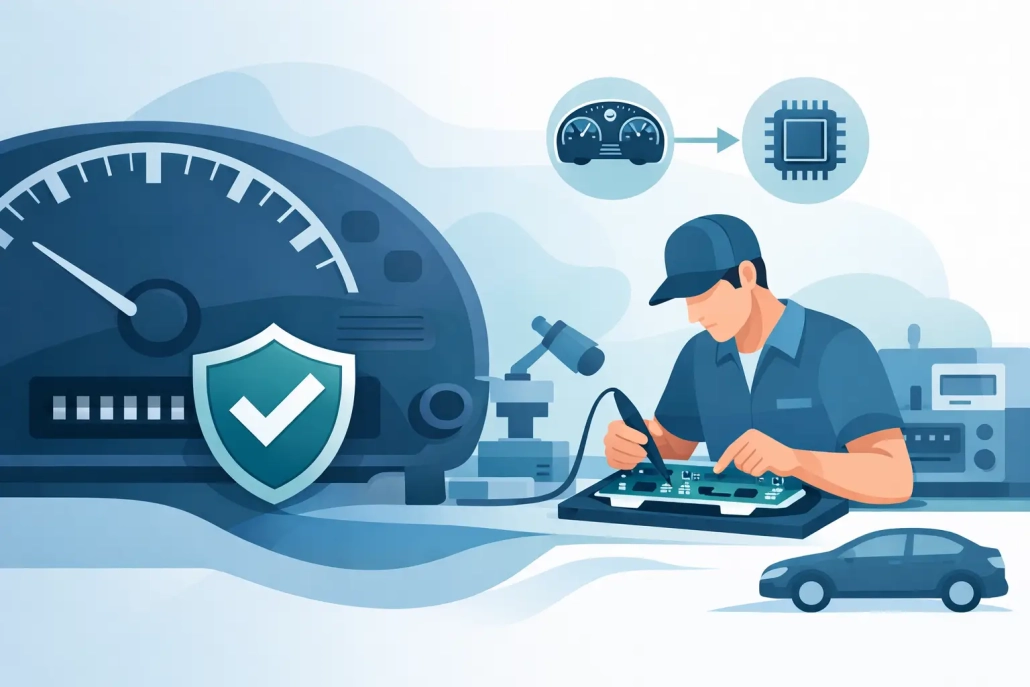
Odometer Mileage Preservation During Cluster Repair
A failed instrument cluster can leave a vehicle unusable in practical terms. The speedometer may stop working, warning lights may disappear, the LCD may lose pixels, or the dashboard may fail to power up at all. When that happens, odometer mileage preservation is not a minor detail. It is central to keeping the vehicle’s history accurate, protecting its value and avoiding unnecessary replacement costs.
For motorists, garages and dealerships, the priority is straightforward: repair the original cluster where possible, retain the mileage and coding already held by the vehicle, and get it back on the road without delay. That is very different from altering mileage. A legitimate repair preserves the true recorded mileage – it does not change or disguise it.
Why odometer mileage matters during a dashboard repair
The odometer reading is part of a vehicle’s documented identity. It supports MOT history, service records, warranty claims, finance checks and resale valuations. If a replacement instrument cluster is fitted without being correctly configured, the mileage displayed may be wrong, unavailable or inconsistent with other vehicle records.
That can create questions when the vehicle is sold or inspected. A buyer may see a mileage discrepancy and assume the worst, even where the cause was a genuine dashboard fault and replacement. A garage may also face extra diagnostic work if the vehicle develops communication errors because a fitted cluster has not been coded correctly.
Modern vehicles do not treat an instrument cluster as a simple display panel. On many makes, it forms part of the car’s electronic network and may hold vehicle-specific coding, security information, service data and mileage records. Replacing it can therefore involve more than fitting a new unit and turning the key.
Odometer mileage preservation means repairing the original unit
Where the original cluster is repairable, keeping it is usually the cleanest solution. The unit already belongs to the vehicle electronically. Its mileage, coding and configuration remain associated with the car, so there is less risk of introducing a mismatch through replacement.
A specialist repair focuses on the fault itself. That could mean repairing failed gauges, a non-functioning speedometer, dead backlighting, pixel loss, LCD display faults, power supply issues or internal communication faults. The aim is to return the original dashboard to working order while retaining the information it already holds.
This approach can be particularly useful on vehicles where a new cluster needs dealer programming, security access or additional modules to be synchronised. It also avoids the uncertainty that can come with used units. A second-hand cluster may carry another vehicle’s mileage, coding or fault history, and may not be compatible even if the part number appears similar.
Repair versus replacement: the practical difference
A repaired original cluster normally returns to the vehicle with its existing mileage and coding intact. A replacement cluster may require coding and configuration before it works correctly, and some vehicles require further steps to ensure records remain consistent.
Replacement is sometimes necessary. Severe fire damage, extensive water damage or missing components can make repair unrealistic. Even then, the fitting process should be handled properly, with clear documentation of the original mileage, the reason for replacement and the work carried out. The correct route depends on the vehicle, the fault and the condition of the unit.
For many common dashboard faults, however, repair is faster and more economical than main dealer replacement. It also preserves the originality of the vehicle, which matters to owners of well-kept cars, specialist models, motorhomes and vehicles with a complete service history.
What can go wrong with a replacement cluster
The visible fault may be only one part of the issue. A dashboard that has failed completely may still contain valuable vehicle data, while the underlying cause could be an internal component fault rather than a need for a complete new unit.
Fitting a replacement without accurate diagnosis can lead to several avoidable problems:
- Incorrect or inconsistent mileage display
- Warning lights, gauges or display functions not operating as expected
- Immobiliser, key recognition or communication faults on affected vehicles
- Extra dealer programming charges and longer vehicle downtime
- A loss of confidence in the vehicle’s mileage history at resale
These risks do not mean every replacement is unsuitable. They do mean that a replacement should never be treated as a simple plug-in fix. Correct part identification, diagnostics and programming are essential.
The legal position: preservation is not mileage alteration
There is a clear distinction between preserving genuine mileage during repair and misrepresenting a vehicle’s mileage. It is unlawful to sell a vehicle with a false mileage reading or to mislead a buyer about its history.
A legitimate cluster repair keeps the true reading associated with the vehicle intact. If a replacement is required and the odometer cannot display the original reading, the vehicle history should be documented clearly. Keep invoices, diagnostic reports and records showing the mileage at the time of repair. This protects the owner and gives future buyers a clear explanation if they see an apparent discrepancy.
For trade customers, good paperwork also protects the workshop. Record the registration, VIN where appropriate, stated mileage, reported fault, repair carried out and date of completion. It is simple administration that can prevent difficult conversations later.
Signs your cluster should be assessed before replacement
Instrument clusters often fail gradually. A display may fade when warm, pixels may disappear, gauges may drop intermittently, or warning lights may become dim. These are signs that an internal repair may be possible before the unit fails completely.
Other faults are more sudden. The cluster may go blank, the speedometer and rev counter may stop together, or the vehicle may show a communication error. On newer vehicles, these symptoms need proper testing because the fault could be within the cluster, its power supply, wiring or another module on the network.
A specialist diagnosis helps avoid replacing parts on guesswork. Using suitable test equipment and emulators, a repairer can assess how the cluster behaves away from the vehicle and identify faults that may not be obvious from a visual inspection. That matters because a cluster can look undamaged while having a failed processor connection, internal voltage fault or display driver issue.
A sensible process for motorists and workshops
Before sending a cluster away or booking it in, note the mileage showing on the display if possible and take a photograph. Write down the symptoms, including whether the fault is permanent or intermittent and whether it changes when the vehicle is cold or warm. If warning messages appear, record those too.
For garages, avoid opening the unit or attempting solder repairs unless you have the correct equipment and experience. Modern clusters use delicate circuit boards, fine connections and vehicle-specific data. An unsuccessful attempt can turn a repairable fault into a more complex job.
Once the fault has been diagnosed, choose the repair route that retains the original unit wherever practical. Cartronix repairs original instrument clusters for a wide range of modern vehicles, helping owners and trade customers avoid dealer replacement costs while retaining mileage and vehicle coding. Postal repairs and workshop appointments can also reduce the time a vehicle is off the road.
Protecting value beyond the repair itself
Mileage preservation is about more than the number on the dashboard. It supports the credibility of the whole vehicle record. A car with matching MOT history, service documentation and odometer reading is easier to assess, easier to sell and less likely to raise avoidable concerns.
After the repair, check that the display, gauges, warning lights and mileage are all operating correctly before treating the job as complete. Retain the repair invoice with the service history, especially if the vehicle is likely to be sold in future. For a straightforward cluster fault, keeping the original unit working is often the best way to keep the vehicle’s history as clear as the dashboard itself.




