
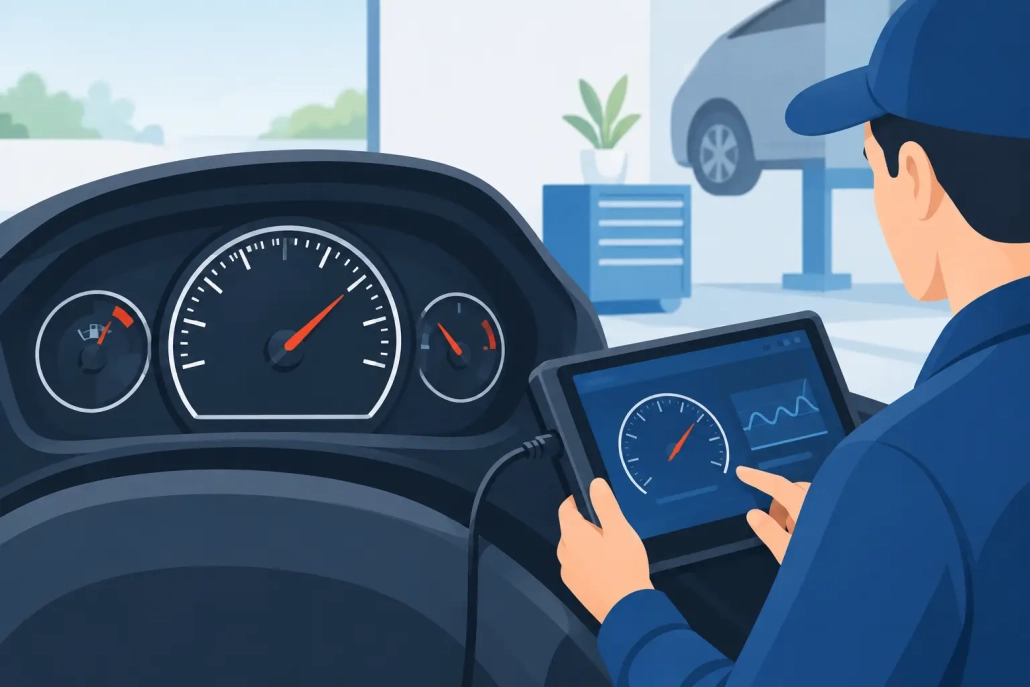
Speedometer Calibration Service for Accurate Readings
A speedometer that reads too high, drops to zero or changes its behaviour without warning is more than an inconvenience. It can affect driving confidence, vehicle safety and the accuracy of the information shown on the dashboard. A professional speedometer calibration service identifies whether the reading is genuinely out of calibration or whether a fault in the instrument cluster, sensor input or vehicle communication system is causing the problem.
That distinction matters. Recalibrating a speedometer will not repair a failing gauge motor, damaged circuit board or interrupted CAN bus signal. Equally, replacing a complete dashboard may be unnecessary when the original unit can be accurately diagnosed and repaired.
What a speedometer calibration service actually checks
A proper service starts with the source of the speed signal, not just the needle or digital display. On modern vehicles, speed information can be generated through wheel-speed sensors, the ABS system, gearbox sensors or vehicle control modules before being sent to the instrument cluster. If any part of that chain is producing the wrong information, the speedometer can appear inaccurate.
A specialist will compare the displayed speed against known inputs and check whether the cluster is interpreting that data correctly. This may involve diagnostic testing, bench testing with dedicated emulators and inspection of the cluster electronics. The aim is to establish whether the issue is calibration, a component fault or an external vehicle fault.
For vehicles from 1996 onwards, the instrument cluster often does far more than show speed. It stores mileage, communicates with other control units and manages warning lights, displays and gauges. That is why a quick swap for a second-hand unit can create additional coding, mileage and compatibility problems.
When a speedometer reading may be normal
Not every apparent speedometer discrepancy needs repair. UK and European vehicle regulations allow speedometers to read slightly higher than the vehicle’s true road speed, but they must not under-read. In practical terms, seeing a small difference between the speed shown on the dashboard and a satellite navigation device is common.
Tyre size can also influence the displayed speed. Fitting tyres with an overall rolling circumference that differs significantly from the original specification changes how far the wheel travels per revolution. Modified vehicles, motorhomes, vans with altered wheel and tyre packages, and cars with non-standard final-drive components may need the speed signal assessed more closely.
Satellite navigation is useful as a reference, but it is not a complete diagnosis. Its displayed speed can lag during acceleration, braking or poor signal conditions. A consistent and significant difference is worth investigating, particularly if the speedometer has changed suddenly or other dashboard functions are also affected.
Signs the fault is inside the instrument cluster
A speedometer calibration issue is often blamed on the cluster, but certain symptoms make an internal dashboard fault more likely. These include a needle that sticks, jumps, falls back to zero while driving or works intermittently after the vehicle warms up. A digital speed display that flickers, disappears or shows implausible values can point to display, soldering or circuit-board faults.
Other warning signs include fuel and temperature gauges behaving erratically, missing pixels, dim illumination, failed warning lights or a complete loss of cluster power. When several functions fail together, the problem is less likely to be a simple calibration adjustment.
Instrument clusters contain precision electronic components that can deteriorate with age, heat cycles and vibration. Stepper motors, voltage regulators, connectors and solder joints can all cause speedometer faults. The right repair restores the original unit rather than introducing the risks that come with replacement.
Why diagnosis should come before calibration
The most cost-effective repair is the one that addresses the actual fault. If an ABS wheel-speed sensor is failing, recalibrating the dashboard will not restore a reliable reading. If the instrument cluster has a faulty gauge motor, changing tyre settings will not stop the needle from dropping out.
For garages, this is especially relevant when a vehicle has arrived with a speedometer fault but no obvious mechanical issue. Standard fault-code checks may identify a communication or sensor concern, yet the cluster itself may still require specialist testing. Sending the unit for diagnosis can prevent unnecessary replacement of sensors, control modules or the complete dashboard.
A specialist repair process should preserve the vehicle’s existing mileage and coding wherever possible. This avoids the administrative and technical complications that can follow fitting a replacement cluster. It also retains the original appearance and functionality of the vehicle, which matters on everything from everyday family cars to specialist vehicles and motorhomes.
Speedometer calibration after tyre or drivetrain changes
Calibration can be appropriate where the vehicle specification has changed. Larger or smaller rolling tyre diameters, gearbox conversions, differential changes and certain specialist conversions can alter the relationship between wheel rotation and road speed. The correct approach depends on how the vehicle generates and processes its speed signal.
On some vehicles, settings can be adjusted within the relevant control module. On others, the practical solution may involve correcting the signal before it reaches the display or ensuring that the vehicle is returned to an approved tyre specification. There is no universal adjustment that suits every make and model.
It is also worth considering the effect on more than the speedometer. Vehicle speed data may be used by cruise control, parking systems, automatic transmission functions, stability control and mileage calculations. Any calibration work must be carried out carefully, with the wider vehicle system in mind.
Repairing the original cluster versus replacing it
Main dealer replacement can be expensive, and replacement clusters may require ordering, coding and configuration before the vehicle is usable again. A used cluster can be cheaper to buy, but it may carry unknown faults, incorrect mileage, incompatible software or a different specification.
Repairing the original cluster is often the better route when the fault is internal. The vehicle keeps its existing unit, mileage and coding, and the repair focuses on the failed component rather than replacing parts that are still working. For many common dashboard faults, this is faster and more economical than fitting a new assembly.
Cartronix provides specialist instrument cluster repair for a wide range of modern vehicles, including speedometer, gauge, display and warning-light faults. Units can be tested using specialist equipment, repaired and returned through a national postal service, while workshop customers may be able to arrange a while-you-wait appointment depending on the vehicle and fault. Repairs are backed by a lifetime warranty for as long as you own the vehicle.
What to provide when booking a speedometer repair
Accurate information helps establish whether a calibration check, cluster repair or wider vehicle diagnosis is the right next step. The vehicle make, model, year, engine type and registration details are useful, along with a clear description of when the fault occurs.
Mention whether the speedometer is consistently high or low, completely dead, intermittent, jumping or accompanied by ABS, engine-management or communication warnings. If tyres, wheels, gearbox components or software settings have recently changed, include that too. These details can save time and help avoid work being carried out on the wrong part of the system.
For postal repairs, remove and package the instrument cluster carefully, following the supplied instructions for your vehicle. Garages should also record any fault codes and confirm whether live wheel-speed data appears plausible, as this can help separate an external signal issue from a cluster fault.
A speedometer should give a stable, trustworthy reading every time the vehicle is driven. If yours has suddenly become inaccurate, intermittent or unresponsive, arrange diagnosis before committing to a replacement dashboard. A targeted repair or correctly assessed calibration can get the original unit working properly again without dealer replacement costs or unnecessary downtime.

