
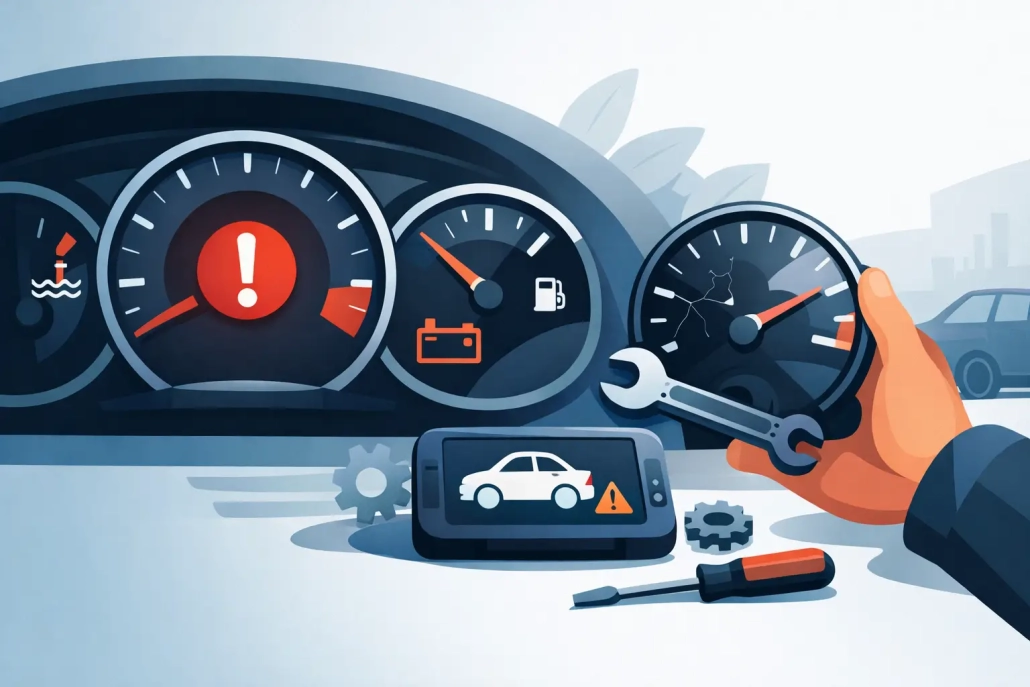
Top Signs Your Gauges Need Repair in Your Car
A speedometer that drops to zero on a dual carriageway is not a fault to put off until the next service. Nor is a fuel gauge that says half full one minute and empty the next. The top signs your gauges need repair often start as intermittent faults, but they can quickly become a safety issue, an MOT concern or a source of unnecessary breakdowns.
Your instrument cluster is the driver’s main source of information. It combines analogue gauges, warning lamps, LCD screens, motors, circuit boards and vehicle communication systems in one unit. When part of it fails, the cause may be inside the cluster itself, but it can also be linked to wiring, sensors, battery voltage or a vehicle network fault. Knowing what you are seeing helps you get the right repair rather than replacing parts on guesswork.
1. Gauge needles stick, jump or read incorrectly
A needle that sticks at zero, climbs slowly, vibrates or suddenly swings to maximum is one of the clearest signs of an instrument cluster fault. This commonly affects speedometers, rev counters, fuel gauges and temperature gauges. You may notice the fault only after the vehicle has warmed up, or it may disappear briefly after restarting the engine.
Stepper motors within the cluster can wear or fail, particularly on vehicles that have covered higher mileages. Internal solder joints and circuit board components can also cause erratic operation. A speedometer reading that is consistently wrong should be checked promptly. It is not just inconvenient – it can lead to accidental speeding and makes it difficult to judge the vehicle’s condition.
Fuel and temperature readings need a little more investigation. A faulty sender unit in the tank or an engine coolant sensor can produce similar symptoms. If several gauges fail together, however, the cluster, its power supply or its communication with the vehicle is more likely to be at fault.
2. The speedometer or rev counter has stopped working
A completely dead speedometer is difficult to ignore, but some drivers assume it must mean a gearbox or wheel sensor failure. On modern vehicles, the speed signal often travels through several control modules before reaching the instrument cluster. The gauge itself, the cluster electronics or the vehicle network may therefore be the problem.
The rev counter can fail in the same way. If the engine runs normally but the needle remains at zero, a cluster repair may be required. If the engine is also misfiring, cutting out or displaying other engine-related warnings, a wider diagnostic check is sensible before removing the dashboard.
For garages, this distinction matters. Replacing a sensor without confirming the signal reaches the cluster can add cost and downtime without curing the fault. Specialist testing with the correct equipment can establish whether the cluster responds properly when supplied with an emulated signal.
3. Your fuel gauge cannot be trusted
A fuel gauge that reads empty after filling up, stays on full for days or moves unpredictably can leave you stranded. Some vehicles also display a low-fuel warning when there is sufficient fuel in the tank, while others lose both the gauge and range display.
Start with the obvious checks: has the fault appeared after a battery change, fuel pump work or another repair? Is there a separate issue with the tank sender? If the sender signal is correct but the displayed reading is not, the fault may sit within the cluster.
Do not rely on the trip meter as a long-term workaround. Fuel consumption varies with traffic, load, driving style and towing. An inaccurate gauge is a repair worth arranging before it turns into a recovery callout.
4. The temperature gauge reads cold, hot or nothing at all
A temperature gauge permanently on cold can make it harder to spot a genuine cooling system issue. One that jumps straight to hot can cause understandable concern, especially when the engine is running normally. In some cases, the gauge follows the warning light or message display, so a cluster fault can create misleading alerts.
There is an important trade-off here: never assume an overheating indication is only a dashboard fault. Check coolant level only when the engine is cold, look for leaks and stop driving if there are signs of overheating, steam or loss of power. Once a mechanical cooling fault has been ruled out, diagnosis can identify whether the sensor signal, wiring or instrument cluster is at fault.
5. LCD screens have missing pixels, lines or faded sections
Pixel loss is a familiar fault on many instrument clusters. Digits may be incomplete, warning messages may be unreadable, or parts of the display may fade once the cabin warms up. On some dashboards, pressing the bezel or changing the temperature seems to bring the display back temporarily. That is not a cure – it usually points to a failing display connection or screen component.
A dim display can also be mistaken for a simple illumination issue. If the backlight works but text is missing, distorted or only visible from certain angles, the LCD itself may need repair. If the entire cluster is dim, check the dashboard dimmer setting first. A weak battery or charging fault can also affect illumination, particularly if other electrical items are behaving oddly.
Clear displays matter more than convenience. Warning messages, service information, mileage readings and trip data should be visible when you need them.
6. Warning lights are dim, permanently on or fail to illuminate
Warning lights should illuminate during the ignition self-test and then go out as expected. A lamp that stays dark may be just as concerning as one that remains on. It can hide a fault that needs attention, and a missing warning lamp can lead to an MOT failure where that warning is tested.
Dim or intermittent lights can be caused by failing LEDs, damaged tracks, poor internal connections or wider voltage problems. Multiple warning lights appearing together may indicate a communication issue rather than several unrelated vehicle faults. The exact pattern matters: note which lights come on, whether they appear with the ignition or only while driving, and whether the display shows a related message.
Modern clusters often receive data through CAN communication. If that communication is interrupted, the cluster may show warnings, dashes in place of readings or a complete loss of several functions. Proper diagnostics are essential before condemning an individual control unit.
7. The cluster resets, flickers or goes completely blank
A dashboard that briefly powers down, reboots or loses its needles and display is a strong sign that something needs attention. The fault may occur over bumps, during cold starts or after the car has been parked overnight. In more severe cases, the cluster remains blank while the vehicle still starts and drives.
Low battery voltage is worth checking first, especially if starting is sluggish or other electrical systems reset. Loose connections, water ingress and poor earth points can also cause intermittent power loss. But if supply and communication checks are correct, an internal cluster failure becomes the likely cause.
Avoid repeatedly disconnecting the battery in the hope of resetting the fault. This can temporarily change the symptom without fixing it, and it may create additional coding or window calibration issues on some models.
When a gauge fault needs specialist repair
The top signs your gauges need repair are not always proof that the cluster is faulty, but they are a reason to investigate early. A single incorrect reading may be sensor-related. Several failed gauges, missing pixels, dead warning lamps and repeated cluster resets point more strongly towards an internal dashboard fault.
Replacing the whole instrument cluster through a dealer can be expensive and may involve programming, mileage handling and vehicle coding. Repairing the original unit is often the more practical option, provided the fault is correctly diagnosed. It retains the vehicle’s original mileage and coding, avoids unnecessary replacement costs and can reduce time off the road.
For vehicle owners, a clear description of the symptoms helps speed up the process. Include the make, model, year, exact gauges affected, warning messages and whether the fault is constant or intermittent. For trade customers, confirming power, earth and network signals before sending a unit can prevent delays and make the repair route clearer.
Cartronix repairs original instrument clusters for a wide range of modern vehicles, with postal and workshop options, fast turnaround and a lifetime warranty for as long as you own the vehicle. If your dashboard is sending mixed messages, act while the fault is still intermittent – it is far easier to plan a repair than to discover you have no reliable speed, fuel or temperature information on the road.




