
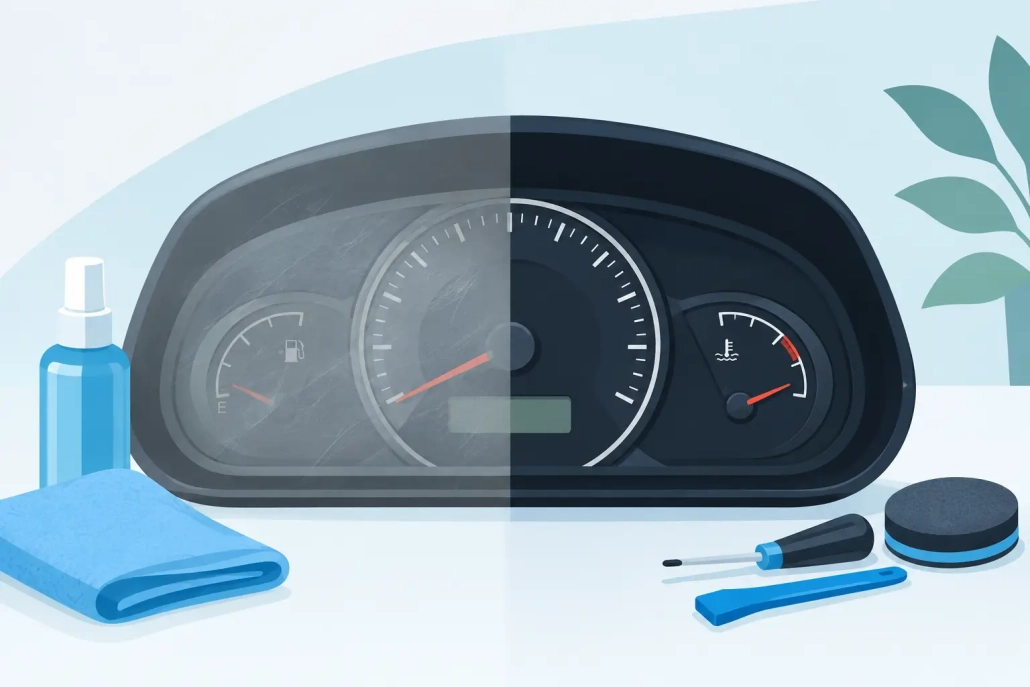
Restore a Faded Odometer Display Properly
A mileage display that is only visible at night, disappears in sunlight or loses whole sections of digits is more than an annoyance. If you need to restore a faded odometer display, the priority is a reliable repair that keeps the vehicle’s original mileage, coding and instrument cluster intact. Replacing the complete dashboard is not automatically the right answer, and it is often the most expensive one.
A dim odometer can affect MOT preparation, servicing records, resale confidence and day-to-day use. On many modern vehicles, the fault sits within the display, its illumination circuit or the cluster’s internal electronics – not in the mileage data itself. Correct diagnosis matters because similar symptoms can have very different causes.
Why an odometer display fades
Most faded odometer faults develop gradually. You may first notice that the reading is weak in bright conditions, that some pixels are missing, or that the display returns after the vehicle has warmed up. Eventually, the mileage may become impossible to read at all.
In older LCD-equipped clusters, the backlight can weaken with age. Small bulbs, LEDs or their associated components may no longer provide enough illumination for the screen to be read clearly. In other cases, the LCD itself deteriorates, or the ribbon connection between the screen and circuit board begins to fail. Heat cycles, vibration and years of use all take their toll.
Some vehicles use vacuum fluorescent displays or other panel designs rather than a conventional LCD. These can dim as the display ages, while faults in the cluster’s power supply or driver circuitry can reduce brightness across one area of the unit. A display that is dark but still faintly visible may point to a different issue from one with random missing lines or permanently blank sections.
The surrounding symptoms provide useful clues. If the backlighting for other gauges is also poor, the fault may be related to the vehicle’s illumination control, a fuse, wiring or cluster power supply. If the warning lights, gauges and centre display work normally but the odometer alone is unreadable, an internal display repair is more likely.
Checks to make before booking a repair
There are a few sensible checks that do not involve dismantling the dashboard. First, adjust the instrument illumination control if your vehicle has one. It sounds obvious, but a dashboard dimmer can be knocked down accidentally, particularly after servicing or valeting.
Next, compare the odometer display in daylight and darkness. A screen that works at night but vanishes in daytime often has reduced backlighting or contrast. Check whether the display changes when the headlights are switched on, as this can help identify whether the illumination circuit is responding correctly.
It is also worth noting exactly what else is affected. Record whether the clock, trip counter, service indicator, warning lamps, speedometer, rev counter or fuel gauge are behaving oddly. For a garage or repair specialist, these details can shorten diagnosis and avoid treating only part of a wider instrument cluster fault.
Do not attempt to prise out the LCD, heat the screen or fit random replacement LEDs unless you have the correct equipment and experience. Instrument clusters contain delicate solder joints, coded memory and components that can be damaged by static electricity or excessive heat. A low-cost DIY attempt can turn a repairable display fault into a complete cluster failure.
How specialists restore faded odometer display units
To restore faded odometer display units properly, the cluster is tested before repair rather than simply stripped down and fitted with parts. Specialist diagnostics can establish whether the issue is confined to the display, caused by failed illumination components, or linked to the board that drives the screen.
The cluster is then opened carefully and the relevant parts are inspected. Depending on the make, model and fault, repair may involve replacing failed backlight components, refurbishing display connections, repairing circuit-board faults or installing a replacement display assembly. The correct method depends on the original cluster design. There is no one-size-fits-all fix for Audi, Ford, Fiat, Alfa Romeo, Aston Martin or the many other vehicles that develop display problems.
A proper repair preserves the original unit wherever possible. That is significant because the cluster commonly stores mileage, vehicle configuration, security data and service information. Fitting a used replacement cluster can introduce coding issues, incorrect mileage, warning messages or incompatibility with other control units.
After the repair, the unit should be fully tested. This means checking display clarity, backlighting, pixel operation and cluster communication, as well as confirming that gauges and warning lamps function as intended. Emulator testing allows specialists to assess the cluster outside the vehicle in many cases, helping to identify intermittent faults and verify the repair before return.
Why replacement is not always the best option
A main dealer may recommend a new instrument cluster when the odometer display is faded. A new unit can solve the immediate problem, but it may come with substantial parts, programming and labour costs. Availability can also be an issue, particularly for older vehicles and certain model variants.
Replacement creates another practical question: how will the new cluster be coded and how will the vehicle mileage be handled? Mileage correction is tightly regulated and must only be carried out lawfully to reflect the vehicle’s genuine recorded mileage. Keeping and repairing the original cluster avoids unnecessary complications because the vehicle retains its existing data and configuration.
There are occasions when replacement is necessary. Severe fire, water or collision damage can make a cluster uneconomical to repair. The same can apply where the circuit board is extensively corroded or multiple components have failed beyond a reliable repair standard. However, a faded screen alone does not usually mean the whole cluster needs replacing.
For vehicle owners, a repair is often the faster and more economical route. For independent garages and dealerships, it provides a practical way to resolve a specialist electronics fault without leaving a customer waiting for a complete new dashboard assembly.
What to expect from a professional repair service
Before sending a cluster away, provide the vehicle make, model, year, engine variant where relevant, and a clear description of the fault. Photographs or a short video can be useful for intermittent dimming, pixel loss or displays that fail only when hot. If there are fault codes or other dashboard warnings, include those too.
A repair service should be clear about the likely turnaround, total price including VAT, and the warranty provided. For urgent jobs, while-you-wait appointments can minimise downtime where available. Postal repair is useful for drivers and trade customers across the UK, provided the unit is packaged securely and labelled with the vehicle details and fault description.
Once the cluster is refitted, check it before reassembling all dashboard trim. Confirm that the odometer is readable in normal daylight, the trip function operates correctly, illumination responds as expected and there are no new warning messages. If the cluster has been removed for repair, it is also sensible to confirm that all connectors are fully seated before assuming there is a further fault.
Cartronix repairs original instrument clusters rather than pushing unnecessary dealer replacement, with specialist diagnosis, fast turnaround options and a lifetime warranty for as long as you own the vehicle.
When a faded display needs urgent attention
A faded odometer is rarely a safety-critical fault on its own, but it should not be ignored. You may be unable to confirm mileage for servicing, prove the reading during a sale or spot important service messages shown in the same display area. If the issue is accompanied by failed gauges, warning lamps that do not illuminate at ignition-on, or an intermittent no-start condition, arrange diagnosis promptly.
Be particularly cautious if the display has failed after water ingress, a flat battery, jump-starting or electrical work. These events can expose a power-supply or communication issue rather than ordinary display wear. A targeted test will identify whether the cluster is the cause or whether the vehicle has a wider electrical problem.
A clear odometer reading is a small part of the dashboard, but it carries important information every time the vehicle is used. Repairing the original unit early is usually the simplest way to retain that information, avoid avoidable replacement costs and keep the vehicle’s dashboard working as it should.




