
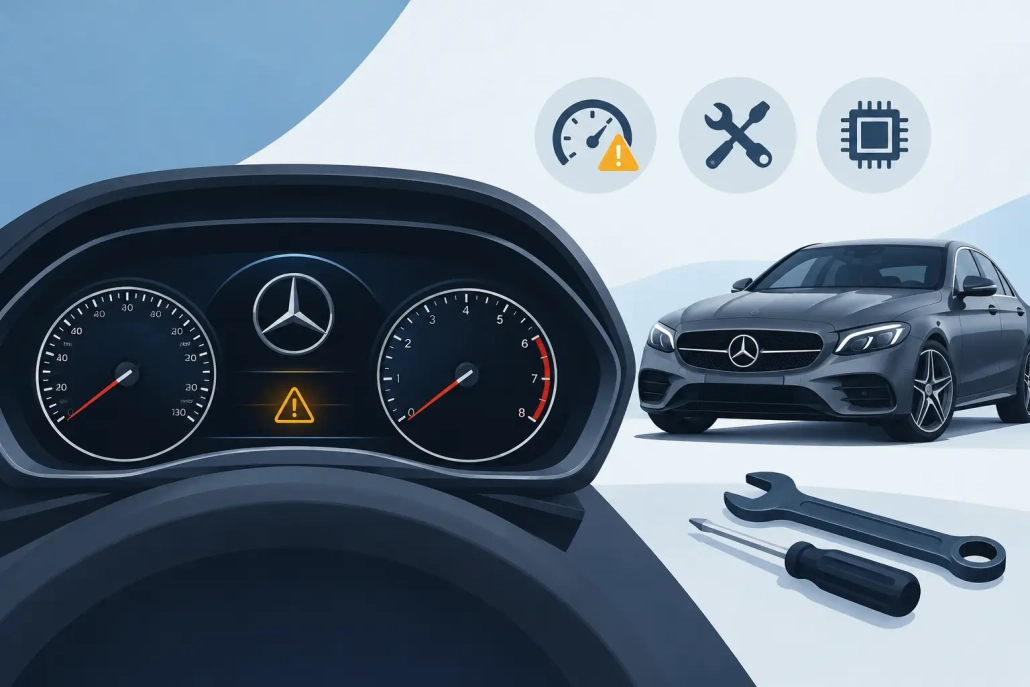
Mercedes Cluster Failure: Signs and Repair Options
A Mercedes cluster failure is more than an annoying dashboard fault. When the instrument panel goes blank, gauges stop responding or warning lights behave unpredictably, you can lose vital information about speed, fuel level, engine temperature and vehicle status. Replacing the whole unit through a main dealer can be expensive and may introduce coding, mileage and vehicle configuration issues that a proper repair avoids.
The right answer depends on the exact fault, the Mercedes model and whether the problem is inside the cluster or elsewhere on the vehicle. Accurate diagnosis comes first. A failed display is not always a failed cluster, but a cluster should not be written off simply because it has stopped working.
Mercedes Cluster Failure: What It Usually Means
Mercedes instrument clusters are electronic control units as well as displays. They receive information from multiple vehicle systems, process it and present it through warning lamps, gauges, LCD screens and digital readouts. A fault can therefore appear in one small area, such as a missing pixel line, or affect the entire dashboard.
Common symptoms include an intermittent or completely blank display, dim illumination, flickering backlighting, dead speedometer or rev counter needles, fuel and temperature gauges reading incorrectly, and warning lights that fail to illuminate at ignition. Some owners see the cluster restart while driving, with needles dropping to zero before returning. Others find that the display works only when cold, warm, or after a knock to the dashboard.
These symptoms are useful clues, but they do not identify the failed component on their own. A cluster that appears dead may have a power, earth, fuse, ignition-feed or CAN communication problem. Equally, a unit with a known internal electronic fault can still communicate with diagnostic equipment, making proper test procedures essential.
Why Mercedes Instrument Clusters Fail
Age, heat cycles and vibration all take their toll on dashboard electronics. Mercedes clusters are built to a high standard, but solder joints, power supply components, display connections and illumination circuits can deteriorate over time. The result is often an intermittent fault at first, before the failure becomes permanent.
LCD and pixel faults are particularly common on older and higher-mileage vehicles. The screen may lose lines of text, fade in certain areas or become difficult to read in daylight. In other cases, failed LEDs or driver circuits leave the cluster dim or completely unlit, even though the gauges and warning functions continue to operate.
Power-related failures can cause a more dramatic loss of function. Internal voltage regulation faults, damaged circuit-board components or failed connections may prevent the cluster from waking up correctly. Water ingress, previous jump-start damage and battery issues can also contribute, although it is important not to assume they are the root cause without testing.
Vehicle-side faults need ruling out too. A weak battery, poor terminal connection, incorrect fuse, wiring damage or a network communication problem can mimic a failed instrument cluster. This is why fitting a used unit as a quick test is rarely a straightforward solution. On many Mercedes models, a replacement cluster will not simply plug in and work as expected.
Checks Before Removing the Dashboard
A few sensible checks can prevent unnecessary removal of the cluster. Start by confirming whether the fault affects only the instrument panel or other electrical systems as well. If central locking, infotainment, lighting or starting behaviour has also changed, the issue may be wider than the dashboard.
Check the vehicle battery condition and terminals, particularly if the fault appeared after the car stood unused or needed a jump-start. Then inspect the relevant fuses against the vehicle handbook and note whether the cluster changes behaviour with ignition position, temperature or road vibration. Finally, have the vehicle scanned for fault codes using suitable Mercedes-capable diagnostic equipment.
Fault codes are evidence, not a final diagnosis. A communication code may be caused by the cluster itself, but it can also be recorded when low voltage or another control unit disrupts the network. An experienced specialist will assess the fault pattern alongside live vehicle checks and bench testing where required.
Repair or Replacement: The Cost and Coding Difference
For many Mercedes cluster faults, repairing the original unit is the better route. The vehicle keeps its own instrument cluster, which means the existing mileage, coding and configuration can be retained. That reduces the risk of incompatibility and avoids the unnecessary cost of a complete dealer-supplied replacement.
A used cluster can look like a bargain, but it is often a false economy. It may carry different mileage data, have a fault of its own, require programming to the vehicle or lack the correct specification. Features such as display type, warning functions, language settings and equipment level can vary between apparently similar units. A second-hand part also gives little assurance about its remaining life.
Main dealer replacement remains appropriate in some circumstances, particularly where the unit is physically damaged beyond viable repair or a manufacturer-led software action is required. However, an internal electronic failure does not automatically mean a new cluster is necessary. A specialist repair can target the failed components while preserving the original unit.
That approach is especially valuable for owners keeping a well-maintained Mercedes, and for garages that need a dependable solution without leaving a customer’s vehicle off the road for an extended period. It also avoids altering mileage records unnecessarily. Mileage must always remain accurate, and any work involving vehicle data should be handled properly and lawfully.
How a Specialist Cluster Repair Works
The cluster is removed from the vehicle and assessed for the reported fault. Depending on the symptom, testing may involve controlled power supplies, specialist emulators, component-level inspection and checks of display, gauge and communication functions. This matters because a repaired screen is of little use if an underlying power fault remains.
Once the fault is confirmed, the defective parts or connections can be repaired and the unit retested before return. The aim is not to mask the symptom but to restore stable operation of the original cluster. A reputable repair service should be clear about the fault being addressed, the turnaround available and the warranty provided.
Cartronix offers postal repairs nationwide as well as workshop appointments for suitable jobs, with many repairs completed the same day or next working day. The original unit is retained, and repairs are covered by a lifetime warranty for as long as you own the vehicle.
When the Fault Needs Urgent Attention
Do not ignore a cluster fault simply because the car still drives. Without a reliable speedometer, warning lamps or temperature reading, it is harder to operate the vehicle safely and identify developing mechanical problems. A failed MOT warning light function can also create problems at test time.
If the dashboard has gone blank while driving, avoid repeatedly disconnecting the battery or fitting random parts in an attempt to reset it. Those actions can create further faults or erase useful diagnostic evidence. Record exactly what happened, including whether the fault followed flat-battery recovery, water exposure, a jump-start or other electrical work.
For trade customers, clear fault notes make the job quicker to assess. Include the Mercedes model, registration year, cluster part number where available, symptoms, whether the unit is intermittent and any diagnostic codes already found. That information helps separate a likely internal repair from a vehicle-side investigation.
A Mercedes dashboard should give dependable information every time you turn the key or press the start button. When it does not, a focused diagnosis and repair of the original cluster can restore that confidence without the delay and cost of an unnecessary replacement.


