
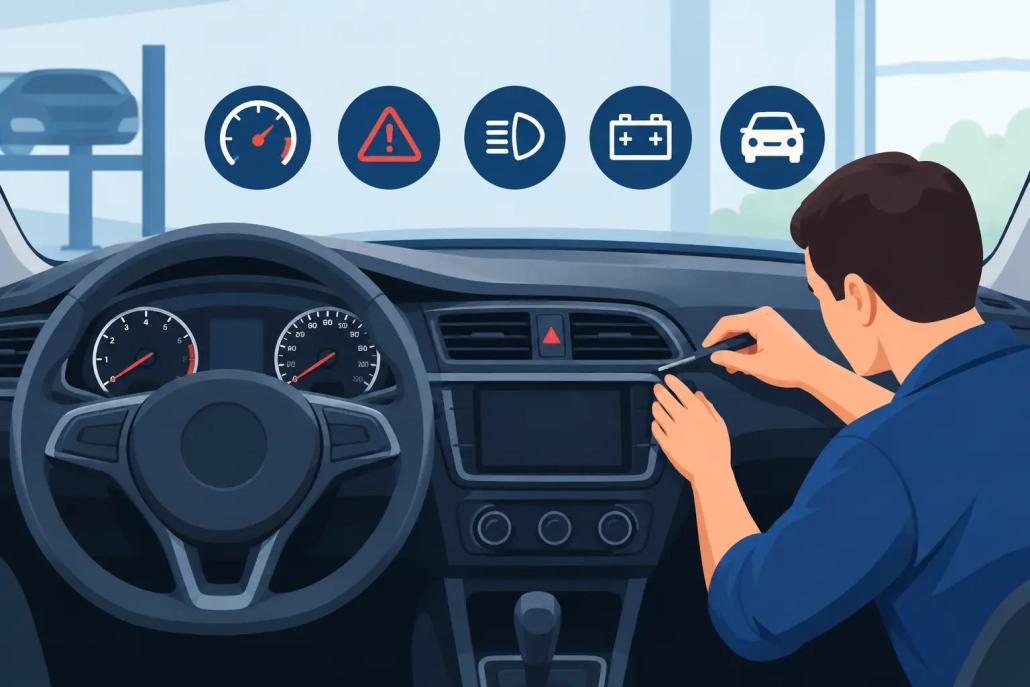
Dashboard Repair Before MOT: What Must Work?
A failed instrument cluster can turn an otherwise straightforward test into an MOT failure, or leave a tester unable to confirm whether a safety system is operating correctly. Dashboard repair before MOT is worth arranging when warning lights remain on, fail to illuminate at ignition, the speedometer has stopped working, or the display is too dim to read. The key is knowing which faults affect the test and which can wait.
Not every pixel fault or backlight issue is an MOT problem. But a dashboard is more than a display: it is where the vehicle reports faults in braking, steering, airbags, emissions and tyre pressure systems. Ignoring the wrong warning lamp can cost you a retest, delay repairs and create uncertainty about the car’s safety.
Does dashboard repair before MOT prevent a failure?
It often can, provided the fault is in a warning lamp or tell-tale the MOT tester is required to check. During the test, the tester will look for relevant warning indicators to illuminate at the appropriate point and, where designed to do so, go out after the engine starts or system check completes. A lamp that stays illuminated, does not come on at all, or is clearly showing a system fault may result in a defect being recorded.
The exact outcome depends on the vehicle’s age, specification and the warning system involved. MOT requirements also develop over time, so the test station applies the current inspection rules. However, a working dashboard is the simplest way to avoid doubt before the vehicle goes into the bay.
A cluster fault can be especially frustrating because the vehicle itself may be mechanically sound. For example, an ABS warning lamp may remain on because the instrument cluster has an internal fault, not because the ABS system has failed. Equally, a missing engine management lamp could be caused by failed LEDs, poor solder joints or a display-board issue. Proper diagnosis matters. Clearing a fault code without finding the cause, or fitting a used cluster, is not a reliable fix.
Warning lights most likely to affect an MOT
The lights that deserve immediate attention are those linked to regulated safety or emissions systems. These commonly include the engine management malfunction indicator lamp, ABS warning light, airbag or SRS warning light, brake system warning light, electronic stability control warning light and electric power steering warning light where fitted.
For vehicles that require a tyre pressure monitoring system to be checked, a TPMS warning lamp showing a fault can also cause an MOT issue. Diesel vehicles with a DPF warning displayed should not be ignored either. The warning may indicate a genuine filter or sensor problem, but it still needs investigating rather than simply being reset.
There are two common dashboard failures to watch for. The first is a light that stays on after start-up. The second is a light that never comes on during the ignition check. A missing lamp is not a benefit. If the tester expects the tell-tale to prove it is working and it does not illuminate, that can be treated as a fault.
Do not rely on an aftermarket scanner alone. Diagnostic equipment may identify a communication code or stored fault, but it cannot always tell you whether the instrument cluster’s circuitry, illumination or processor is at fault. A specialist can test the original unit using vehicle-specific diagnostic methods and emulators, then establish whether the cluster is reporting a genuine vehicle fault or creating one.
What about a failed speedometer or pixel display?
A dead speedometer is a serious usability and safety concern, even where the specific fault is not the direct reason for an MOT refusal. You need to know your road speed, and a speedometer fault can point to a wider communication issue between the cluster, ABS module and vehicle network. It should be repaired before continued use rather than left until the next service.
Pixel loss and faded LCD screens need a more considered approach. If the display has a few missing segments but warning messages and essential information remain clear, it may not prevent an MOT. If it means you cannot read a critical warning, mileage display, gear selection or vehicle message, arrange repair before the test. Dim illumination is similar: a dashboard that is difficult to read in normal conditions may not be practical, even if the tester can see it on the day.
Gauge faults are also worth checking. Fuel, temperature and rev counter issues do not all carry the same MOT consequence, but a temperature gauge that reads incorrectly can hide overheating, while a fuel gauge fault can leave the driver stranded. If several gauges have failed together, the root cause may be inside the cluster rather than multiple separate sensors.
Why replacement is not always the sensible option
A main dealer may recommend a new instrument cluster, but replacement can be expensive and may involve coding, mileage programming and vehicle configuration. A used unit is rarely a simple plug-and-play answer. It can carry incorrect mileage, incompatible software or faults of its own, and fitting it may create further warning lights.
Repairing the original cluster usually avoids those complications. The vehicle retains its original mileage, coding and configuration, while the faulty electronic components are repaired. This is often the faster route as well, particularly where a replacement unit is on back order.
For motorists, that means less disruption before an MOT deadline. For independent garages and dealerships, it means a clearer repair path without tying up a ramp or asking a customer to wait weeks for a new part. Cartronix repairs original instrument clusters from 1996 onwards, with postal repairs nationwide and workshop appointments available for suitable vehicles.
Check the dashboard before booking the MOT
Do not wait until the test day to discover a warning lamp problem. A short check on the drive can identify whether the cluster needs attention. Turn the ignition on without starting the engine and watch the warning lamps. Relevant system indicators should appear for their bulb check. Start the engine and see whether they extinguish as expected.
Then check that the speedometer, fuel and temperature gauges behave normally, the display is readable and the backlighting is consistent. Look for intermittent faults too. A cluster that cuts out over bumps, works only when cold, flickers after ten minutes or resets its clock may fail at an inconvenient moment even if it appears fine during a quick inspection.
If a warning lamp remains on, avoid assuming it is a dashboard-only issue. Ask for the vehicle to be scanned and the results interpreted alongside the cluster behaviour. If the system has no live fault but the lamp is permanently illuminated, the cluster is a likely suspect. If the scan confirms a sensor, module or wiring fault, resolve that fault first or alongside the dashboard repair.
Allow time for proper diagnosis and repair
Book early if your MOT is due soon. Some faults can be repaired on the same day or returned on the next working day once the unit arrives, but the best approach depends on the vehicle and the fault. A straightforward LCD or pixel repair may be different from a complete cluster power failure or a network communication issue.
Give the repair specialist clear symptoms when booking: the make, model, year, part number where available, which lights are on, whether the fault is intermittent and whether any diagnostic codes have been found. This helps target the likely failure and avoids unnecessary delay.
For postal work, package the unit securely and include the required vehicle details. For a while-you-wait appointment, make sure the vehicle can be driven safely to the workshop. If the dashboard failure affects speed indication, braking warnings or other essential information, transport may be the safer choice.
Do not hide a warning light
Covering a warning lamp, removing a bulb or attempting to code out an alert is not a repair. It can lead to an MOT failure and may conceal a fault that needs attention. More importantly, it leaves the driver without a working warning system when it is needed.
A correctly repaired original dashboard gives you a readable display, functioning gauges and warning lights that report genuine problems as intended. If your MOT is approaching and the cluster is showing any of the faults above, deal with it before the test rather than hoping the issue stays hidden for one more journey.

