
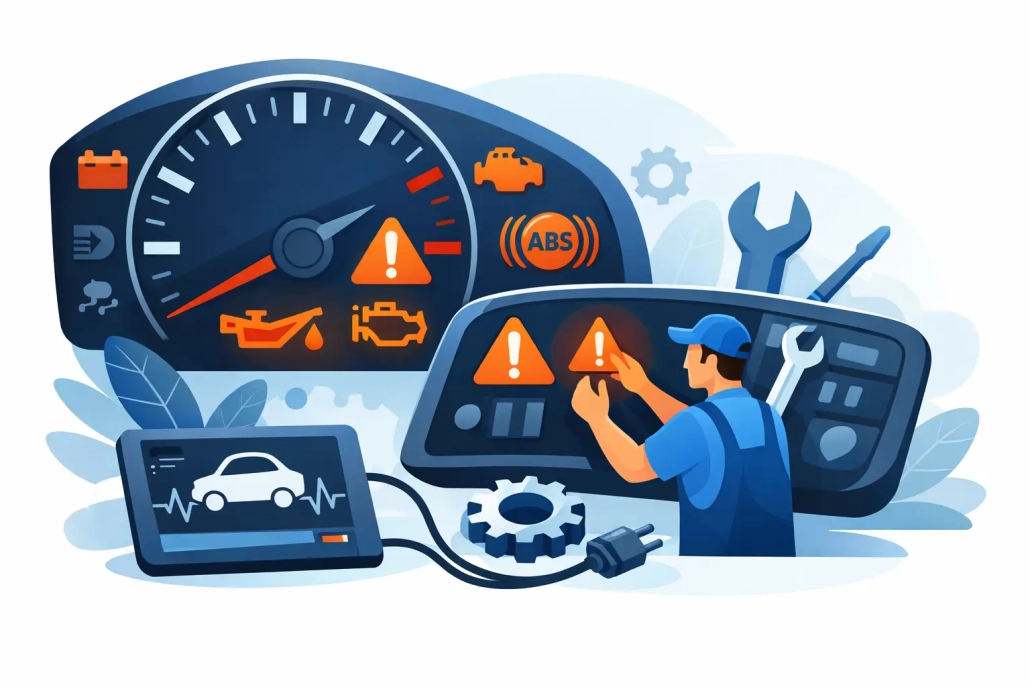
How to Repair Dashboard Warning Indicators
A warning light that stays dark can be just as serious as one that stays on. When you need to repair dashboard warning indicators, the job is not simply about making a symbol light up again. The cause may be within the instrument cluster, but it can also involve vehicle wiring, a control module or a genuine fault being reported by the car.
For motorists, garages and dealerships, the aim is clear: establish whether the dashboard is displaying information correctly, repair the original unit where possible, and avoid unnecessary dealer replacement costs. A proper diagnosis protects the vehicle, its mileage data and its coding.
What dashboard warning indicators are meant to do
Most warning indicators illuminate briefly when the ignition is switched on. This bulb check, or lamp check, confirms that the relevant LED, circuit and display path are working. Once the engine starts, the lights should normally go out unless the vehicle has detected a fault.
Modern instrument clusters do far more than show speed and fuel level. They receive data from multiple systems, including the engine control unit, ABS module, airbag system, body control module and parking brake system. A missing indicator can therefore be caused by a failed LED or internal circuit fault, but it may also be the result of lost communication between modules.
This is why fitting a replacement cluster without testing is often the wrong first move. It can introduce mileage discrepancies, immobiliser or coding issues, and additional programming work, while leaving the original fault unresolved.
When a warning indicator needs urgent attention
Do not assume a lamp has failed just because it is not behaving normally. Some warning lights relate directly to safety-critical systems and should be checked without delay. This includes:
- The red brake warning light, particularly if accompanied by a soft brake pedal, fluid loss or reduced braking performance.
- The oil pressure warning light, which can indicate inadequate engine lubrication.
- The engine temperature warning light, especially if the temperature gauge is high or coolant is escaping.
- Airbag, ABS and electronic stability warnings, which may affect occupant protection or vehicle control systems.
If a red warning light appears while driving, stop safely when practical and consult the vehicle handbook. Continuing to drive can turn a repairable fault into major mechanical damage. An amber warning is not always an emergency, but it should still be diagnosed promptly rather than ignored until MOT time.
A warning indicator that never comes on during ignition can also be a problem. For example, an airbag or engine-management lamp that fails its lamp check may prevent the driver from knowing the system has stored a fault. It may also lead to an MOT failure where a required warning lamp is missing, inoperative or indicates a fault.
Common reasons dashboard warning lights fail
Instrument cluster faults are common on vehicles built from the late 1990s onwards, particularly where heat, vibration and age affect electronic components. Dim or completely failed warning lights may be caused by worn LEDs, damaged solder joints, failed drivers on the circuit board or degradation within the cluster display assembly.
Pixel loss and LCD faults can make warning messages difficult to read, even when the vehicle is reporting them correctly. On some dashboards, faded backlighting means indicators are visible only at night. Others may show intermittent illumination, flickering gauges, a dead speedometer or a total cluster blackout alongside warning-light problems.
The fault does not always sit inside the dashboard itself. A low battery voltage, poor earth connection, corroded wiring, blown fuse or communication fault can stop a warning light from operating as expected. Vehicle diagnostics should be used to check fault codes and live data before the cluster is removed for repair.
There is also an important distinction between a warning light that is functioning correctly and a dashboard that is faulty. If the engine-management light remains on because the engine control unit has logged a genuine emissions fault, repairing the cluster will not clear it. The underlying engine fault must be corrected first.
How to repair dashboard warning indicators properly
A dependable repair starts with diagnosis, not parts swapping. A technician should confirm the customer complaint, check whether the indicator operates during ignition, scan the relevant vehicle modules and assess the cluster for associated symptoms such as gauge failure, display loss or intermittent power.
Where the instrument cluster is confirmed as the cause, specialist bench testing can replicate vehicle signals outside the car. This allows faults to be traced to the relevant circuit, display, LED driver or component without guessing. Emulators are particularly useful where a cluster needs to be tested under controlled conditions before and after repair.
The faulty components can then be repaired or replaced at board level. Depending on the cluster design and reported fault, this may involve restoring failed warning LEDs, repairing damaged tracks or solder joints, addressing display illumination faults, or correcting internal power-supply problems. The unit should be fully tested before it is returned.
For many vehicles, repairing the original cluster is the best option because it retains the vehicle’s existing mileage, coding and configuration. Replacement units may require specialist programming and can create complications if their stored data does not match the vehicle. A used unit is not necessarily a saving once compatibility checks, coding and labour are included.
Repair or replacement: which makes sense?
Replacement is sometimes necessary. Severe physical damage, water ingress that has destroyed multiple circuits, or a cluster that is no longer economically repairable can make a new or remanufactured unit the sensible choice. Even then, the replacement must be correctly configured for the vehicle.
In most cases, however, an original-unit repair offers better value and less disruption. It avoids the cost of a full dealer-supplied dashboard, preserves the factory unit and reduces the risk of mileage or immobiliser complications. It is also usually quicker than waiting for a new part to be ordered and programmed.
The right option depends on the make, model, year and fault type. Audi, Aston Martin, Fiat, Ford and Alfa Romeo clusters all have their own common failure patterns, and the correct diagnostic route varies by vehicle. A speedometer fault combined with warning-light failure points to a different investigation than a single dim ABS lamp or a blank central display.
What to check before sending a cluster for repair
A garage should record all diagnostic trouble codes before disconnecting the dashboard. This provides a useful baseline and helps separate a cluster fault from a fault elsewhere on the vehicle. Photographing the dashboard with the ignition on can also show exactly which lamps are missing, dim or permanently illuminated.
Vehicle owners should note when the problem occurs. Does the display fail only when cold? Do warning lamps flicker after hitting a pothole? Has the battery recently gone flat, or has the dashboard stopped working after another repair? These details can shorten diagnosis and prevent unnecessary work.
Do not attempt to cover, remove or disable a warning light to get through an MOT. Apart from being unsafe, this does not fix the reason the vehicle is warning you. The same applies to fitting random LEDs or modifying the cluster without the correct equipment. Modern dashboards are coded electronic control units, not simple bulb holders.
Fast specialist help for cluster faults
For a confirmed dashboard fault, Cartronix repairs original instrument clusters for motorists and trade customers across the UK. Units can be assessed through a national postal repair service or at a while-you-wait workshop appointment, subject to the vehicle and fault. Repairs are designed to retain original mileage and coding, with same-day or next-working-day turnaround available for many common faults.
A lifetime warranty for as long as you own the vehicle provides added reassurance that the repair is built to last. For garages, this means a specialist route for jobs that sit beyond routine mechanical repair, without holding a customer’s car off the road for a dealer replacement dashboard.
If a dashboard warning indicator is dim, absent, intermittent or accompanied by gauge and display faults, treat it as a diagnostic issue rather than a cosmetic annoyance. Getting the original cluster tested early is often the quickest route back to a clear, correctly functioning dashboard and a vehicle that tells you what it needs to tell you.

