
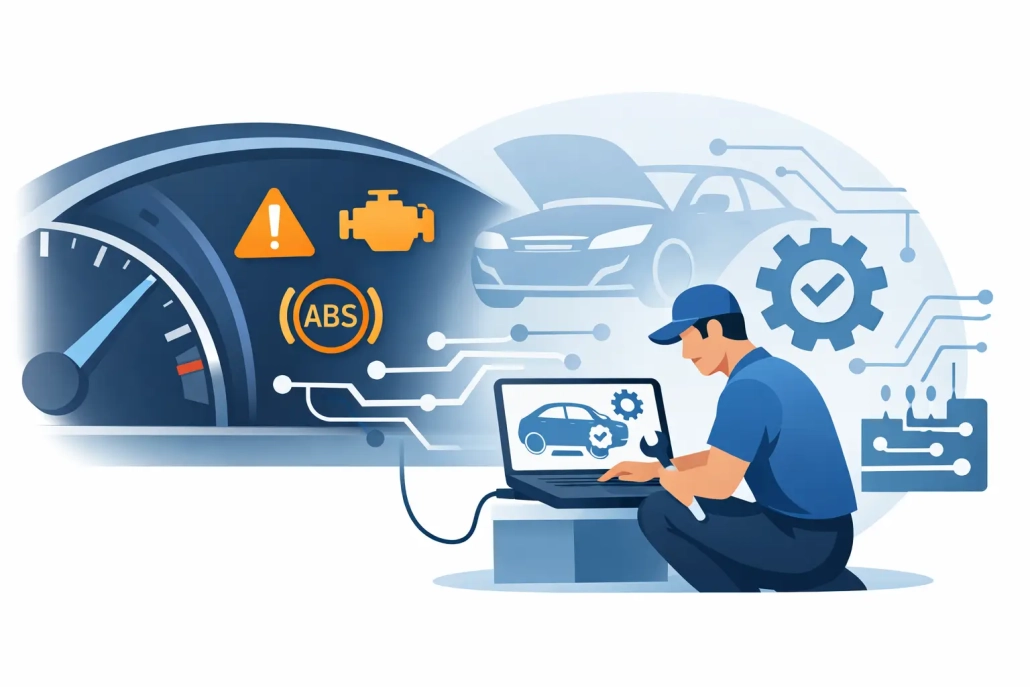
Repairing Dashboard Faults Without Recoding
A speedometer that drops to zero, an LCD display with missing pixels or warning lights that have gone dim can make a vehicle feel far less usable than it is. Repairing dashboard faults without recoding means technicians repair the original instrument cluster and return it to the vehicle. That avoids replacing it with a new unit that may need programming, mileage alignment and configuration.
For owners, garages and dealerships, that difference can save considerable time and cost. The dashboard already belongs to the vehicle. Its mileage, settings and coding already belong to it. Where the fault is repairable, restoring the original unit is usually the most direct route back to a working display.
Why original dashboard repair makes sense
Modern instrument clusters are more than a set of gauges. They are electronic control units, often communicating with the engine ECU, body control module, immobiliser, steering wheel controls, parking sensors and other vehicle systems. Replacing one is not always a simple fit-and-go job.
A replacement cluster can require coding to the vehicle specification, configuration of optional equipment and, in some cases, dealer-level access. Mileage may also need to be addressed correctly. This can add cost, delay and uncertainty. This matters where a new unit is on back order or a used unit has an unknown history.
Repairing the original cluster avoids those unnecessary steps when the fault lies within the unit itself. The vehicle retains the dashboard it left the factory with, including its existing mileage and coding. There is no need to transfer data to another unit simply because a display, motor, solder joint or internal circuit has failed.
This approach is particularly useful for vehicles from 1996 onwards, where clusters commonly suffer known age-related electronic faults but are still otherwise fully compatible with the car.
What faults can be repaired without recoding?
The answer depends on the cluster design and the condition of the unit. But many common faults specialists can correct at component level. A proper diagnosis matters because symptoms that appear to be a dashboard failure can sometimes come from vehicle wiring, a weak battery, poor earth connections or a network communication issue.
Where testing confirms an internal cluster fault, repair may be suitable for problems such as failed speedometers, rev counters or fuel gauges; intermittent or dead gauges; pixel loss and faded LCD screens; dim, flickering or failed warning lights; backlight failure; clusters that power up intermittently; and complete instrument cluster failure.
On certain models, loose or fractured solder connections can cause gauges and displays to work one moment and fail the next. On others, failed stepper motors cause inaccurate readings, while ageing display connections create missing lines or unreadable information. These are repair issues, not reasons to discard an otherwise correct original dashboard.
A fault code does not always mean a new cluster
Communication errors can lead technicians towards replacement too quickly. A stored fault code may indicate that the cluster has stopped communicating. But it does not automatically prove that the unit is beyond repair. The source could be inside the cluster, elsewhere on the vehicle network, or related to supply voltage.
Specialist testing is useful here. By assessing the cluster away from the vehicle with appropriate diagnostic equipment and emulators, it is possible to check its functions in a controlled setting. This helps separate a genuine internal fault from a vehicle-side issue before you spend money on parts that may not be needed.
The practical benefit of repairing dashboard faults without recoding
The main advantage is continuity. The original instrument cluster stays with the vehicle, so there is no replacement identity to programme and no need to alter recorded mileage. For a private owner, this keeps the repair straightforward. For a garage handling several jobs a week, it reduces workshop time and avoids tying up a ramp while waiting for a replacement part or coding appointment.
It also protects the vehicle’s originality. This matters on everything from daily family cars and vans to specialist models, motorhomes and performance vehicles. A repaired original unit is normally preferable to fitting a second-hand cluster with unknown mileage, unknown condition and potentially different software or specification.
Cost is another factor. Main dealer replacement can be expensive because it may involve a new cluster, coding, labour and lead time. A component-level repair addresses the failed part of the original unit rather than replacing the complete assembly. The right route depends on the diagnosis. But repair is often the more economical option.
There is a sustainability benefit too. Reusing a serviceable cluster housing, circuit board and display assembly where possible avoids replacing a complex electronic unit for the sake of one failed component.
When recoding may still be necessary
No reputable repairer should promise that every dashboard problem can be solved without coding. If the original cluster is severely fire damaged, water damaged beyond economic repair, physically destroyed or missing, replacement may be the only sensible option. In that situation, programming and configuration can be part of fitting another unit correctly.
Recoding may also be required if a previous repair attempt has corrupted data, if the vehicle has already had an incompatible replacement fitted, or if the fault is not in the cluster at all. A network issue, ECU fault or vehicle wiring defect will not be fixed by repairing the dashboard alone.
That is why diagnosis comes first. The aim is not to force every job into a repair. It is to establish whether the original unit can be restored reliably, then recommend the most cost-effective path.
Mileage and vehicle records must be treated correctly
Mileage is a legal and practical concern. The purpose of retaining the original cluster is to preserve the genuine recorded mileage already held by the vehicle. A repair should not result in an unexplained mileage discrepancy, and a professional repairer should never present mileage alteration as a shortcut.
For trade customers, this is also about protecting the customer relationship. A documented repair to the original unit is easier to explain than a second-hand replacement cluster with a different reading or an unclear history.
What a professional cluster repair process should look like
The job starts with clear fault information. Useful details include the make, model, year, engine type where relevant, part number and exact symptoms. “Dashboard not working” is a starting point. But knowing whether the illumination has failed, the speedometer is intermittent or the display is losing pixels helps direct the assessment.
The cluster technicians then test it and inspected. Depending on the model and fault, this can involve checking power supply sections, display circuits, gauge motors, internal connections and communication functions. Technicians repair or replace failed components with suitable parts, then test the unit again before return.
A quality repair is not simply about getting one needle to move on a bench. Functions need to be checked thoroughly so the cluster can return ready for refitting. That is especially important where faults are intermittent, as they can be the most frustrating for both drivers and workshops.
Cartronix provides national postal repairs as well as while-you-wait workshop appointments where suitable. For many repairs, same-day or next-working-day turnaround keeps disruption to a minimum, whether the vehicle belongs to a private owner or is waiting in a busy independent garage.
Before removing and sending your dashboard
Take a clear photograph of the cluster in the vehicle if it powers up. This can be helpful for recording mileage and visible symptoms. Remove the unit carefully, following the correct procedure for the vehicle, and avoid levering on the lens, needles or circuit board.
Package it properly for post. Instrument clusters contain delicate screens, needles and electronic components, so a strong box and generous protective packing are essential. Include the vehicle details and a written description of the fault. If the cluster has been affected by water ingress, mention it, as this can influence both diagnosis and repair options.
For garages, it is worth checking battery condition, fuses, supply feeds and earths before removing the cluster. This prevents avoidable repeat work where the actual cause is outside the dashboard. If there are diagnostic fault codes, record them before disconnecting the unit.
A repair that keeps the vehicle moving
A failed dashboard can stop an MOT preparation, delay a sale, leave a customer without a reliable speed reading or keep a vehicle off the road unnecessarily. Yet the answer is often not a costly new cluster and a coding session.
When the original unit is repairable, restoring it keeps the vehicle’s existing identity, mileage and configuration intact. It is a practical solution that reduces downtime, avoids dealer replacement costs and gives owners and workshops a clear route back to a fully functioning dashboard. A lifetime warranty tied to vehicle ownership adds further confidence that the repair is built to last.




