
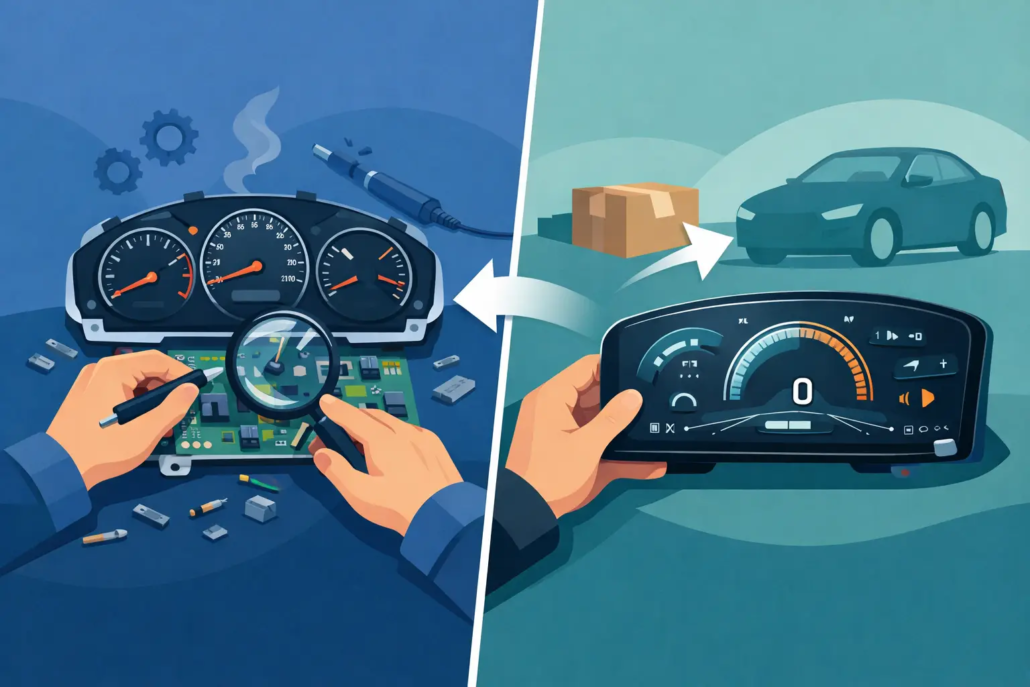
Repair Original Cluster or Replace?
Repair Original Cluster Or Replace: quick repair guidance
Repair Original Cluster or Replace? covers a common dashboard and instrument cluster problem. Cartronix checks the symptoms, repairs the original electronics where possible, and tests the result before return.
First, note the fault clearly. Next, check when it appears. Then, book the repair with the vehicle details. This gives the workshop useful information before the unit arrives.
Quick checks before booking
- Record the vehicle make, model, and year.
- Write down the exact dashboard warning or display fault.
- Check whether the issue appears every time you start the vehicle.
- Note any dead gauges, dim screens, pixel loss, or flashing lights.
- Tell the team if another garage opened the unit.
- Take a photo of the fault if the display still works.
- Keep the original unit with the vehicle whenever possible.
- Pack the cluster securely before posting it.
- Include your name, phone number, return address, and fault notes.
- Use tracked postage for the repair parcel.
- Contact Cartronix first if the vehicle has water damage.
- Ask for advice if the fault only appears when the vehicle warms up.
How Cartronix handles the repair
Firstly, technicians inspect the unit and confirm the reported fault. Secondly, they repair the failed components and check the circuit carefully. Finally, they test the unit before it leaves the workshop.
This approach helps drivers avoid unnecessary dealer replacement costs. It also helps garages reduce downtime, protect the original mileage data, and give customers a clearer repair option.
A dashboard fault rarely gives you much warning. One day the speedometer starts dropping out, the display loses pixels, warning lights go dim, or the whole cluster goes dead. At that point, most owners and workshops ask the same question – should you repair original cluster or replace it?
In most cases, repairing the original unit is the better option. It is usually faster, more cost-effective, and avoids the extra complications that come with sourcing, coding and configuring a replacement cluster. That said, there are situations where replacement makes sense, so the right answer depends on the fault, the vehicle and how quickly you need a reliable result.
Repair original cluster or replace – what actually changes?
The biggest difference is not just the part itself. It is everything attached to it.
An instrument cluster is not a simple display panel. On many vehicles built from the late 1990s onwards, it is tied into the vehicle’s immobiliser, coding, configuration and recorded mileage. Swap the unit, and you may not just be changing a faulty dashboard. You may also be creating a programming job, a security job and, in some cases, a legal or practical mileage issue.
When the original cluster is repaired, those complications are often avoided. The unit stays with the vehicle, the existing coding is retained, and the repair is focused on the failed components rather than replacing the whole assembly. For owners, that usually means less downtime and lower cost. For garages, it often means less risk of fitting a part that still needs further electronic work before the vehicle can be handed back.
Why repair is often the smarter first step
For common cluster faults, repair is usually the most sensible route because the failure is often localised. Pixel loss, failed backlighting, intermittent gauges, dead sections of the display, warning light faults and complete power loss can often be traced to known internal issues rather than total unit failure.
That matters because replacing the whole cluster for a repairable fault is often unnecessary. Main dealer replacement can be expensive, not because every cluster is beyond saving, but because dealer-level solutions tend to follow the replacement path. That may suit warranty processes, but outside that environment it is not always the best value.
Repairing the original unit also preserves originality. The car keeps its factory-fitted cluster, with the correct mileage and coding already associated with that vehicle. There is no need to source a used unit of uncertain history or wait for a new one to be ordered, supplied and then programmed.
For many motorists, the practical benefit is simple – the car is back on the road sooner. For workshops, it means a cleaner job with fewer unknowns.
When replacement might be the better option
There are cases where replacing the cluster is justified. If the housing is physically destroyed, there is severe fire or water damage, or previous repair attempts have caused extensive board damage, repair may no longer be the most economical route.
Availability also plays a part. On some older vehicles, a good used unit may be easy to obtain and the coding requirements may be relatively straightforward. In those cases, replacement can work well if the installer understands the configuration process and can deal with immobiliser, mileage and adaptation correctly.
But this is where many replacement jobs become more complicated than expected. A used cluster is not automatically plug-and-play. Even if the connectors fit and the display comes to life, warning lights, immobiliser issues, incorrect mileage, missing functions or communication faults can still follow.
That is why replacement should not be treated as the easy option just because it sounds simple at first glance.
Cost is only part of the decision
Price matters, but comparing repair and replacement on parts cost alone can be misleading.
A replacement cluster may appear to solve the issue quickly, yet the total bill often grows once coding, fitting time, diagnostics and the risk of incompatibility are factored in. If the replacement is used, there is also the question of lifespan. A second-hand unit may already have the same age-related weaknesses as the failed one.
Repair tends to be more controlled. The fault is diagnosed, the known failed components are addressed, and the original cluster is returned ready to refit. In many cases, that makes the outcome both cheaper and more predictable.
This is especially relevant for trade customers managing workshop time. A job that starts as a straightforward cluster swap can quickly tie up a bay if configuration issues appear after fitting. A proper repair service reduces that uncertainty.
Downtime matters more than most people expect
When a cluster fails, the inconvenience is immediate. Drivers may lose speed indication, fuel level, warning messages or odometer display. On some vehicles, a failed cluster can affect usability far beyond basic dashboard information.
That is why turnaround matters. A specialist repair service is often quicker than ordering a new replacement through dealer channels, particularly where parts are on back order or require factory programming. Postal repair and while-you-wait workshop options make repair practical even when the vehicle is needed back quickly.
For garages and dealers, speed is not just a customer service issue. It affects workshop flow, courtesy car pressure and booking capacity. The faster a specialist can diagnose and repair the original unit, the easier the whole job becomes.
The coding and mileage issue
This is where the decision often becomes clear.
Modern instrument clusters frequently store data that is specific to the vehicle. Replace the unit, and that data may no longer match. Depending on the make and model, the result can be immobiliser lockout, VIN mismatch, incorrect options, warning messages or mileage discrepancies.
Repairing the original cluster avoids most of that because you are not changing the identity of the unit. You are restoring it.
For owners, that means less concern over whether the replacement will display the correct mileage or whether further coding work will be needed. For workshops, it reduces comeback risk. The vehicle leaves with its original module in place rather than an adapted substitute.
This point alone is often enough to tip the balance in favour of repair.
Reliability depends on who carries out the work
A poor repair is no better than a poor replacement. What matters is accurate diagnosis and experience with known faults across different makes and models.
Instrument clusters fail in patterns. Certain Audi, Ford, Fiat, Alfa Romeo and other models are well known for specific display, gauge or power issues. An experienced specialist understands those failure points, tests the unit properly and confirms the fault before repair. That is a very different process from simply opening a cluster and replacing a few visible components.
Specialist diagnostics matter because not every dashboard symptom is caused by the cluster itself. A communication fault, power supply issue or network problem elsewhere in the vehicle can mimic cluster failure. Proper bench testing and emulator-based checks help separate cluster faults from vehicle-side faults before unnecessary work is done.
That level of diagnosis is what makes repair a dependable option rather than a gamble.
For owners: what usually makes most sense
If your cluster has a dim display, dead pixels, failed gauges, intermittent power, warning light issues or total failure, repair is usually the best first option. It keeps the original unit, avoids dealer replacement costs and often gets the vehicle sorted faster.
Replacement is worth considering when the unit is physically beyond repair or where a suitable replacement can be installed and coded without creating further issues. Even then, it is best approached with caution rather than assumption.
The key is to diagnose before deciding. Guesswork is expensive.
For garages and technicians: where repair adds value
For the trade, sending the original unit to a specialist often makes more commercial sense than chasing replacement stock, coding access and uncertain used parts. It allows the workshop to offer a proper solution without tying up time on a niche electronics job.
It also protects the customer relationship. If the cluster returns repaired, tested and covered by warranty, the garage can complete the job with confidence. That is why many independent workshops and main dealers use specialist support for cluster faults rather than trying to force a replacement route on every vehicle.
A business like Cartronix is built around that exact need – fast diagnosis, repair of the original unit, nationwide postal coverage and a lifetime warranty tied to vehicle ownership.
So, should you repair the original cluster or replace it?
If the cluster is repairable, repairing the original is usually the better decision. It avoids unnecessary replacement costs, keeps mileage and coding intact, reduces downtime and removes many of the compatibility problems that come with fitting another unit.
Replacement still has its place, but it should normally be the second choice rather than the default one. Start with diagnosis, understand the extent of the fault, and choose the route that gives you the most reliable result with the least disruption.
When a dashboard fails, the best fix is not always a new part. Often, it is getting the original one repaired properly and getting the vehicle back where it belongs – on the road.








Trackbacks & Pingbacks
[…] erase stored settings and, on some vehicles, complicate diagnosis. It is also sensible not to fit a used instrument cluster as a quick fix. Replacement units can bring mileage discrepancies, coding issues, immobiliser […]
[…] keeps the original unit with the vehicle. That matters because the original coding and mileage data remain with the […]
[…] clusters, LCD displays, speedometers and dashboard faults where repair is viable. Related guides on repairing the original cluster, instrument cluster repair cost and dashboard repair turnaround time can help you compare the […]
Comments are closed.