
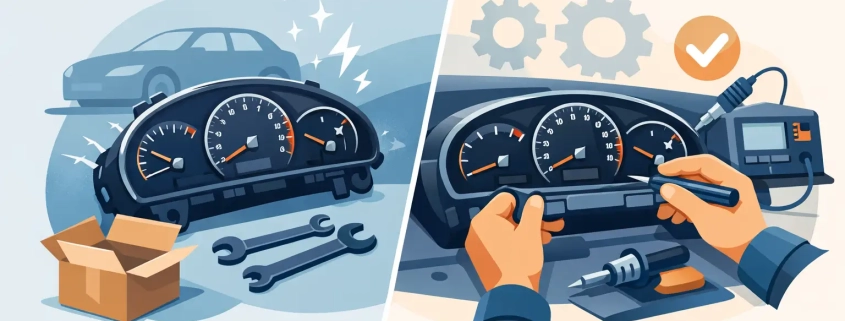
Used instrument cluster vs original repair
When a dashboard fails, the cheapest-looking fix is often a used replacement pulled from another vehicle. On paper, that can seem sensible. In practice, the choice between a used instrument cluster vs original repair usually comes down to coding, mileage, reliability and how quickly you need the car back on the road.
A faulty cluster is rarely just an annoyance. If the speedometer cuts out, warning lights stay dark, the LCD fades or the gauges start reading incorrectly, the vehicle becomes harder to trust and sometimes harder to use at all. For garages, it can also become the job that ties up a ramp because the fault sits somewhere between electronics, coding and vehicle communication.
Used instrument cluster vs original repair – what changes in real life?
The biggest difference is simple. A used cluster is another vehicle’s unit, with its own stored data, wear history and compatibility questions. An original repair keeps the factory-fitted cluster in the car and repairs the failed components inside it.
That matters because modern instrument clusters do far more than display speed and fuel level. On many vehicles built from the late 1990s onwards, manufacturers integrate the cluster with the immobiliser, body systems, warning logic and vehicle configuration. Swap the unit, and you may not just be changing the screen or gauges – you may be introducing coding conflicts, mileage discrepancies or communication faults.
An original repair avoids most of that because the car keeps the same unit it was built with. Mileage, coding and vehicle identity stay with the vehicle. For many owners and workshops, that is the deciding factor.
Why used clusters are not always the bargain they appear to be
There are cases where a used unit can work. If the part number is correct, the hardware version matches, the software can be adapted and the donor unit is healthy, a replacement may be possible. But that is a lot of ifs.
The first issue is compatibility. Two clusters that look identical from the front may have different internal specifications, coding options or immobiliser data. Even when the plugs fit, the vehicle may reject the unit or certain functions may stop working properly. You can end up with warning lights, no start conditions, partial display operation or missing features.
The second issue is mileage. A used unit comes with mileage already stored. Depending on the vehicle, correcting or synchronising that data may be restricted, limited or impossible without specialist equipment and the right conditions. Even where adaptation is technically possible, it adds time, cost and risk.
The third issue is unknown condition. A second-hand cluster may already have the exact fault you are trying to solve, just not as badly yet. Pixel loss, dry joints, failing voltage regulation, dim backlighting and intermittent gauge problems are often age-related electronic faults. Buying a used unit from a breaker does not reset the clock – it simply gives you another ageing cluster.
That is why a cheaper purchase price can become an expensive repair path. Once you add sourcing time, coding work, diagnosis, fitting and the possibility of failure, the saving can disappear quickly.
Why original repair is often the cleaner fix
Original repair focuses on the fault rather than the whole assembly. If the LCD is fading, the gauges are dead, warning lamps are dim, the cluster resets itself or there is a communication problem within the unit, a specialist can test the original cluster and repair the defective circuitry or components.
The key benefit is retention of originality. The unit already belongs to that vehicle. It already carries the correct identity, mileage relationship and coding structure. Repairing it means there is usually no need to introduce another module with unknown history.
For owners, that means less hassle and usually lower overall cost than dealer replacement. For garages, it reduces comeback risk because the car returns with its original electronics rather than a used part of uncertain quality.
There is also a practical time advantage. A proper instrument cluster specialist can often diagnose and repair common faults on a same-day or next-working-day basis, either by post or through workshop booking. That is often faster than chasing the right used unit, fitting it, attempting coding and then diagnosing what still does not work.
Cost is not just the price of the part
This is where many decisions go wrong. A used cluster may be cheaper to buy than a repair invoice, but the part price is only one line of the job.
You also need to account for removal and refitting, programming time, fault finding, potential immobiliser adaptation and the chance that the used unit is faulty as well. If the replacement does not solve the issue, the vehicle has now had extra labour spent on the wrong route.
Original repair tends to be more predictable. The specialist assesses the fault, repairs and tests the unit, and then fits the same cluster back into the vehicle. Because the coding and mileage remain with the original unit, there are fewer moving parts in the job.
Main dealer replacement sits at the top end of the scale, especially where the dealer must order, code and configure a brand-new cluster. That can be the right route in some situations, but many motorists and workshops are simply looking for a faster, more economical solution without replacing the entire assembly.
Reliability depends on diagnosis, not guesswork
A cluster fault is not always a cluster fault. Power supply issues, CAN communication faults, battery voltage problems or wiring defects can mimic an internal dashboard failure. Equally, a failing cluster can trigger wider symptoms that look like network issues elsewhere in the vehicle.
That is why diagnosis matters before you choose between a used instrument cluster vs original repair. If you fit a second-hand unit without confirming the original fault, you may still have the same symptoms and now a coding problem as well.
A specialist repair service tests the cluster properly, often with bench equipment and emulators that reproduce vehicle signals outside the car. That allows technicians to confirm faults at component level instead of relying on trial and error. It is a more controlled way to repair modern automotive electronics, and it usually saves time in the long run.
When a used cluster might still make sense
A used replacement can make sense in limited cases. If water, fire or severe board damage has destroyed the original unit beyond economic repair, the customer may need a replacement. Some rare or discontinued units can also push owners towards used parts if new supply is unavailable.
Even then, the workshop should approach the job carefully. The workshop should check part number matching, software compatibility, immobiliser considerations and mileage handling before anyone fits the unit. For trade customers, this is where specialist support can prevent wasted labour.
So it is not that used clusters are always wrong. The real problem is that people often treat them as simple plug-and-play parts when they are anything but.
What drivers and workshops should ask before deciding
Before choosing either route, ask a few direct questions. Has testing confirmed the original cluster fault? Does the fault match a known repairable issue such as pixel failure, gauge malfunction, dim display, warning light failure or intermittent power loss? Will a used unit require coding or immobiliser adaptation? What happens to mileage? And if the second-hand part fails after fitting, who carries that cost?
Those questions usually lead people towards repair of the original unit, because the risk is easier to control. You repair a known module from the vehicle rather than introducing another unknown module into the system.
For UK motorists dealing with a failed dashboard, and for garages that need a dependable route without dealer replacement costs, original repair is usually the more straightforward answer. It preserves what belongs to the car, avoids most coding and mileage complications, and gets the vehicle back into service faster. That is exactly why specialists such as Cartronix focus on repairing original clusters rather than treating replacement as the first option.
If your dashboard has started failing, the best next step is not to hunt for the cheapest used part online – it is to confirm the fault properly and choose the route that leaves you with the least risk once the car is back in daily use.




