
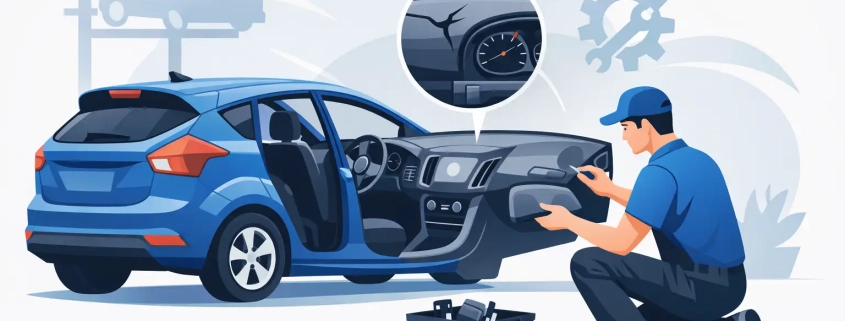
Ford Focus Dashboard Repair Example
A Ford Focus dashboard can fail in ways that look far worse than they are. If you are searching for a Ford Focus dashboard repair example, the usual pattern is familiar – dead gauges, warning lights behaving oddly, a blank or dim display, or an intermittent cluster that comes back to life after a bump in the road. In many cases, the fault sits within the instrument cluster itself, which means repair is often the sensible route rather than replacing the whole unit.
For Focus owners and garages alike, the key question is not just what has stopped working. It is whether the original dashboard can be repaired quickly, without dealer-level replacement costs, and without creating extra issues around mileage, coding or vehicle downtime. On this type of job, the answer is often yes.
A typical Ford Focus dashboard repair example
A common Ford Focus case starts with intermittent failure. The customer may report that the speedometer drops to zero, the rev counter sticks, the warning lights flicker, or the LCD display becomes unreadable. Sometimes the dashboard powers up normally on a cold start, then fails once the car has warmed through. In other cases, the entire cluster goes dead without warning.
On the vehicle side, these symptoms can easily be mistaken for a battery problem, a wiring issue or a wider electrical fault. That is why proper diagnosis matters. A failed dashboard is not always completely dead, and partial function can send garages in the wrong direction if the cluster is not tested properly.
In a typical repair example, the unit is removed from the vehicle and assessed on the bench using specialist test equipment and emulators. This allows the fault to be reproduced outside the car and helps separate a genuine instrument cluster fault from a vehicle-side issue. Once confirmed, the repair usually involves addressing failed internal components, poor solder joints, power supply faults or display-related failures, depending on the version of Focus cluster involved.
The important part is that the original unit is retained. That means the dashboard already matched to the vehicle can usually be repaired and returned, rather than replaced with a second-hand or new unit that then raises coding and compatibility questions.
Common Focus dashboard faults we see
A Ford Focus instrument cluster can fail in several different ways, and the exact fault often depends on age, model year and cluster design. Some units suffer from complete power loss. Others develop gauge faults where one or more needles stop responding properly. Display issues are also common, especially where the screen dims, loses segments or becomes unreadable in normal daylight.
Warning light faults are another regular issue. A customer may report that certain tell-tales no longer illuminate, while others stay on when they should not. In some cases the cluster works intermittently, which is often the most frustrating fault because it can disappear during basic checks and return later.
Communication problems can also be tied to the dashboard. If the cluster is not processing or displaying information correctly, the vehicle may appear to have more than one electrical issue at once. This is where experience with these units makes a real difference. Replacing parts based on guesswork tends to get expensive quickly.
Why these faults are often repairable
Most Focus dashboard failures come down to known electronic faults within the unit rather than physical damage that makes repair impossible. Age, heat cycles, vibration and component wear can all take their toll over time. The good news is that this kind of failure is usually exactly what specialist repair is designed for.
Repairing the existing cluster keeps the original electronics architecture in place. That matters because replacement clusters can create new problems, especially where immobiliser pairing, mileage discrepancies or variant coding come into play. A repair approach is often faster, cleaner and more cost-effective.
Repair or replacement – what makes more sense?
For many owners, dealer replacement sounds like the safe option until the price comes through. A new cluster can be costly, and that is before coding, setup and potential delays for parts availability are added. On older Focus models, a brand-new unit may not even be the most practical answer.
A used replacement can look cheaper on paper, but it comes with risks. You do not always know the history of the donor unit, whether the internal fault is already developing, or whether it will code correctly to the vehicle. Mileage and configuration issues can turn a simple-looking swap into a longer job.
Repairing the original dashboard is often the better choice because it preserves what is already matched to the car. Mileage and coding remain with the original unit, and the fault is addressed at source. For trade customers, that also means fewer unknowns and a more predictable result.
When replacement may still be needed
There are cases where repair is not the right route. Severe liquid damage, burnt tracks beyond viable recovery, major casing destruction or previous poor-quality tampering can all change the picture. The point is not to claim every cluster is repairable regardless of condition. It depends on the fault, the extent of damage and whether the unit has already been compromised.
That said, many dashboards that have been written off elsewhere can still be repaired once properly tested by a specialist.
What the repair process usually looks like
With a Ford Focus dashboard repair example, the process should be straightforward. First, the cluster fault is identified based on the symptoms and, where needed, tested to confirm that the dashboard is the actual cause. Once the unit is removed, it can be bench tested under controlled conditions.
After diagnosis, the repair is carried out on the original cluster. That may involve component-level work, rectifying known weak points, restoring display function or resolving intermittent operation. The repaired unit is then retested to make sure gauges, warning lights, display functions and communication behave as they should.
For customers, speed matters almost as much as accuracy. This is why specialist dashboard repair services are built around same-day or next-working-day turnaround wherever possible. For a daily driver or a workshop with a ramp tied up, that reduced downtime makes a real difference.
Why proper testing matters on a Focus cluster
One of the biggest mistakes with dashboard faults is assuming the cluster is at fault without proving it, or assuming it is not at fault because it works briefly during inspection. Intermittent electrical issues can waste hours if they are not approached methodically.
Bench testing with the right equipment allows the dashboard to be checked in a way that is difficult to achieve in the vehicle alone. This is particularly useful where the problem only appears under certain conditions or where multiple symptoms overlap. It also helps garages avoid unnecessary replacement of batteries, alternators, control modules or wiring sections when the real issue sits inside the cluster.
For trade customers, that confidence is essential. You need to know the unit you are refitting has been properly tested and the original fault has been dealt with, not just temporarily masked.
A practical Ford Focus dashboard repair example for owners and garages
Take a Focus with an intermittent blank dashboard, non-working speedometer and warning lamps flickering at random. The owner may have already replaced the battery and checked fuses, with no lasting fix. A garage may even suspect a body control issue because the symptoms appear inconsistent.
Once the cluster is removed and bench tested, the fault is traced to the dashboard itself. Internal electronic failure is causing unstable operation across multiple functions. The original unit is repaired, tested again, and returned ready to refit. The vehicle regains normal gauge operation, stable warning light behaviour and a readable display, without needing a dealer-supplied replacement cluster.
That is the value of specialist repair in real terms. It is not just about saving money, though that matters. It is about getting to the actual fault quickly and putting the original part back into reliable service.
What to look for from a repair service
If you are booking this type of work, look for a service that understands instrument clusters specifically rather than general auto electrics alone. The difference shows up in diagnosis, turnaround and confidence with model-specific faults. You also want clear pricing, proper testing and a warranty that reflects the quality of the repair.
For a Ford Focus dashboard issue, retaining the original unit should be a priority wherever possible. That keeps things simpler and usually avoids the headaches that come with replacement coding. A service such as Cartronix is built around that exact approach – repair the original cluster, keep downtime low and return a tested unit with lifetime warranty cover tied to vehicle ownership.
For owners, the main benefit is getting the car back on the road without paying dealer replacement costs. For garages, it is having a dependable specialist option when a cluster fault falls outside normal workshop repair.
If your Focus dashboard is failing, the best next step is not guesswork. It is proper diagnosis followed by repair of the original unit where viable. That usually gives the quickest route back to a working dashboard, with less cost and fewer complications than replacement.