
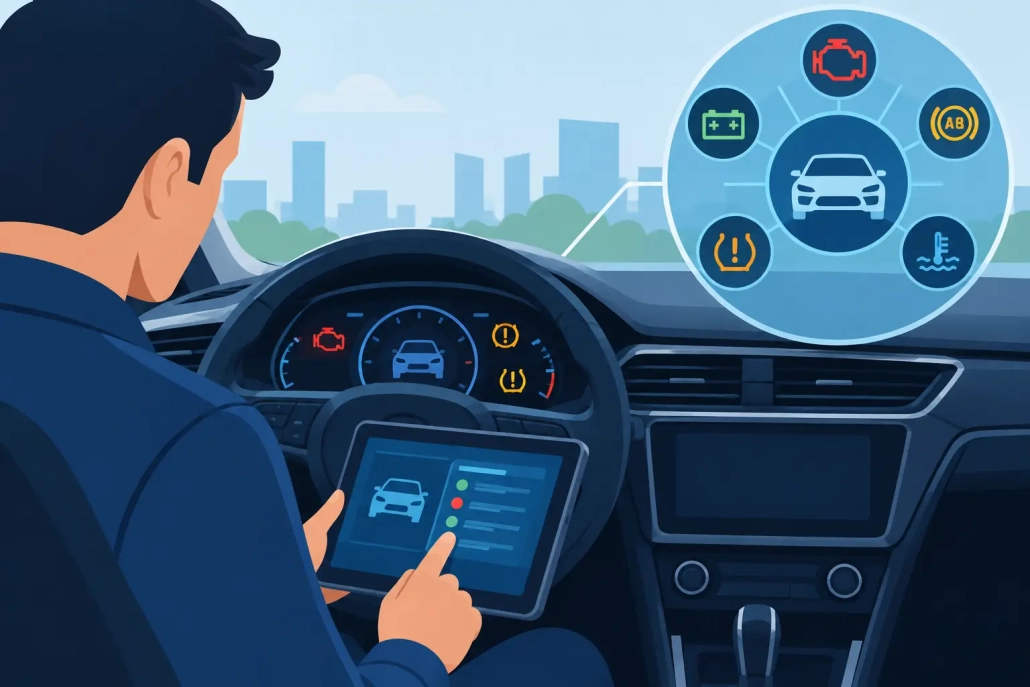
Dashboard Fault Diagnosis for Modern Vehicles
A speedometer dropping to zero, pixels disappearing from the display or warning lights that will not illuminate can turn a straightforward journey into an uncertain one. Proper dashboard fault diagnosis establishes whether the problem sits within the instrument cluster itself, the vehicle wiring, a control module or the power supply. That distinction matters before anyone orders an expensive replacement dashboard.
Modern instrument clusters are not simply sets of dials. They are electronic control units that receive data from multiple systems, display safety information and, on many vehicles, store mileage and vehicle-specific coding. A fault can look dramatic while being repairable, but only if it is tested correctly.
What dashboard fault diagnosis should establish
The aim is not just to identify a visible symptom. A useful diagnosis traces the cause of that symptom and confirms the repair needed. If the fuel gauge reads empty despite fuel in the tank, for example, the issue may be the gauge motor, the cluster circuit board, the tank sender or the wiring between them. Replacing the complete cluster without proving the fault can be costly and may not solve anything.
The same applies to blank or intermittent displays. A display can fail because of damaged LCD connections, deteriorated internal components, poor solder joints, low battery voltage or a communication fault elsewhere in the vehicle. The pattern of the failure is often revealing. A display that fades when warm suggests a different route of investigation from one that is completely dead all the time.
A specialist assessment should therefore check the cluster’s power and earth supplies, communication lines and internal operation. Where appropriate, the unit can be tested outside the vehicle using dedicated emulators. This recreates vehicle signals in a controlled setting and helps confirm whether the dashboard is at fault before repair begins.
Common faults found during dashboard diagnosis
Instrument cluster faults vary by make, model and age, but several symptoms appear regularly. Intermittent faults are especially common, and they should not be dismissed simply because the dashboard starts working again after a restart.
A failed speedometer or rev counter may be caused by a defective stepper motor, internal circuit fault or missing signal from another vehicle system. With some vehicles, several gauges fail together because the fault affects the cluster’s power supply or processor rather than each gauge individually.
Pixel loss and dim LCD screens are another familiar problem. Missing characters can make warning messages, radio information or trip computer data difficult to read. The display itself, its ribbon connections or associated electronics may be repairable without changing the whole instrument cluster.
Warning-light faults need particular care. A light that is permanently on can point to an underlying vehicle fault, but a light that fails to illuminate at ignition-on may be an instrument cluster issue. MOT-relevant warning lamps should never be ignored or masked. Diagnosis must establish whether the vehicle has a genuine stored fault, a failed LED or display circuit, or a communication problem preventing the correct message from reaching the dashboard.
Other common signs include a cluster that resets while driving, needles stuck in one position, a clock that loses time, backlighting that is dim or uneven, and a dashboard that remains completely blank. On some cars, a cluster may also trigger non-starting, immobiliser or network communication concerns. It depends on how that particular vehicle shares data and security information.
Why fault codes alone are not enough
A diagnostic scan is valuable, but it is only one part of the job. Fault codes can show a loss of communication with the instrument cluster or identify a sensor concern, yet they do not automatically prove which component has failed. A code may be historic, intermittent or caused by a low-voltage event.
For example, a weak battery or poor charging system can create a long list of seemingly unrelated warning messages. If voltage is not checked first, it is easy to chase faults that disappear once the supply problem is corrected. Equally, a communication code may be caused by damaged wiring or corrosion at a connector rather than an internal dashboard failure.
This is why diagnosis should combine scan data with live readings, supply checks, visual inspection and functional testing. The technician needs to compare what the vehicle is sending with what the cluster is displaying. When those do not match, the next step is to isolate where the signal is being lost or interpreted incorrectly.
The value of testing the original unit
Testing and repairing the original cluster is often preferable to fitting a used unit. A second-hand dashboard may have different mileage, incorrect coding, incompatible software or its own hidden faults. It may also require additional programming before the vehicle operates correctly.
Repairing the original unit retains the vehicle’s existing mileage and coding where the fault allows. It also avoids treating an electronic repair as a replacement-parts exercise. For owners, garages and dealerships, this can mean less downtime and no dealer replacement costs for a part that may be recoverable.
Checks worth making before removing the dashboard
Some basic checks can save time and help provide a clearer fault description. First, note exactly what happens. Does the fault appear from cold, after a period of driving, in damp weather or when the headlights are switched on? Does it affect one gauge, the entire display or every cluster function?
Check whether other electrical items are affected. Central locking, electric windows, starting problems and multiple warning lamps may suggest a broader voltage or network issue. If the vehicle has recently had a flat battery, jump-start, battery replacement, water ingress or other electrical work, mention it. These details can be highly relevant.
It is also useful to record the vehicle registration, make, model, year and engine type, together with any diagnostic codes already found. A clear photograph or short video of an intermittent display or gauge fault can be helpful, particularly if the symptom is not present when the vehicle reaches the workshop.
Avoid repeatedly disconnecting the battery in an attempt to reset the problem. A reset may temporarily clear a symptom without curing its cause, and some vehicles require settings to be restored afterwards. Do not attempt to open the cluster unless you have the correct equipment and experience. Delicate needles, LCD layers and ribbon connections can be damaged easily.
When a specialist repair is the right route
A specialist repair is usually appropriate when the cluster has a known internal fault, the display has failed, gauges behave incorrectly, warning-light illumination is faulty or the unit has lost communication despite correct external feeds. It is particularly useful when the vehicle is otherwise running correctly but the dashboard is not providing reliable information.
There are cases where the fault lies outside the cluster. A failed wheel speed sensor can cause speed-related warnings, a defective fuel sender can produce an inaccurate fuel reading, and wiring damage can interrupt signals to several systems. A reputable diagnosis should say so rather than repairing a dashboard that is not the cause.
For confirmed instrument cluster faults, Cartronix can assess and repair original units for a wide range of vehicles from 1996 onwards. Postal repairs suit customers across the UK, while workshop appointments can be arranged for faults that benefit from vehicle-based testing. Repairs are designed to preserve originality, with same-day or next-working-day turnaround available for many common faults and a lifetime warranty for as long as you own the vehicle.
Give the repairer the right information
The quickest route to an accurate result is a precise fault report. State whether the vehicle starts and drives, which functions have failed, whether the issue is constant or intermittent, and whether any warning messages or fault codes are present. Include details of battery issues, previous repair attempts and water damage where relevant.
This allows the correct testing process to begin without assumptions. It also reduces the risk of a unit being sent for repair when the real issue is a sensor, wiring fault or vehicle network problem.
A dashboard is the driver’s primary source of speed, fuel, warning and status information. If it is behaving unpredictably, treat it as a repair priority rather than an inconvenience. Accurate diagnosis first gives you the best chance of a lasting repair, retained vehicle originality and a quicker return to the road.


