
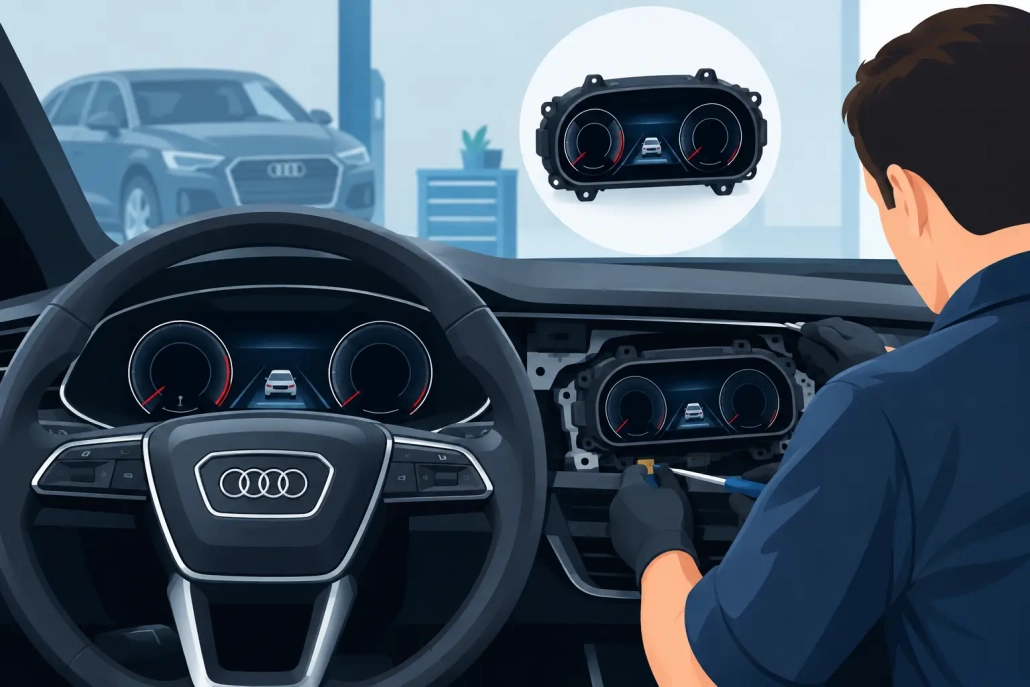
Audi Virtual Cockpit Repair Example in Practice
An Audi virtual cockpit repair example often starts with a fault that looks more serious than it is. The driver may find the digital display stays black after starting, repeatedly restarts, shows warning messages with no gauges, or works intermittently after the cabin has warmed up. A dealer may recommend replacing the complete instrument cluster. In many cases, however, the original unit can be diagnosed and repaired instead.
For the owner, the difference matters. Replacing a virtual cockpit can involve high parts costs, vehicle coding, mileage synchronisation and time off the road. Repairing the original cluster avoids unnecessary replacement where the fault is repairable, while retaining the vehicle’s original mileage, configuration and coding.
The fault: intermittent screen and gauge failure
This representative case concerns an Audi fitted with a fully digital instrument cluster. The vehicle arrived with a complaint that the cockpit would occasionally remain blank at ignition on. On other journeys, the display came on but then froze, leaving warning lights illuminated and gauges unresponsive. Turning the ignition off and on again could temporarily restore operation.
Intermittent faults are frustrating because they can disappear by the time a garage inspects the car. They are also easy to misdiagnose. A blank virtual cockpit does not automatically mean the screen itself has failed, and it does not always mean the vehicle needs a new dashboard.
Before removing the cluster, the first job is to establish whether the problem is within the unit or caused by an external issue. Battery condition, supply voltage, earth connections, relevant fuses and communication on the vehicle network all need checking. Low voltage and network faults can create misleading symptoms, particularly on modern Audi electrical systems.
In this case, power and ground supplies were present and stable, while diagnostic checks pointed towards an internal cluster fault. The failure pattern also remained when the unit was tested away from the vehicle. That narrowed the diagnosis considerably.
Audi virtual cockpit repair example: testing the original unit
Once removed, the instrument cluster was connected to specialist test equipment and an emulator. This allows the unit to be powered and assessed under controlled conditions without relying on the car being available throughout the repair.
The cluster was run through repeated start-up cycles and monitored for its display behaviour, gauge operation and internal communication. With an intermittent issue, one successful power-up proves very little. A proper test needs to reproduce the operating conditions that trigger the fault and confirm stable operation afterwards.
In this example, the virtual cockpit initially started as expected, then failed during repeat testing. The display lost operation while the unit’s internal electronics showed an inconsistent response. Inspection and component-level diagnosis identified a fault within the cluster’s electronic circuitry rather than a failed vehicle control module or a simple software setting.
This is why fitting a used cluster is rarely a straightforward shortcut. A second-hand unit may have its own unknown history and can introduce problems with immobiliser data, component protection, mileage accuracy and coding. It may also fail in the same way shortly after fitting. Repairing the original unit is usually the cleaner option when the fault is serviceable.
The repair: retain mileage and coding
The repair was carried out on the original Audi virtual cockpit unit. The defective electronic area was repaired using appropriate specialist equipment, then the board and associated connections were carefully inspected before reassembly. The aim is not merely to make the display light up once. It is to restore reliable operation under repeat testing.
Because the original cluster remained with the vehicle, its stored configuration, mileage and coding were retained. That is a major advantage over replacement. There is no need to transfer a car’s identity to an unknown donor unit, and there is less risk of creating further warning messages or communication problems after refitting.
It is worth being clear that every Audi virtual cockpit fault is different. Some failures can be repaired at component level, while others may be caused by external wiring, water ingress, accident damage or wider network problems. A unit with severe physical damage or extensive corrosion may not be a sensible repair candidate. Diagnosis should come before promises.
Proving the repair before return
After repair, the instrument cluster was returned to the emulator for extended testing. The display was checked across repeated ignition cycles, and the gauge and warning-light functions were monitored for correct response. The unit was allowed to run long enough to ensure the original intermittent failure did not return as the electronics warmed up.
Only after the cluster passed those checks was it ready to go back into the vehicle. On refitting, the installer should clear any stored fault codes related to the original failure where appropriate, then verify the display, warning lamps, steering-wheel controls and vehicle information screens. A road test may also be sensible if the original symptoms occurred while driving.
For a postal repair, this process means the unit can be removed by a competent garage or sent in by arrangement, repaired and returned ready for refitting. For workshop customers, a while-you-wait appointment may be suitable depending on the vehicle and fault. The practical priority is always the same: minimise downtime without skipping diagnosis.
What this type of repair can save
A main dealer replacement cluster is sometimes necessary, but it is not automatically the best first answer. New units can be expensive and may require additional programming, security procedures and parts lead time. The vehicle can also remain off the road while the replacement is ordered and configured.
A successful original-unit repair can offer a faster and more economical route. It keeps the dashboard fitted by the factory, preserves the information already held in the cluster and avoids replacing a complete assembly for a localised electronic fault.
For independent garages, this is particularly useful. Rather than losing time chasing an intermittent dashboard complaint or referring the customer directly to a dealer replacement, the vehicle can be assessed properly and the cluster sent to a specialist repairer. The garage remains in control of the customer journey while using focused electronics expertise where it is needed.
Cartronix repairs modern instrument clusters for motorists and trade customers across the UK, including digital display, gauge, warning-light and complete cluster faults. Repairs are supported by specialist testing and a lifetime warranty for as long as the customer owns the vehicle.
When to arrange an inspection
A virtual cockpit should be investigated promptly if it goes blank, flickers, freezes, loses gauge information or displays warnings that do not match the vehicle’s actual condition. The instrument cluster is not just a screen. It provides speed, fuel, warning and driver-information functions that need to be dependable.
Avoid repeatedly disconnecting the battery or attempting to force software updates in the hope that the fault will disappear. Those steps can complicate diagnosis and may introduce new errors. A basic battery and charging-system check is sensible, but once power supplies and fuses have been ruled out, specialist cluster testing is the practical next step.
The useful question is not simply whether the virtual cockpit has failed. It is whether the original unit can be repaired reliably. With the right diagnosis, a blank or intermittent Audi display does not always have to become a costly dealer replacement job.


